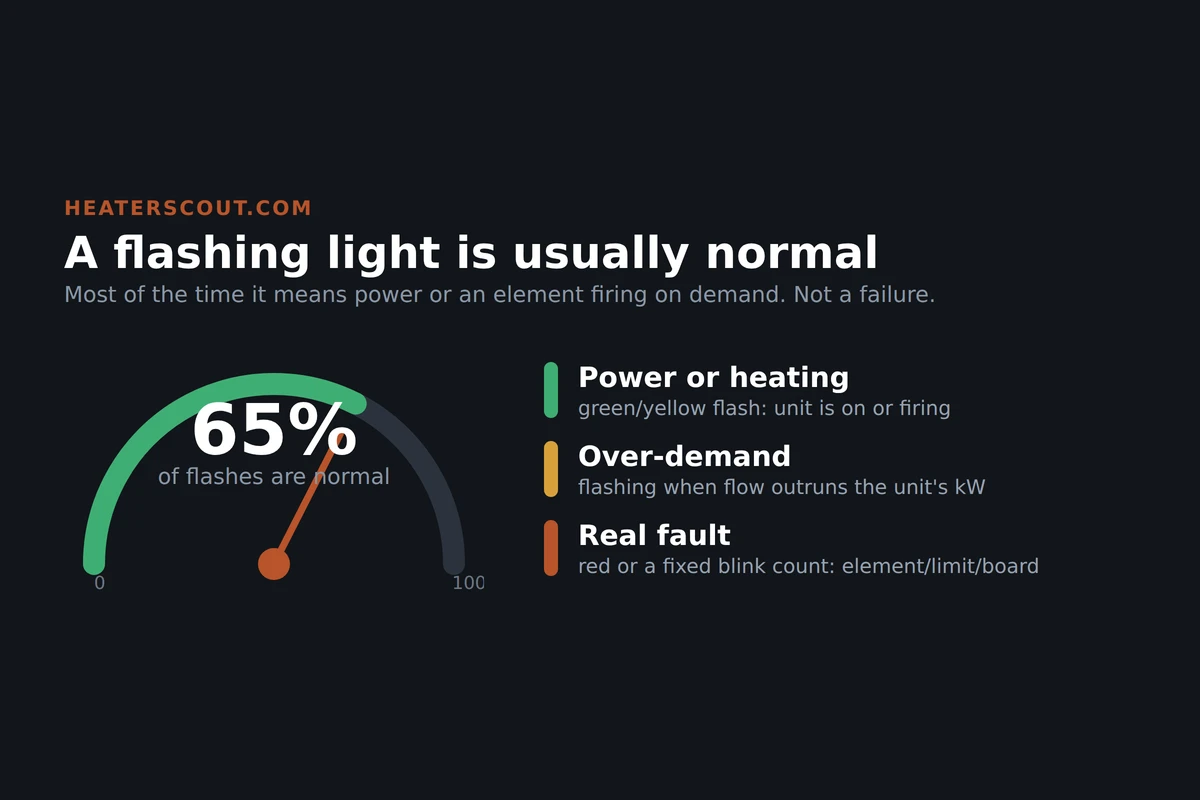
The light on the front of an electric tankless water heater flickering on and off scares people into thinking an element just died. Most of the time it is the opposite. That indicator is usually telling you the unit has power or is firing an element on demand, which is exactly what a tankless heater does every time you open a hot tap. Whether the flash means normal operation or an actual fault comes down to one thing you can read in five seconds: the color, and whether it blinks a fixed count.
Quick answer
On most electric tankless heaters a flashing element or heating light is the unit reporting power or an element firing on demand, which is normal every time you draw hot water. It signals a real fault only when the light is red, stays on with no water running, or blinks a fixed repeating count. Read the color for your brand first: green is usually power or standby, yellow or amber is heating, and red is a fault. If hot water still flows, the element is fine and the flash is just the heating cycle.
Why an electric tankless flashes in the first place
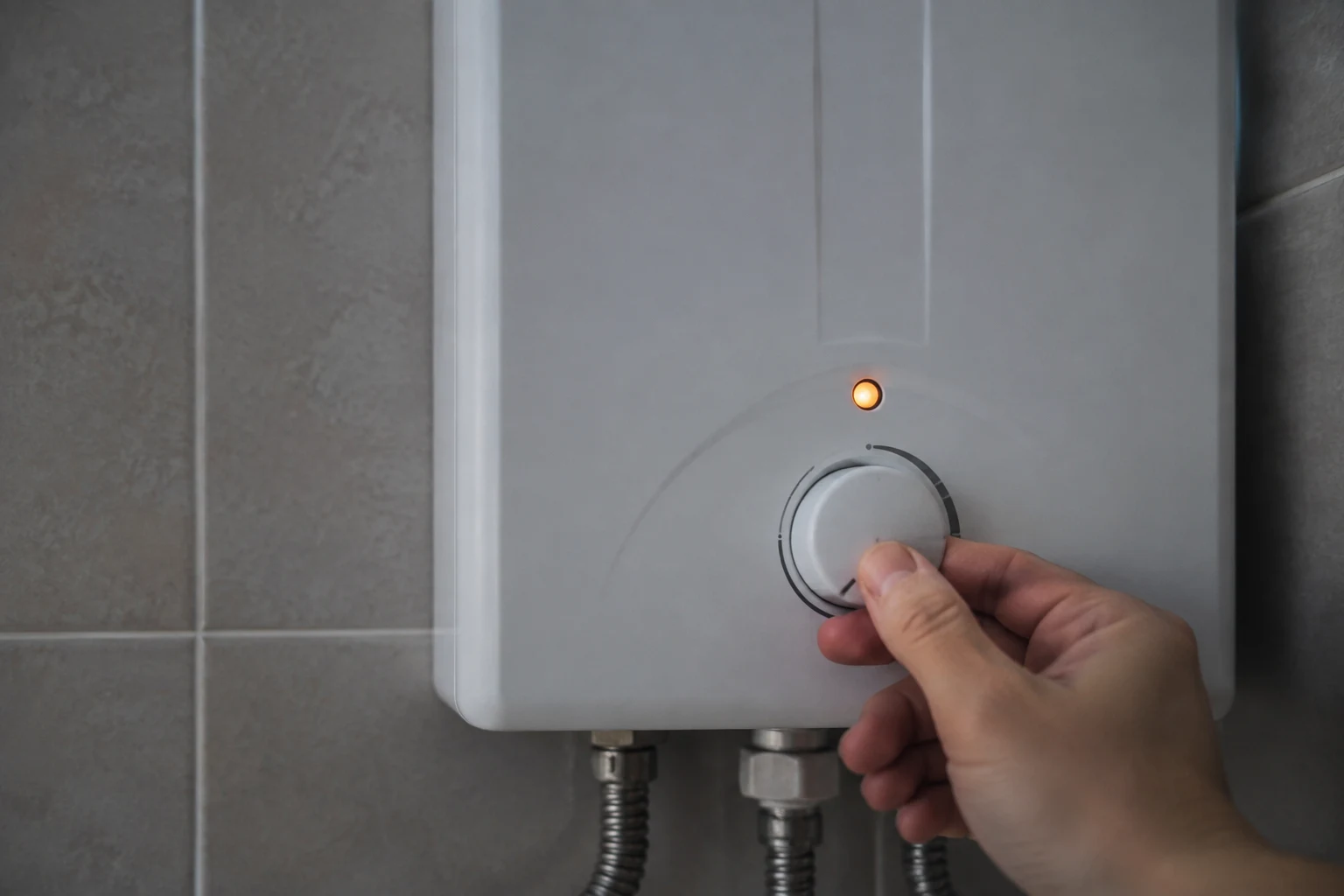
A tankless heater has no reservoir of pre-warmed water. There is nothing to keep hot between draws, so the unit sits idle until you open a tap, then fires its heating elements to raise the incoming water to your setpoint in the seconds it takes to pass through the block, and shuts them off the instant flow stops. The indicator light is wired to that cycle. When the elements energize, the light comes on or changes color; when they stop, it goes quiet. So a light that pulses in step with your faucet is not a warning, it is the heater breathing. This is the single most misread signal on these units. People used to a tank heater, where a steady pilot or a solid light means all is well, see a flickering LED and assume something is cycling on and off in distress. On a tankless, cycling with demand is the whole design.
The same flash means different things by brand
There is no industry standard here, which is why a generic answer fails. Each manufacturer assigns its own meaning to color and pattern, and the word element in the phrase people search rarely maps to a real element-specific lamp. On a Stiebel Eltron Tempra or DHB-E the indicator is a three-color traffic light. Green flashing means the appliance has power and is idle, yellow means it is actively heating, and red means a fault. On several Stiebel models the yellow light flashes specifically when the unit hits its output limit, its way of saying the flow is outrunning its kilowatt rating. EcoSmart uses a simpler indicator that lights when the unit is energized and calling for heat; because its elements modulate power to hold your setpoint, the light naturally pulses with flow and temperature demand. Titan is different again: models built after October 2018 carry a self-diagnostic board with four red LEDs that blink a count to name the fault. Rheem's electric lines vary by model, with green for normal or heating and red or amber blinking for a fault, and Rheem itself warns that the same color can mean different things across its families. Read the legend for your unit before you act on anyone's generic chart.
Reading a Titan blink count
Titan is worth calling out because its flash is an actual code, the closest thing to a numeric error on these otherwise light-only units. On a post-2018 SCR-2 or N-series board, four LEDs blinking together point to a defective critical component on the circuit board, and the cure is a board replacement. Three LEDs blinking mean the unit detected a very high temperature, which can come from a flow switch clogged with sediment, a stuck spring in the chamber, an SCR shorted closed, or a failing board. Two LEDs blinking usually mean the red or blue setpoint key is physically stuck, and you clear it by working the key side to side until the blinking stops. The SCR in that list is the electronic switch that actually fires the heating element, so on a Titan a heating or element complaint frequently traces to the SCR or the board rather than the element wire itself.
Confirm the light is really a fault
Watch the color and count. Green or a heating-color flash that tracks your tap is normal operation. Only a red light, a light stuck on with no flow, or a fixed repeating blink count is a fault worth chasing.
Verify demand: flow and inlet temperature
Open one fixture and check the flow. Electric tankless units are kilowatt-limited, and cold winter inlet water shrinks how much they can raise. If the flash is an output-limit warning, cutting flow or lowering the setpoint stops it. That is a sizing signal, not a broken part.
Power cycle, then check for a physical reset
Kill the breaker for thirty seconds and restore it to clear a latched code. If the unit has a high-limit reset button, an EcoSmart one near the panel or the small buttons atop each Stiebel heating vessel, press it only with power off and after the unit has cooled.
Ohm the element and its high-limit
With power off, measure resistance across each element's terminals. A high-wattage element reads a few ohms; an open reading means it is burnt. Check the thermal cutout for continuity too, since a tripped or open high-limit locks the heater out and lights the fault even when the element is good.
Suspect the control board or SCR last
If the elements, the high-limit, the flow switch, and the wiring all check out and the fault light still returns, the control board or, on a Titan, the SCR is the remaining suspect. That is the most expensive part and the point where a tech with the model service sheet earns the call.
Does a modulating element make the light flicker on its own?
Yes, and this trips people up. EcoSmart and other modulating units vary the power fed to the elements to hold your exact setpoint rather than running full blast and cycling hard like a tank. As the demand and the inlet temperature shift, the elements ramp up and down, and the indicator can flicker along with that modulation. If hot water is steady and correct, that flicker is the control loop working, not a fault. It is only a concern when the flicker comes with temperature swings at the tap, which points to flow that is bouncing around a low activation threshold.
A flash that follows your faucet is the heater breathing. A flash that stays red, or blinks the same count no matter what you do, is the heater asking for help.The one rule that covers every brand
Where the homeowner line sits
Reading the light, watching it against your water use, power cycling, and pressing a labeled high-limit reset are all fair game for a careful owner. Ohming an element or a thermal cutout with the power off and a multimeter is within reach too, since it is a meter and a screwdriver, not a live-current job. Where you stop is anything that means working on the terminals with power present or diagnosing a control board. Electric whole-house tankless units pull heavy current, commonly forty to sixty amps and more on the large kilowatt models, across a double-pole circuit, and a mistake there is not a nuisance, it injures. Never jumper or bypass a thermal cutout to force a flashing unit to run, because that limit is the reason the heater does not cook water or melt its own wiring. If the fault light keeps returning after you have confirmed the elements and the high-limit are good, the board is next, and that is a licensed tech's job with the service sheet for your exact model.
Keeping the light green
The faults that turn a normal flash into a red one are mostly preventable. Scale is the biggest one on electric units: minerals coat the elements and the temperature sensors, which pushes the high-limit toward tripping and makes the heater flash on demand it used to handle. Flush the unit on the schedule your water hardness calls for. Keep the inlet screen and any flow switch clean, because a clogged flow switch is one of the exact conditions a Titan reports with three blinks and a high-temperature lockout. Size honestly: a unit that flashes an output-limit warning every winter is not broken, it is being asked to raise more cold water than its kilowatts allow, and no repair fixes physics. Match the heater to your fixtures and your coldest inlet temperature, and the light spends its life a calm green.
Frequently asked
What does a flashing element light on an electric tankless heater mean?
It depends on the color and the brand, and most of the time it is not a failure. On a Stiebel Eltron the diagnostic LED is a three-color traffic light: green flashing means the unit simply has power and is sitting idle, yellow means it is actively heating, and red means a fault. On an EcoSmart the indicator lights or pulses when the unit is energized and calling for heat, and since the elements only draw power on demand and modulate to your temperature setting, a light that comes on and off with the water flow is normal. A Titan built after October 2018 uses four red LEDs that blink a count to report a fault. So before you assume a burnt-out element, read what color the light is and whether it blinks a fixed number of times. Steady green or a light that pulses with the tap is the unit working, not breaking.
Is a flashing heating light on my tankless normal or a problem?
Normal, if it tracks your water use. An electric tankless heater has no tank to keep warm, so it only fires its elements the instant you open a hot tap and stops the moment you close it. The indicator following that on-off rhythm is the heater doing exactly what it should. It becomes a problem when the light turns red, stays on with no water running, or blinks a repeating pattern like three or four flashes in a row. Those are fault signals, not the heating cycle. The quickest test is to open a hot tap and watch: if the light steadies or changes to a heating color while hot water flows, the unit is fine. If it flashes the same fixed count over and over regardless of flow, look up that count for your model.
Why does my Stiebel Eltron light flash red?
A red LED on a Stiebel Eltron Tempra or DHB-E means a fault, not the normal heating state. The two common causes are a tripped thermal safety cutout and an over-demand condition. If the red light appears when you open a hot tap, the high-limit thermal cutout may have tripped; Tempra units have small red or gray reset buttons on top of each copper heating vessel that you press to reset once the unit has cooled and power is off. On some Stiebel models the yellow light flashes, not red, when the unit hits its output limit, which means the flow is more than the heater's kilowatt rating can raise to your setpoint. That is a sizing or flow problem, not a broken part. Turn the temperature down or the flow down and the flashing stops.
How do I reset an electric tankless heater when the element light flashes?
Start with a power cycle, which clears a latched fault so you can see whether it returns. Turn the unit off at its breaker, wait about thirty seconds, then restore power. If the flashing was a one-time glitch it will not come back. If the heater has a physical high-limit reset, that is a separate step: EcoSmart units have a reset button near the top or side panel, and Stiebel Tempra units have the small reset buttons on top of each heating vessel. Always cut power at the breaker before pressing any reset. A reset only clears the trip; it does not fix what tripped it. If the light flashes red or blinks the same count again right after a reset, the underlying fault, an element, a high-limit sensor, a flow switch, or the board, is still there and needs diagnosing.
What does it mean when all the lights blink on a Titan tankless?
On a Titan SCR-2 or N-series built after October 2018, the number of blinking red LEDs is a diagnostic code, not a light bulb dying. Four LEDs blinking together means a critical component on the circuit board is defective and the board needs replacing. Three LEDs blinking means the unit sensed a very high temperature, which can come from a flow switch clogged with sediment, a stuck spring in the chamber, an SCR shorted closed, or a bad board. Two LEDs blinking usually means the red or blue setpoint key is physically stuck, and you fix it by working the key side to side until the blinking stops. The SCR is the electronic switch that fires the heating element, so a Titan heating fault often traces back to the SCR or the board rather than the element itself.
Does a flashing element light mean the heating element is bad?
Not by itself. The word element in what people call a flashing element light usually refers to the heating or status indicator, not a lamp wired to a specific element. A genuinely dead element shows up as lukewarm or cold water, a tripped high-limit, or a fault code, and you confirm it with a multimeter by measuring resistance across the element terminals with the power off. An open reading means a burnt element; a normal reading, often a few ohms for a high-wattage element, means it is intact. If the light flashes but you still get hot water, the element is fine and the flash is just the heating cycle. Test before you buy a part.
Why does my tankless flash and give lukewarm water at the same time?
That pairing points to an over-demand or a partial-heating problem rather than a dead unit. Electric tankless heaters are sized by kilowatts, and each unit can only raise a certain gallons-per-minute by a certain number of degrees. Pull more flow than that, especially with cold winter inlet water, and the heater cannot keep up: it flashes an output-limit warning and delivers water below your setpoint. The fix is to reduce flow, lower the target temperature, or accept that the unit is undersized for that fixture. The other cause is one element or one relay not firing, so only part of the bank heats. If lowering the flow to a trickle gives you full hot water, it is a sizing issue. If even a trickle stays lukewarm, suspect an element, a relay, or the control board and diagnose from there.
Is it safe to keep using a tankless heater with a flashing light?
It depends on the signal. A green or heating-color flash that tracks your water use is safe; that is the normal operating state. A steady red fault light, a repeating blink count, or a light paired with no hot water is the unit protecting itself, often by locking out an element or the whole heater on a high-limit trip, and you should stop and diagnose rather than force it. Never bypass or jumper a thermal cutout to make a flashing unit run, because that safety exists to stop the heater from cooking water or overheating its own wiring. Electric tankless units pull heavy current, forty to sixty amps or more on large models, so if you see or smell anything scorched at the terminals, cut power at the breaker and get a licensed electrician on it.