An Eemax that quits heating is not usually broken in the way a homeowner fears. On the electric tankless units Eemax builds, the fault almost always traces back to one of three things: not enough flow, water that is already too hot going in, or an electrical feed that cannot carry the load. The tricky part is that Eemax splits into two generations. Older SP and SPEX FlowCo models say everything through a single indicator light, so its blink pattern is the code. Newer digital models show real E-codes, E0 through E5. This page reads both, routes each signal to its cause, and walks the breaker reset, all from Eemax's own manuals rather than guesswork.
Quick answer
Eemax electric tankless heaters fault two ways. On SP and SPEX FlowCo models the single indicator light is the readout: solid means heating, one flash every four seconds means idle and waiting for flow, and no light with the tap fully open means the unit is not activating, usually from low flow. On digital models you get codes: E0 is excessive flow, E1 is low flow or an inlet-side fault, E4 is a high inlet temperature or overheat, and E5 is high flow or an undersized electrical feed. The reset is not a button. Cut the breaker for a few minutes, then restore power.
Is Eemax the same as Rheem, so do the gas codes apply?
Eemax is a Rheem brand, but Eemax makes electric tankless heaters, not gas. The numbered Rheem and Ruud gas chart, with flame-failure, fan, and vent codes, does not apply to an Eemax. Electric units have no burner, flame rod, or flue, so ignore any gas code list you find and use the electric flow, temperature, and element logic on this page.
First, know which Eemax you have
Before you read a code, figure out which generation is in front of you, because the two speak different languages. Check the U.L. rating label on the front cover. If the model prefix is SP or SPEX, you have a FlowCo-era point-of-use unit with a single indicator light and no digital display. If it is HA (HomeAdvantage II), an AutoBooster, or a ProSeries with a lighted number readout, you have a digital model that shows E-codes. The model number itself decodes the unit. HA027240, for instance, is a HomeAdvantage II at 27 kW on 240 volts. Write down the full model, which Eemax also calls the order reference, and the serial number off the backplate inside before you call for parts.
The Eemax digital code chart
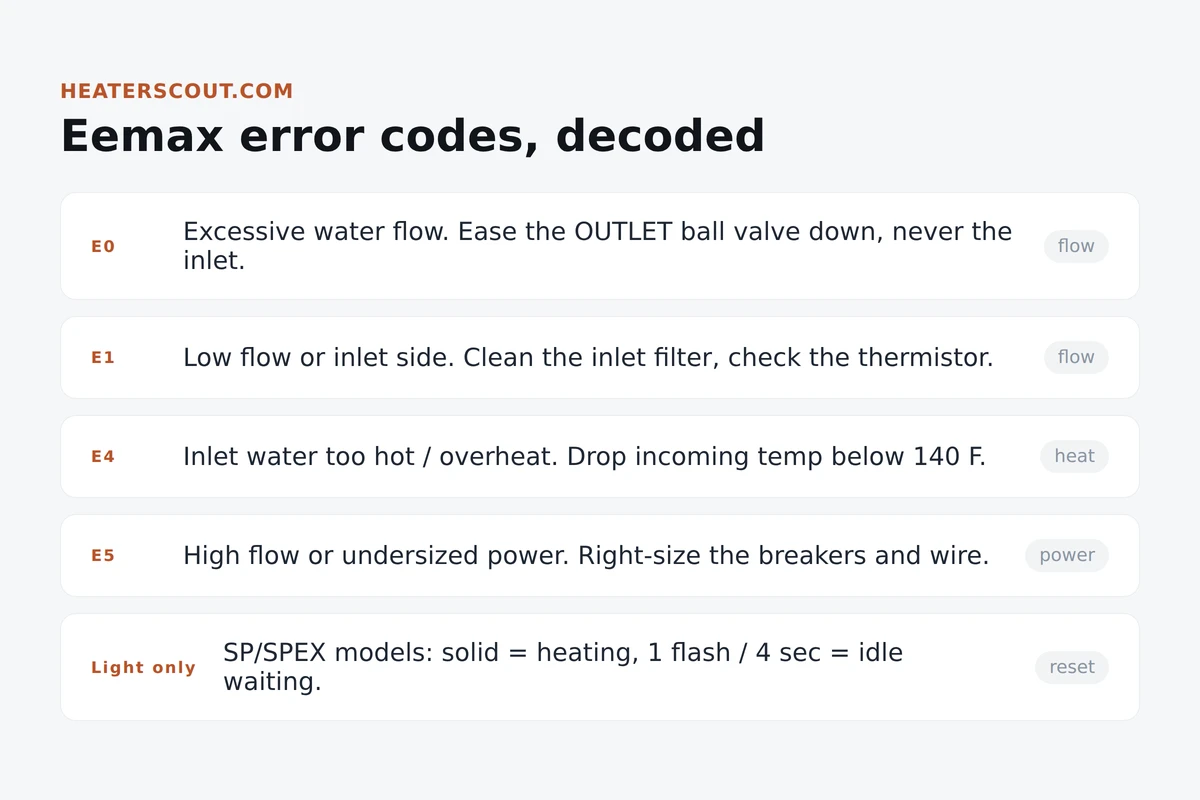
These are the codes on the display models, drawn from Eemax's own manuals and installer field reports. The through-line is that Eemax reads flow and temperature, not combustion, so every code is about how fast water moves through the elements, how hot it is coming in, or whether the electrical feed can carry the draw. The table pairs each code with what the board is reporting and where to start.
| E0 | Excessive water flow. Water is moving through the elements faster than they can heat it. Use the OUTLET ball valve to slowly reduce flow. Never throttle the inlet valve. |
| E1 | Low flow or inlet-side fault. Clean the inlet filter screen and open every valve fully; if it persists on good flow, suspect the inlet thermistor or its wiring. |
| E4 | High inlet temperature / overheat. Incoming water is past the safe limit, often from a recirc loop or upstream heater. Bring the inlet below ~140 F. Do not bypass this trip. |
| E5 | High flow or undersized power supply. Confirm the breakers and wire match the unit's rated draw; a 30 A breaker on 10 ga wire faults a unit that needs 40 A on 8 ga. |
| No code, no light | Unit not activating. Flow is below the activation point, breaker is off, or an element or supply-voltage fault. Start with flow, then power, then the element ohm test. |
A note on E0 and the outlet valve, because it is the one place people make things worse. Eemax's own instruction for excessive flow is to ease the flow down using the valve on the outlet side, slowly, until the temperature comes up. Temperature rise is inversely proportional to flow, so less water through the same elements means hotter water out. What you must not do is choke the inlet to fix it. Restricting the inlet starves the unit and can dry-fire an element. Outlet side, slowly, is the rule.
SP and SPEX models: the light is the code
The older point-of-use Eemax units, the SP and SPEX FlowCo line, have no display. They diagnose through one indicator light, and reading it correctly saves a wasted service call. A solid light means the unit sees enough flow and is heating. One flash roughly every four seconds means the heater is idle, powered and waiting for water flow it has not seen yet. A light that never comes on when you open the hot tap fully means the unit is not activating at all, and on these models the activation flow is about half a gallon per minute. HomeAdvantage II activates lower, around 0.3 GPM. When the light will not light, the fix is nearly always flow: open every valve, pull the faucet aerator, and clean the inlet filter screen that sits in the cold inlet fitting.
If the light comes on but the water stays cold, flow is fine and the trouble has moved downstream to the heating element or the supply voltage. Eemax's SP guide walks a specific element test. With the breaker off, remove the cover and find the two threaded silver rods with brass nuts where the wires land. Set a meter to a plain ohms scale, not continuity, and read resistance across those two rods. Under about 20 ohms on the Rx1 or Rx10 scale means the element is good. A reading up around 10,000 ohms, or anything that only shows on the Rx1K scale, means the element is open and needs replacing. That test is the difference between ordering an element and chasing a phantom.
Too much flow
The elements cannot heat water moving this fast. Ease the outlet valve down slowly, confirm the Eemax aerator is on the faucet, and the temperature climbs. Never throttle the inlet.
Too little flow
Below roughly 0.5 GPM on an SP, 0.3 GPM on HomeAdvantage II, the unit will not fire. Open every valve, remove the aerator, and clean the inlet filter screen. Then look at the inlet thermistor.
Inlet water too hot
Fed from a recirc loop or downstream of another heater, the incoming water trips the over-temp limit. Bring the inlet below about 140 F by fixing the plumbing that feeds it hot water. Do not defeat the trip.
Undersized electrical feed
A whole-home unit needs its full rated breakers and wire. A 27 kW model draws about 113 amps across three circuits on 8 AWG. Undersize any of that and the board faults out as E5.
240 volts: kill the breaker before you open anything
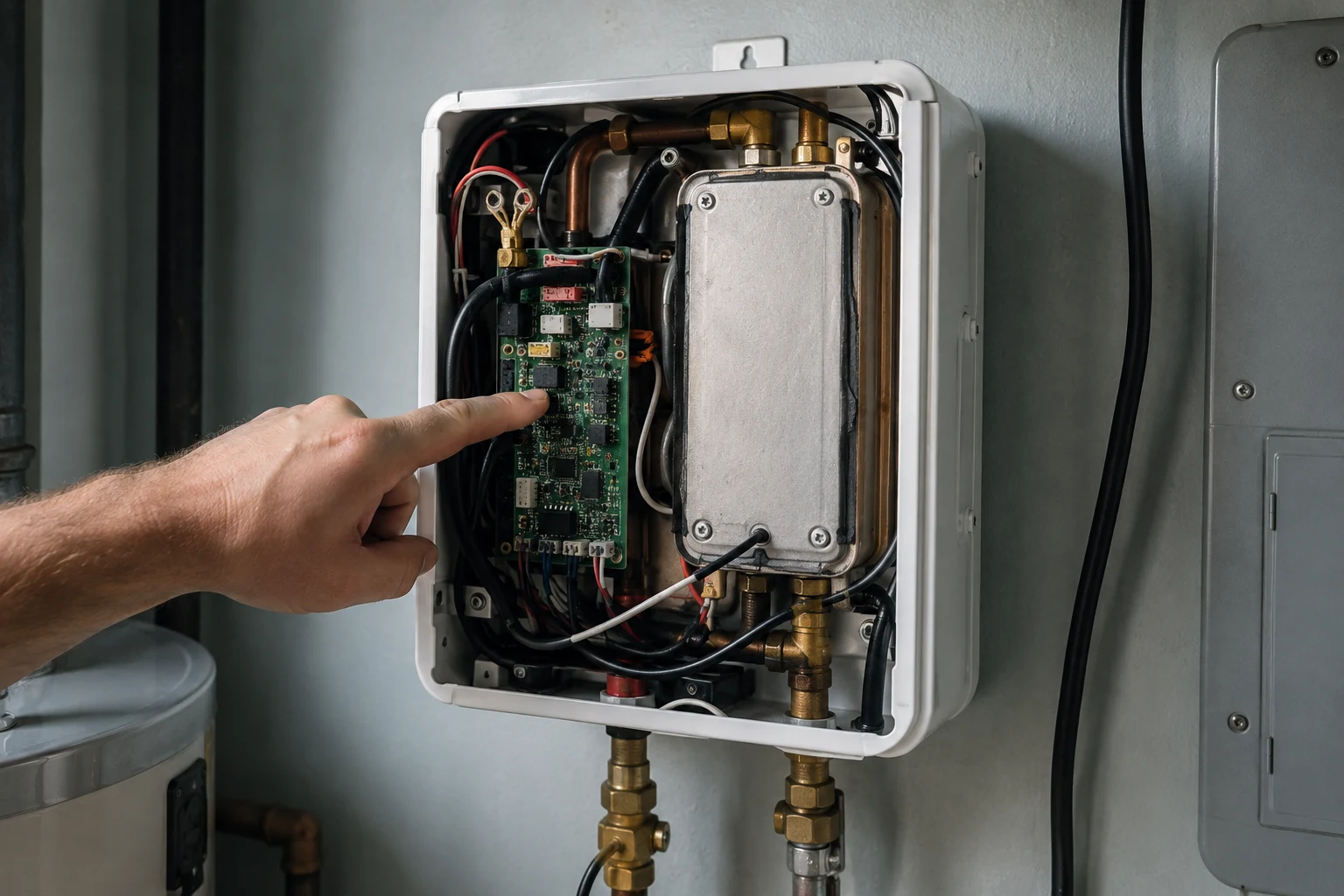
Every one of these steps that involves removing a cover, testing an element, or touching a wire starts the same way: shut off all power at the circuit breaker first. Eemax elements run on 240 volts and a whole-home unit can draw over 100 amps across multiple circuits. Cut every breaker feeding the heater, verify it is dead, and only then open the unit. Never bypass or jumper a safety limit like the E4 over-temperature trip to force the heater to run.
Power, wiring, and why E5 shows up on new installs
The code that stumps people most on a fresh install is E5, and it is usually not a broken part at all. Whole-home Eemax units are big electrical loads split across multiple circuits, and the board expects the feed the model was rated for. A 27 kW HomeAdvantage II like the HA027240 draws about 113 amps, arranged as three separate 37-amp circuits, and Eemax calls for three sets of 8 AWG conductors on three breakers. Put that unit on 30-amp breakers with 10-gauge wire and the current it needs is more than the wire and breakers can carry, so the control board flags it, commonly as E5. The fix is electrical, not a sensor swap: confirm the breaker count, amperage, and wire gauge match the model's rating plate, that every circuit is landed and not tripped, and that the supply is a true 240 volts. Eemax elements are designed for 240 volts, and a lower supply drops heating power and skews the display reading, so a unit fed under-voltage will read and behave as if something is wrong when the real issue is the feed.
Once the wiring is right, the rest of an E5 is the same flow-and-sensor drill: back the flow off with the outlet valve, and with the breaker off, check the temperature-sensor connections for a loose or corroded lead before you condemn the board. Then reset at the breaker. If the electrical feed is correct and the flow is sane and the code still returns, that is when a call to Eemax technical support at 1-800-543-6163 is worth it, with your order-reference and serial numbers in hand. Have them ready: the model tells the parts desk which element, thermistor, or board fits your exact unit, and the serial lets them check the warranty window before you buy anything.
Reading the fault, not just resetting it
The habit that separates a fixed Eemax from one that keeps faulting is refusing to reset on a loop. A breaker cycle clears the latched code, but it does nothing to the cause. If an E4 over-temp comes right back, the inlet is still hot and you have a plumbing problem to solve, not a code to silence. If an E5 returns, the wiring is still undersized or the flow is still too high. If an SP light still will not come on after you have opened every valve and cleaned the filter, the flow switch or an element is the next stop, not another reset. Count the flashes or read the code, sort it into flow, temperature, or power, fix that one thing, and reset once to confirm. That is the whole method, and it is the same method Eemax's own manuals walk, from the SP light chart to the digital E-codes.
Frequently asked
What does an E5 error mean on an Eemax tankless water heater?
E5 on the digital Eemax models points at flow and power together, and it is the code installers see most on a fresh whole-home install. It reads as a high-flow condition, but the underlying cause is often an undersized electrical feed. A whole-home Eemax like the 27 kW HA027240 pulls about 113 amps across three separate 37-amp circuits and wants three sets of 8 AWG conductors on three breakers. Wire it on 30-amp breakers with 10-gauge wire and the draw the unit needs exceeds what the wire and breakers can carry, so the control board faults out as E5. Before you suspect a sensor, confirm every breaker the unit calls for is present, the correct amperage, on the right gauge wire, and not tripped. If the wiring is correct, back the flow off with the outlet valve and check the temperature-sensor connections for a loose or corroded lead. A power cycle at the breaker clears the latched code once the real cause is fixed.
How do I reset an Eemax tankless water heater?
There is no red reset button on most Eemax electric units. The reset is the breaker. Turn off the circuit breaker or breakers feeding the heater at the main panel, leave the power off a few minutes so the control board fully de-energizes, then switch the breakers back on. That clears a latched fault code and lets the board re-read flow and temperature from scratch. On a whole-home model with two or three circuits, cut all of them, not just one. A reset clears the readout, it does not fix the cause: if the same code returns as soon as you draw hot water, the condition behind it is still live, whether that is low flow, an over-temperature inlet, undersized wiring, or a failed sensor. Reset once to confirm, then chase the code rather than resetting on a loop.
Why is the light on my Eemax blinking but no hot water?
On the SP and SPEX FlowCo models, the single indicator light is the whole diagnostic system, and its rhythm is the message. A solid light means the unit sees enough flow and is actively heating. One flash roughly every four seconds means the heater is idle and waiting for water flow, so it is powered and ready but has not seen the flow it needs to fire. If the light will not come on at all when you open the hot tap fully, the unit is not activating, and the usual reason is too little flow. SP models need about half a gallon per minute to switch on, HomeAdvantage II about 0.3 GPM. Open every valve fully, pull the aerator, and check the inlet filter for debris. If the light comes on but the water stays cold, the problem shifts to a heating element or the supply voltage, not the flow switch.
What is E1 on an Eemax and how do I clear it?
E1 on the digital Eemax models is a flow and inlet-side fault. The board is not seeing the flow it expects, or the inlet thermistor that reads incoming water temperature is reading wrong or disconnected. Start with flow, because that is the cheap fix: shut the water, pull and clean the inlet filter screen, and make sure no valve upstream is half closed. Restore flow and cycle the breaker. If E1 returns on a heater that clearly has good flow, the inlet thermistor or its wiring is the next suspect, and testing it means killing the breaker and ohming the sensor to confirm its resistance changes as water temperature changes. That is service-tech territory. Do not keep resetting a repeating E1 hoping it clears, because a genuine sensor fault will come straight back the moment the unit tries to read the incoming water.
What does E4 mean and is it dangerous?
E4 is a high-temperature condition, the electric equivalent of an over-temperature trip. The unit sensed the water, usually the incoming water, past a safe limit and cut heating to protect itself. The common real-world cause is inlet water that is already hot, which happens when the Eemax is fed from a recirculation loop or downstream of another water heater. The fix is to bring the incoming temperature down, typically below about 140 degrees, by correcting the plumbing that is feeding it hot water or adding a mixing arrangement. E4 is not a code to bypass. It is a safety limit doing its job, and the danger is not the code, it is defeating it and letting the unit run past a temperature it flagged. Clear the heat source, cut the breaker to reset, and the code should stay gone if the inlet is back in range.
Where do I find the model and serial number on an Eemax?
The model number, which Eemax also calls the order reference, is printed on the U.L. rating label on the front cover of the unit. The serial number is inside the heater, on the backplate. On the SP troubleshooting flow, Eemax specifically asks you to have both the order-reference number and the serial number in hand before you call their support line. Write both down, because the model tells the parts desk which element, thermistor, or control board fits, and the serial encodes the build so they can check warranty. The model number also decodes the unit: HA027240, for example, is a HomeAdvantage II at 27 kW on 240 volts. Eemax technical support is 1-800-543-6163.
How much flow does an Eemax need to turn on?
Electric tankless heaters only fire when they see enough flow, and Eemax sets that activation point low. HomeAdvantage II units activate at roughly 0.3 GPM. The older SP point-of-use models need about 0.5 GPM, half a gallon a minute. A simple field test on an SP: fill a one-gallon jug from the hot outlet, and if it takes longer than two minutes the flow is probably too low to switch the heater on. When the unit will not activate, the fix is almost always more flow, so open every valve fully, remove the faucet aerator, and clean the inlet filter screen. On the other end, too much flow causes the opposite complaint, lukewarm water or an E0 excessive-flow code, because temperature rise is inversely proportional to how fast water moves through the elements.