An EcoSmart electric tankless unit that goes cold is not throwing a spark plug or clogging a vent, because there is nothing to burn. It is a bank of electric heating elements switched by a control board that watches water flow and temperature. So when the water runs cold with the display still lit, or when the breaker snaps off the moment you draw a hot shower, the fault is somewhere in that short chain: flow, sensors, elements, wiring, or the breaker feeding it. The two symptoms point in different directions, and mixing them up wastes an afternoon.
No heat with the display lit usually means the board is refusing to fire. A tripping breaker usually means an element or a connection is drawing current it should not.The two-symptom rule
Quick answer
No heat with power on is most often no water flow (the inlet flow sensor propeller must spin freely), a tripped manual-reset thermal cutout, or a failed thermistor that makes the board withhold power to the elements. A tripping breaker is most often a burnt or shorted heating element, a loose lug heating at the terminal, or a breaker and wire undersized for the model. Diagnose flow and elements before you touch the panel.
Why these heaters fail in exactly two ways
A gas tankless heater has a dozen ways to lock out: venting, ignition, gas pressure, condensate. An EcoSmart electric unit has almost none of that. It has a flow sensor on the inlet, one or more banks of resistance elements, a thermistor on each side of the heating chamber to read incoming and outgoing water, a manual-reset thermal cutout as a last line of safety, and a control board that ties it together. That small parts count is the whole reason the symptoms sort so cleanly. Either the board decides not to fire the elements, and you get no heat with the display still on, or something in the power path draws current it should not, and the breaker trips. Almost every real-world complaint lands in one of those two buckets.
The flow sensor deserves a first mention because it explains so many false alarms. It is a small propeller on the cold inlet that has to spin freely counter-clockwise to tell the board that water is moving. Below the minimum flow rate, or if grit jams the propeller, the board never energizes the elements. People assume the heater is broken when the real problem is a clogged aerator, a partly closed shutoff, or debris on the sensor. It is the first thing to rule out, and it costs nothing.
Key takeaways
- No heat with power on: check flow first, then the manual-reset thermal cutout, then thermistors, then elements.
- Tripping breaker: a burnt or shorted heating element is the single most common cause.
- A loose power lug heats up under load and can trip the breaker or scorch the terminal.
- ECO 11 wants one 60 A breaker on 6 AWG; ECO 18 wants two 40 A on 8 AWG; ECO 27 wants three 40 A on 8 AWG.
- The ECO 27 pulls 112.5 amps total, so undersized wiring or a weak service will nuisance-trip on a hot shower.
- After swapping an element, purge air for 3 to 5 minutes before powering up or you can dry-fire the new element.
Sorting the symptom before you open anything
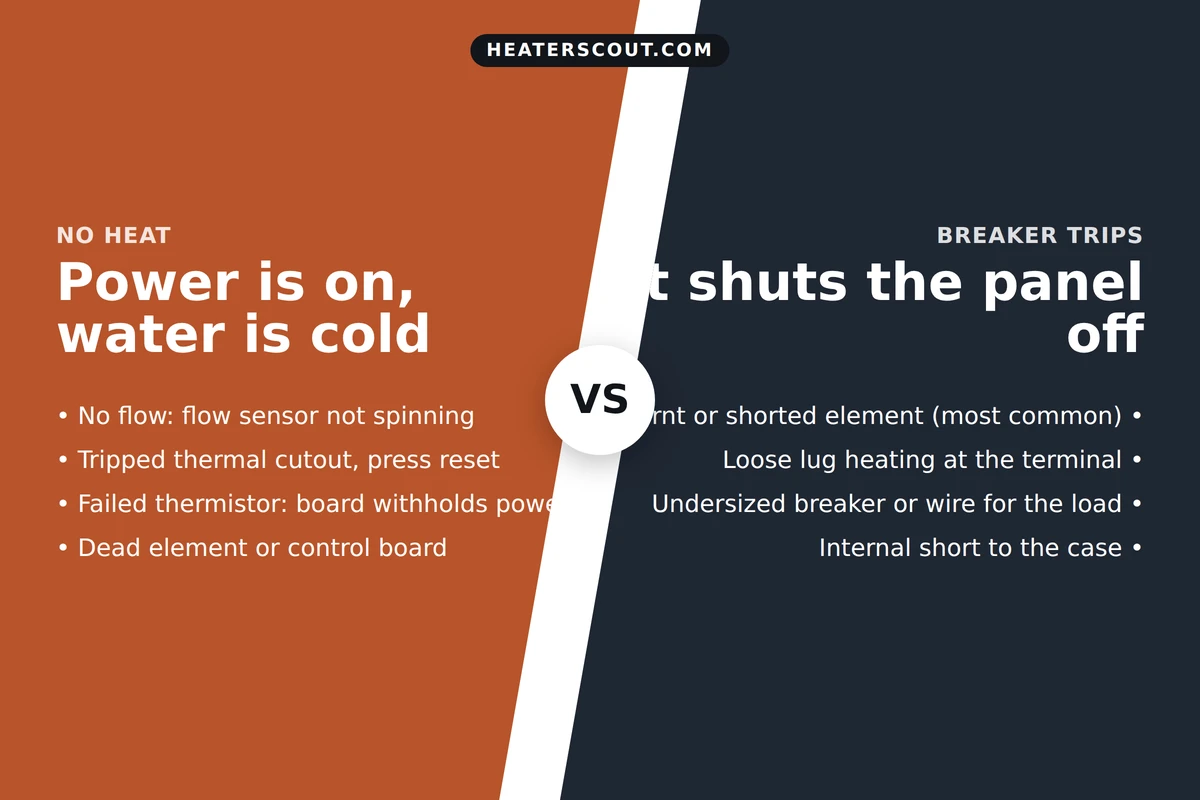
Before you pull a cover, decide which problem you actually have, because the two paths barely overlap. Ask one question: is the display still lit and the water simply cold, or does the breaker physically flip to off? If the display is on and heat is missing, the board is choosing not to fire, and you chase flow and sensors. If the breaker trips, current is going somewhere it should not, and you chase elements, connections, and wire sizing. The columns below split the usual suspects for each.
No heat, display still on
- Flow too low or the inlet flow sensor is jammed with debris.
- Manual-reset thermal cutout has tripped and needs its button pressed.
- A thermistor has failed, so the board withholds power to the elements.
- A heating element is open, or the control board itself is faulty.
- One 240 volt leg is missing from a half-tripped breaker, so heat is weak.
The breaker trips
- A heating element has burned out or shorted to ground.
- A lug at a power terminal is loose and heating up under load.
- The breaker or wire is undersized for this model's full draw.
- Wiring has shorted inside the unit or at the terminal block.
- Water has intruded onto a live connection.
The verified electrical numbers
Half of the trip complaints on these units are really sizing complaints, so it is worth pinning the real numbers down. The ECO 11 is a 13.6 kW unit and calls for a single 60 amp double-pole breaker fed by 6 AWG copper. The ECO 18 is 18 kW and calls for two 40 amp double-pole breakers, each on its own 8 AWG copper run. The ECO 27 is the big one: 27 kW, 112.5 amps at full load, wired as three 9 kW modules that each pull about 37.5 amps, so it needs three separate 40 amp double-pole breakers on three 8 AWG copper runs. That total draw is why an ECO 27 belongs on a 150 to 200 amp service with headroom to spare. If the wire or breaker is a size light, the unit runs fine on a trickle and trips the instant every stage modulates up for a real shower.
Working the fault down
Kill power at the breaker before any cover comes off. From there the checks run in order of how often they turn out to be the culprit, cheapest and safest first. Do not skip to replacing the control board; it is the least common fault and the most expensive part.
Confirm water is actually flowing
Open the hot side wide and check that flow meets the unit's minimum, often around half a gallon per minute to start. Clean the aerator and any inlet screen. The flow sensor propeller on the inlet must spin freely counter-clockwise; grit on it keeps the board from ever firing the elements. This is the number one no-heat cause and it costs nothing to rule out.
Check the manual-reset thermal cutout
With power off, find the reset button near the thermostat on the element housing. If the cutout tripped on a high-temperature event, the unit shows power but makes no heat until you press it back in. Reset it only after you understand why it popped, because a cutout that trips repeatedly is flagging a stuck thermostat, scale, or a control fault, not asking to be reset again.
Ohm the heating elements
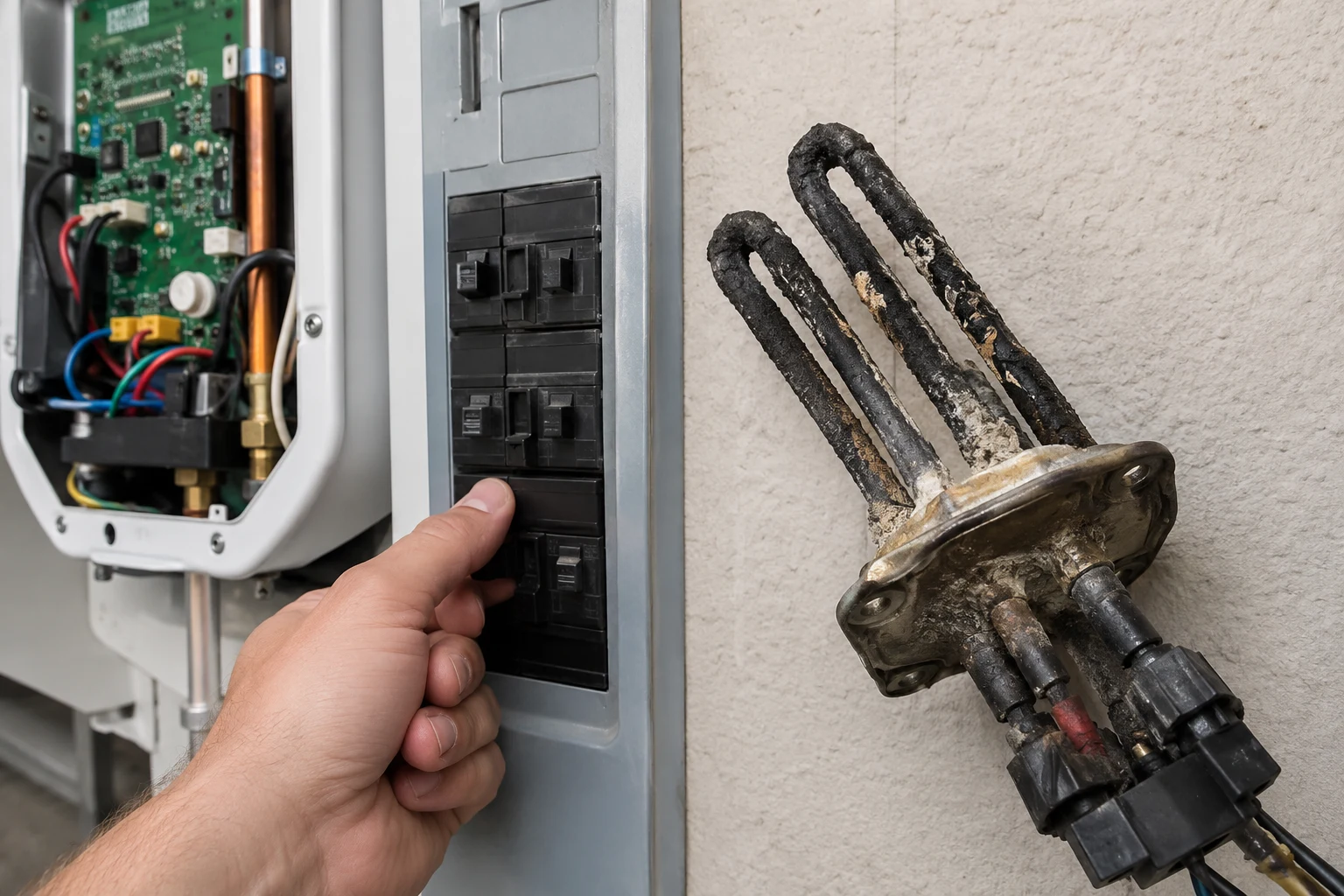
With the breaker off, disconnect and measure each element for continuity and for a short to the metal case. An open element gives you no heat on that stage; a shorted one trips the breaker. A burnt or shorted element is the single most common reason an EcoSmart trips its breaker, so this test settles most trip complaints. Replace any element that reads open or shorted with the correct wattage part.
Inspect the lugs and terminals
Look at every power terminal for discoloration, melted insulation, or a lug that backed off. A loose connection heats up under 40 amps of load, which can nuisance-trip the breaker or char the block. Torquing lugs to spec and replacing any scorched wire is electrician territory, not something to force with a bigger breaker.
Test the thermistors, then the board
Each heater carries a yellow inlet and a red outlet thermistor. If one fails, the control board refuses to energize the elements even though the unit powers up, so you get cold water with no obvious error. Measure them against spec. Only after flow, cutout, elements, lugs, and thermistors all check out do you suspect the control board, the priciest and least likely part.
Where the homeowner line sits
Cleaning the flow sensor, flushing air, pressing the thermal cutout, and testing elements and thermistors with a meter are all reasonable for a careful owner who cuts power first. Swapping a failed element is a real repair but a doable one, since EcoSmart sells the elements and publishes a parts diagram. The hard line is the wiring. Breaker sizing, wire gauge, and a loose lug carrying 240 volts at 40 amps are not places to improvise. A too-small wire or a poorly torqued terminal is a fire risk, not a nuisance, and that work belongs to a licensed electrician. The one thing you never do is bypass the thermal cutout or jumper a sensor to force the unit to run, because those parts exist to keep it from cooking water or itself.
Keeping it from coming back
Two habits prevent most repeat calls. First, purge air before you ever power a fresh element. EcoSmart's guidance is to open a few hot faucets and run water three to five minutes to clear air pockets, because firing an element into an air gap dry-fires it and cracks the sheath, which is the very failure that shorts the element and trips the breaker later. Second, on hard water, descale on a schedule. Scale on the elements and in the chamber raises resistance and temperature, which stresses the elements and can pop the thermal cutout. A unit that flows freely, sits on correctly sized wiring, and gets flushed once a year rarely surprises anyone with a cold shower or a dark panel.
Frequently asked
Why does my EcoSmart tankless heater have no hot water but power is on?
Power at the display does not mean power at the elements. An EcoSmart electric unit will only fire when the flow sensor sees enough water moving through it. That sensor is a small propeller on the inlet side that has to spin freely counter-clockwise; if it is stuck with debris or your flow rate is too low, the display lights up but the elements never energize. The next common cause is a failed thermistor. Each heater has two, a yellow inlet sensor and a red outlet sensor, and if one fails the control board deliberately will not send power to the elements even though the unit otherwise looks alive. After that, look at a tripped manual-reset thermal cutout, a burnt element, or a control board fault. Check flow first, because it is free and it is the most frequent reason for cold water with a lit display.
What size breaker and wire does an EcoSmart tankless need?
It depends on the model, and getting this wrong is a common reason the unit trips or underperforms. The ECO 11 is 13.6 kW and wants one 60 amp double-pole breaker on 6 AWG copper. The ECO 18 is 18 kW and wants two 40 amp double-pole breakers, each on its own 8 AWG copper run. The ECO 27 is 27 kW, draws 112.5 amps at full load, and wants three 40 amp double-pole breakers, each on 8 AWG copper. The ECO 27 is built as three 9 kW modules internally, roughly 37.5 amps apiece, which is why it needs three separate circuits. Undersizing any of this makes the breaker trip on a hot shower when all stages modulate up. Always confirm against the label on your exact unit, and make sure your main service can carry the draw, which for an ECO 27 typically means 150 to 200 amp service with room to spare.
Why does my EcoSmart tankless keep tripping the breaker?
The most common cause is a heating element that has burned out or shorted internally. When an element's sheath cracks, the current path can short to ground or draw far more than the breaker allows, and the breaker does its job and trips. Test each element for continuity and for a short to the case with a multimeter after killing power. The second suspect is a loose lug. A power terminal that is not torqued down heats up under load, and that heat can nuisance-trip the breaker or, worse, scorch the terminal. The third is an undersized or wrong breaker for the model, which trips only when demand pushes the unit to full output. If the breaker trips the instant you flip it on with no water flowing, that points to a dead short in an element or the wiring, not a load problem.
Can I fix EcoSmart no heat or breaker trips myself?
Some of it, yes, if you respect the electricity. Cleaning the flow sensor, flushing air out of the lines, and pressing the manual-reset thermal cutout are homeowner tasks. Testing elements and thermistors with a multimeter is fair game if you are comfortable working inside a live-capable panel with the breaker off. Swapping a failed element is a doable repair for a handy owner, since EcoSmart sells the elements and posts a parts diagram. Where you stop is anything involving the breaker sizing, the wire gauge, or a suspected loose lug carrying 240 volts and 40 amps. Undersized wiring and loose terminals are fire risks, and that is a licensed electrician's call. Never bypass the thermal cutout to force the unit to run.
How do I reset an EcoSmart tankless water heater?
There are two different resets and they solve different problems. To clear a control lockout, cut power at the breaker for about thirty seconds, then restore it. That reboots the control board. Separately, the unit has a manual-reset thermal cutout, a small button near the thermostat that pops when the water exceeds the high-temperature limit, usually rated around 140 degrees. If the cutout has tripped, the unit will show power but produce no heat until you press that button back in. Before you reset the cutout, find out why it tripped, because a cutout that pops repeatedly is warning you about a stuck thermostat, a control fault, or scale, not asking to be reset over and over.
Why is there no hot water after I replaced the EcoSmart heating elements?
This trips up a lot of people. The usual reason is an air pocket. EcoSmart's own guidance is to open a few hot faucets and let water run for three to five minutes to purge air from the lines before you power the unit up. If you fire a new element with air in the chamber, you can dry-fire and damage it on the spot, which is exactly the failure you were trying to fix. The second reason is voltage. An electric tankless needs a solid 240 volts; if one leg is missing because of a half-tripped breaker or a loose lug, the elements cannot make full heat. The third is that a thermistor was disturbed during the swap, and a failed or unplugged thermistor makes the board withhold power from the very elements you just installed.
Is undersized wiring on an EcoSmart tankless dangerous?
Yes, and it is one of the few parts of this job that is genuinely a fire hazard rather than just an inconvenience. These units pull real current. An ECO 27 draws 112.5 amps across three circuits, and each 8 AWG run is carrying close to 40 amps continuously when the unit modulates up. Wire that is too thin for that load heats up inside the walls, and a lug that is not torqued to spec heats up at the terminal. Either can char insulation and start a fire long before the breaker notices. A breaker that trips on a hot shower is annoying, but it is also the system telling you the circuit is stressed. Do not fix that by swapping in a bigger breaker on the same thin wire. That removes the protection and keeps the hazard. The wire has to match the breaker, and both have to match the model.