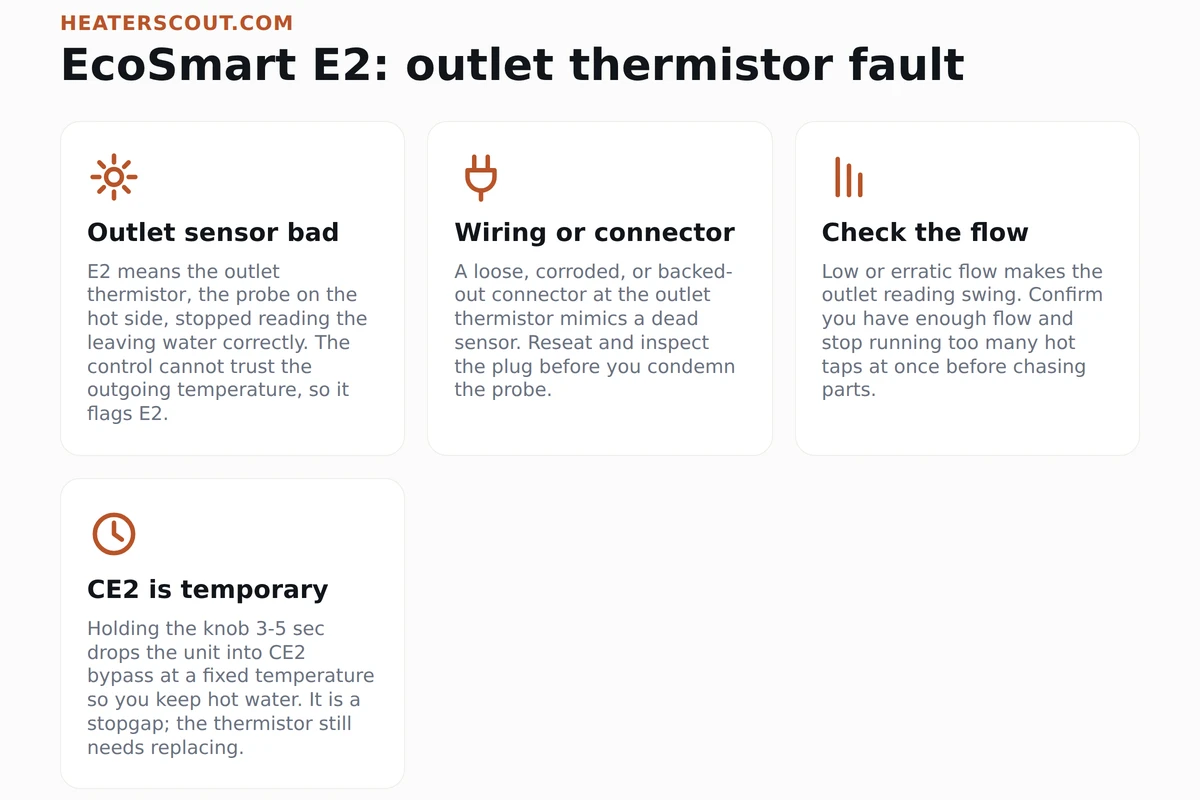
An EcoSmart showing E2 is not telling you an element burned out or that the unit ran dry. It is telling you the outlet thermistor, the little temperature probe on the hot side, stopped reading the leaving water correctly. The control board leans on that number to run the heating elements and hold your setpoint, so when the signal goes open, shorted, or implausible, it posts E2 and stops trusting the outgoing temperature. The part at fault is a sensor that costs under thirty dollars, and the fix is often a reseated connector, not a board that scares people into a service call.
Where E2 sits in EcoSmart's code family
EcoSmart keeps its temperature-sensor faults simple, which makes E2 easy to place once you know the pattern. The unit reads two thermistors: one at the cold water inlet and one at the hot water outlet. It compares them to figure out how hard to drive the elements. When the inlet sensor reads wrong, you get E1. When the outlet sensor reads wrong, you get E2. When both read wrong at the same time, you get E3. So E2 points at exactly one part, the outlet thermistor on the hot side, and its wiring back to the board. This is worth stating plainly because a common bit of bad advice online calls E2 a dry-fire or element fault. It is not. A genuine dry-fire, running the elements with no water, is prevented by the flow switch, which stops the unit from firing without flow in the first place. E2 is a sensor code.
EcoSmart error code E2
An outlet thermistor fault. The outlet thermistor is the temperature probe on the hot side of the heater that reads the water leaving the unit. The control board uses that reading to modulate the elements and hold your setpoint. When the board sees the outlet thermistor as open, shorted, or out of range, it can no longer trust the outgoing temperature, so it flags E2. Distinct from E1 (inlet thermistor) and E3 (both thermistors reading wrong).
What the outlet thermistor actually does
A tankless heater has no tank of pre-warmed water to lean on. Every time you open a hot tap it has to raise the incoming water to your setpoint in the seconds it takes to pass through the heating chamber. To do that cleanly it needs two temperatures: how cold the water is coming in, and how hot it is going out. The outlet thermistor supplies the second. The board watches that leaving temperature and trims element power up or down to keep it steady as your flow changes. If someone flushes a toilet and your shower flow drops, the outlet reading is how the unit knows to back off before it overshoots. Take that reading away and the heater is modulating blind, which is exactly the situation E2 exists to prevent. A thermistor is a resistor whose resistance changes with temperature, and when it fails it usually goes fully open (a broken probe or wire) or fully shorted, either of which the board reads as nonsense.
The short version
E2 is an outlet thermistor fault, not an element or dry-fire fault. Confirm you have adequate flow and are not running too many hot taps at once, then kill the breaker and reseat the outlet thermistor connector. Use the CE2 bypass (hold the round knob 3 to 5 seconds) to keep hot water at a fixed temperature while you wait on parts. To clear E2 for good, replace the outlet thermistor, a part under $30. Suspect the control board only if a fresh sensor and good wiring still throw the code.
Quick answer
E2 means the outlet thermistor, the hot-side temperature sensor, is not reading the outgoing water correctly. First confirm you have enough flow and are not overloading the unit with too many simultaneous hot taps. Then cut the breaker, open the cover, and reseat or inspect the outlet thermistor connector for corrosion or a backed-out pin. If the code survives that, the sensor has failed and needs replacing, a part that runs about $28. To keep hot water in the meantime, hold the round knob 3 to 5 seconds until the display reads CE2, which bypasses the sensor at a fixed temperature. CE2 is a stopgap, not a repair.
Work the cheap causes first
Most E2 faults are the connection, the flow, or the probe, in that order of how cheap they are to fix. Start with the two that cost nothing. Confirm you actually have enough flow, because a starved or sputtering flow lets the outlet water temperature swing hard and the board can read that swing as an implausible sensor signal. Running four fixtures off an undersized ECO on a cold day can do it. Reduce simultaneous draws and see whether E2 settles. Next, kill the dedicated breaker, confirm the unit is dead, and open the front cover. Find the outlet thermistor on the hot side and check its connector for green corrosion, a backed-out pin, or a burnt terminal. Reseat it firmly. A surprising number of E2 calls end right here, at a connector that worked loose over years of the cabinet heating and cooling.
Cut the power first
The EcoSmart cabinet carries 240-volt wiring to the heating elements even though the control side is low voltage. Always shut off the dedicated breaker and confirm the unit is de-energized before you open the cover or touch any connector. If a thermistor terminal looks burnt rather than just loose or corroded, stop and get a licensed electrician, because a scorched terminal points at a bigger wiring or element problem than a simple sensor fault.
Replacing the outlet thermistor
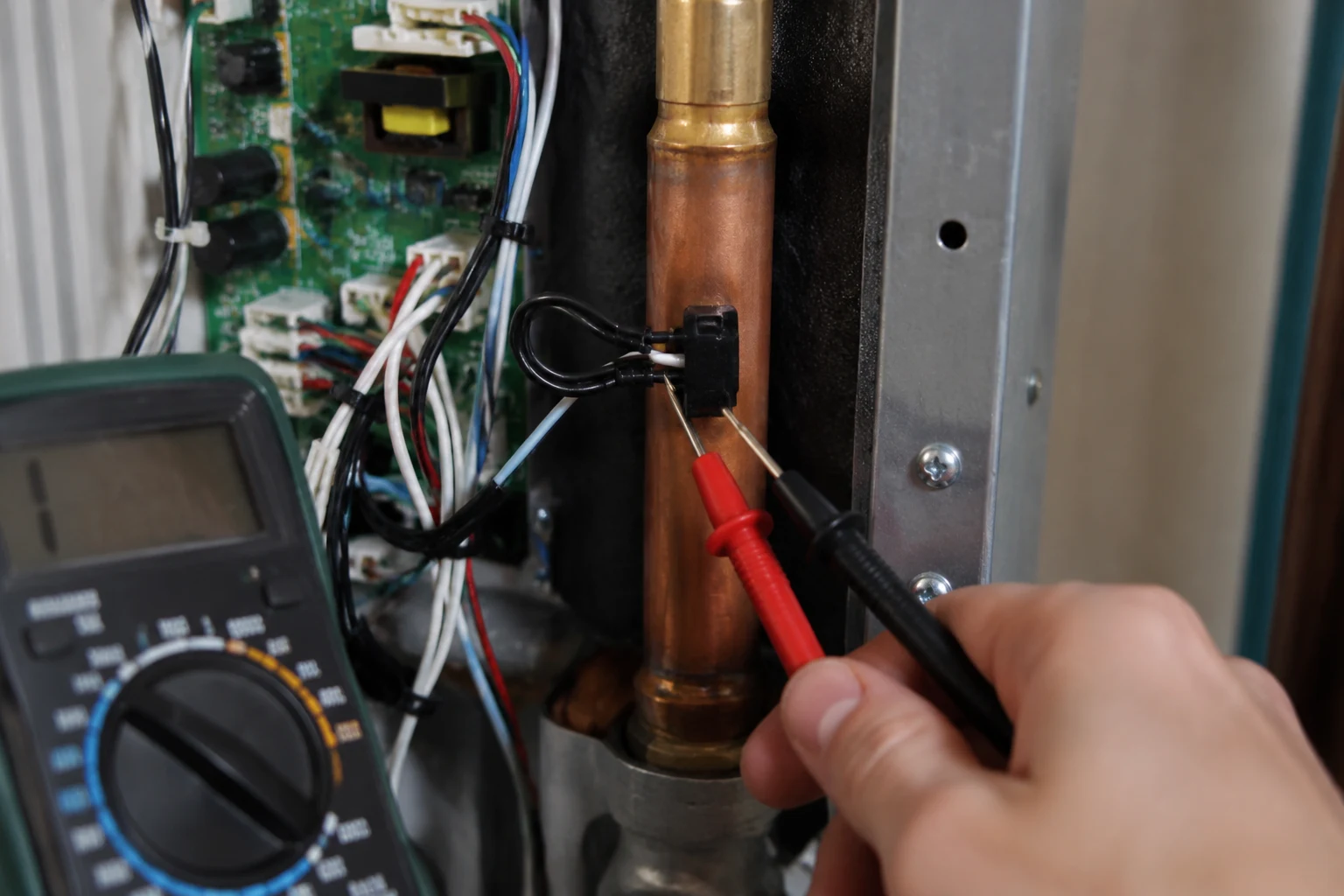
If reseating the connector and fixing the flow does not clear E2, the sensor has failed and the honest fix is a new one. EcoSmart sells the thermistor as an assembly that includes both the inlet and outlet sensor wires, and it fits the common ECO 18, 24, and 27, with matching parts for the ECO 11 and 36. The part is usually $25 to $30. With the breaker off and the cover already open, unplug the failed outlet thermistor at its connector, release it from its clip or fitting, route the new sensor the same way, and seat the connector. Close the unit up, restore power, run a hot tap, and watch the display. If E2 is gone and the outlet temperature tracks your setpoint again, you are done. If a brand new sensor with a clean connection still throws E2, the remaining suspect is the reading circuit on the control board, and a board is the point where paying a tech to diagnose against EcoSmart's guide beats guessing.
Living on CE2, and why not to
CE2 is a genuinely useful feature, and it is easy to lean on it too long. When you hold the round knob and the display flips to CE2, the unit stops reading the failed outlet thermistor and heats to a fixed default temperature, around 125 degrees, the way a plain tank heater runs. You keep hot water, which matters if the part is a few days out. But you lose the ability to set your outlet temperature, and you are running on a fallback instead of a working sensor. A fixed 125-degree output is hotter than many people set their heaters, so mind the scald risk at fixtures without anti-scald valves. Treat CE2 as a bridge to the repair, not the repair. Order the thermistor, run on CE2 until it arrives, then swap the sensor and get your temperature control back.
Keeping E2 from coming back
An outlet thermistor fails from three things: age, a connection that works loose over years of thermal cycling, and water quality that leaves film on the probe. You cannot stop the sensor from aging, but you can keep the rest in check. Pull and rinse the inlet filter screen at your annual service so debris does not starve the flow, because flow problems are what make a marginal outlet reading tip into an E2. While the cover is off, reseat the thermistor connectors and look for the first hint of corrosion, since catching a green pin early beats chasing an intermittent E2 on the coldest morning of the year. Descaling on schedule keeps the elements and waterways clean even though it does nothing for the sensor directly, and a unit that gets a yearly look-over rarely surprises you with a sensor code out of nowhere. Size the heater to your climate too. An ECO that is undersized for a cold-inlet winter runs its flow and temperature at the edges, and edges are where sensor codes live.
Frequently asked
What does EcoSmart error code E2 mean?
E2 on an EcoSmart electric tankless heater is an outlet thermistor fault. The outlet thermistor is the small temperature probe on the hot side of the unit, the one that reads the temperature of the water leaving the heater. The control board uses that reading to modulate the heating elements and hold your setpoint. When the board sees a signal from the outlet thermistor that does not make sense, open, shorted, or wildly out of range, it posts E2 and stops trusting the outgoing temperature. It is a sensor fault, not an element or burn-out fault. EcoSmart groups three thermistor codes together: E1 is the inlet thermistor on the cold side, E2 is the outlet thermistor on the hot side, and E3 means both are reading wrong. So if you see E2, the part you are chasing is the outlet temperature sensor and its wiring, not a heating element.
Can I reset EcoSmart E2 myself?
Yes, and EcoSmart even builds in a bypass so you keep hot water while you wait on the part. With water running and E2 showing on the LED, press and hold the round knob for 3 to 5 seconds, then release. The display should change to CE2. Keep the water running for 2 to 3 minutes and check for hot water. In CE2 mode the unit ignores the failed outlet thermistor and heats to a fixed default temperature, around 125 degrees, the way a simple tank heater would, which means you lose the ability to dial in your outlet temperature. Understand what this is: a temporary bypass, not a repair. E2 will not clear for good until the outlet thermistor is replaced. A full power cycle at the breaker will also drop the latched code, but if the sensor is bad the code comes right back.
How much does it cost to fix EcoSmart E2?
The part is cheap. An EcoSmart thermistor assembly, which comes with the inlet and outlet sensor wires, runs roughly $25 to $30 online and fits the common ECO 18, 24, and 27 models, with matching parts for the ECO 11 and 36. If you do the swap yourself, that part cost is the whole bill. If the trouble turns out to be a loose or corroded connector rather than a dead probe, the fix is free beyond your time. Bringing in a plumber or electrician to diagnose and replace the sensor typically lands somewhere around $100 to $250 once you count the trip and labor, more in high-cost metros. The expensive outcome, the control board, only comes up if the sensor and wiring both check out and E2 still returns, and that is uncommon.
Will descaling clear EcoSmart E2?
No. Descaling flushes vinegar or a descaling solution through the unit to strip mineral scale off the waterways and the elements, and on hard water it is worth doing on schedule. But E2 is an electrical sensor fault. The outlet thermistor reads temperature; it does not care whether the elements are scaled. A descale will not repair a broken wire, a corroded connector, or a failed probe. That said, while you have the cover off chasing E2 it is a reasonable moment to look at scale on the elements and the condition of the inlet filter screen, because a unit that has never been flushed has usually never been serviced at all. Just do not expect the descale itself to make E2 go away.
Why does EcoSmart E2 keep coming back?
A code that returns after CE2 bypass or a power cycle means the real fault is still live. The usual repeat offenders: the outlet thermistor connector was reseated but a pin is corroded or backed out, so the signal drops intermittently. Or the sensor reads borderline, drifting in and out of range as the water heats and cools, which is easy to miss with a single cold check. Low or erratic flow is another one, because a starved flow lets the outlet water temperature swing hard and the reading can look implausible to the board. Confirm you have enough flow and are not running too many hot fixtures at once, reseat and inspect the connector, and if E2 still cycles back, the outlet thermistor has failed and needs to be replaced. If a fresh sensor and good wiring still throw E2, the reading circuit on the control board is the last suspect.
Is EcoSmart error code E2 dangerous?
The code itself is a protective response, not a hazard. The outlet thermistor tells the board how hot the water leaving the unit is, and the board leans on that number to avoid overheating and to hold your setpoint. When that reading goes bad, the unit flags E2 rather than keep modulating blind. Even the CE2 bypass is designed to be safe: it falls back to a fixed default temperature rather than running with no temperature feedback at all. What you should not do is ignore E2 indefinitely and live on CE2, because you lose fine temperature control and you are relying on a fallback instead of a working sensor. The fault lives on the water and electronics side, not a gas train, so it is low risk to deal with. Just remember the cabinet carries 240-volt element wiring, so cut the breaker before you open it.
Do I need a plumber or an electrician for EcoSmart E2?
Either can handle it, and a handy owner often can too. The repair is a temperature sensor swap: kill the breaker, open the front cover, unplug the old outlet thermistor, fit the replacement, and close it up. That is closer to electrical work than plumbing, since you are not opening the water side. What raises the stakes is that an EcoSmart cabinet has 240-volt wiring feeding the elements, so the non-negotiable step is shutting off the dedicated breaker and confirming the unit is dead before your hands are inside. If you are not comfortable verifying power is off, or the connector looks burnt rather than just loose, bring in a licensed electrician. Burnt terminals hint at a bigger wiring or element problem than a simple E2.