An EcoSmart flashing E1 is not telling you the water is too hot, too cold, or not flowing. It is telling you the unit has lost its read on the temperature of the water coming in. A small sensor at the cold-water inlet, the inlet thermistor, feeds the control board the one number it needs to size how hard to drive the heating elements. When that sensor reads out of range, the board throws E1 and stops trusting it. The fix is usually a reseated connector or a sub-40-dollar sensor, not the flow-sensor problem some guides wrongly pin on this code.
| Code meaning | Inlet thermistor error (incoming water temp sensor) |
| Sensor location | Cold-water inlet inside the unit |
| What the board loses | The incoming water temperature it uses to set element power |
| Common cause | Faulty inlet thermistor, corroded connector, or chafed wire |
| Related codes | E2 outlet, E3 both sensors, E4 water too hot, E5 high flow |
| Reset method | Hold the round knob 3-5 sec to enter CE1 bypass |
| CE1 behavior | Ignores the sensor, heats to a fixed ~125F, mix in cold at the tap |
| Is CE1 a fix | No, it is a temporary bypass until you replace the sensor |
| OEM part | EcoSmart inlet thermistor (medium/large per model) |
| DIY part cost | About $15 to $40 for the thermistor |
| Pro repair range | About $100 to $250 to diagnose and swap |
| Difficulty | Call a pro: live 240V terminals sit near the sensor |
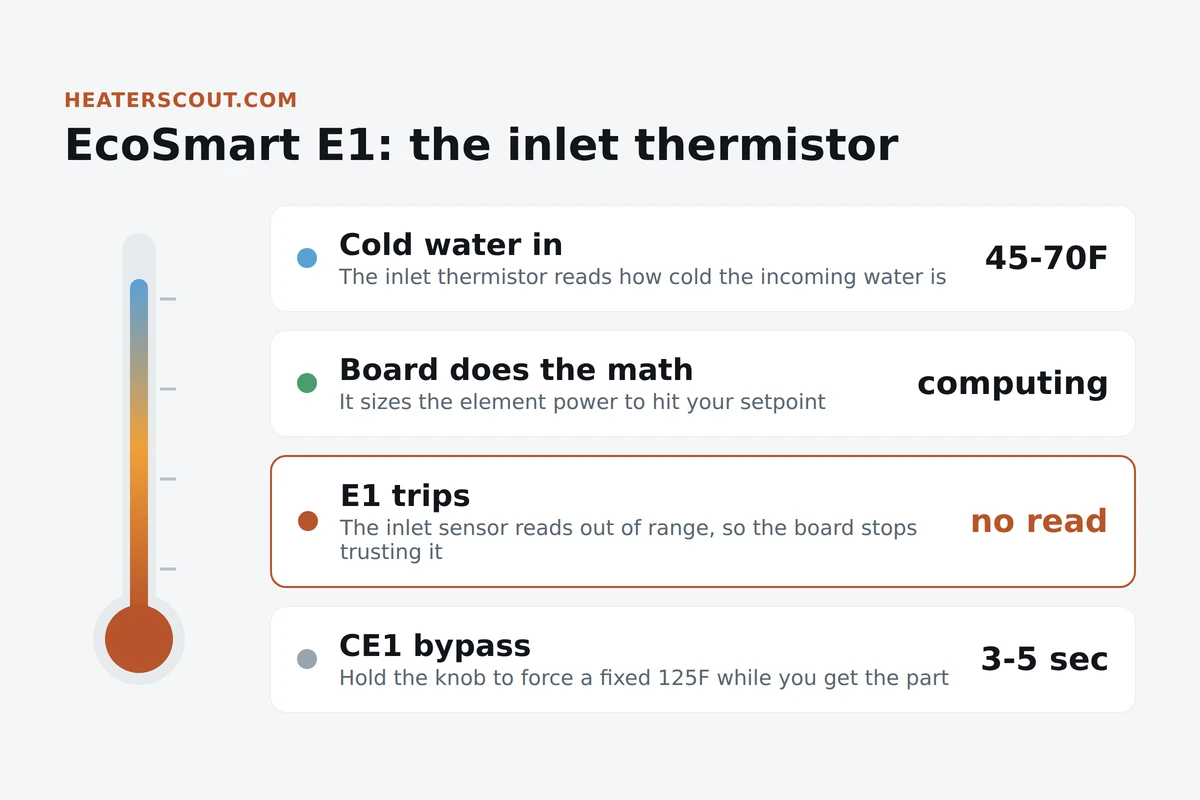
Why the inlet reading is the whole game on an electric tankless
Understanding what the sensor does makes E1 make sense. An electric tankless heater has no tank of pre-warmed water to lean on. Every time you open a hot tap, it has to raise the water from whatever temperature it arrives at, right now, to your setpoint, in the couple of seconds it takes to pass the heating elements. To do that the board needs two numbers: how cold the water is coming in and how hot it is leaving. The inlet thermistor supplies the first. In January that incoming water might be 45 degrees; in August it might be 70. That 25-degree swing changes how many kilowatts the elements have to pour in. EcoSmart's whole selling point is self-modulating power, sending exactly the wattage the flow and inlet temperature call for. Take away the inlet reading and that modulation logic has no starting point, so the board reports E1 and stops rather than heat blind.
What the code is and is not
This is where the internet gets it wrong, and where a dispatch hint got it wrong too. E1 is not a flow sensor fault. It is not a no-flow condition. On EcoSmart's ECO line the E-codes are a thermistor family, and they split cleanly by which sensor the board is unhappy with. E1 is the inlet thermistor. E2 is the outlet thermistor on the hot side. E3 means the board sees both thermistors erroring at once, which usually points at a shared harness or the control board rather than two probes dying together. E4 is a different beast, it means the incoming water is already too hot, roughly 150 degrees or more, past the unit's design limit. E5 is the actual flow code: flow rate higher than the heater can handle. So if a guide told you E1 was about flow, it was describing E5. Chase the inlet temperature sensor for E1.
CE1 is not a repair. It tells the unit to stop listening to a broken sensor and heat to a fixed 125 degrees so you have hot water while the real part ships.EcoSmart CE1 bypass
The CE1 bypass, step by step
EcoSmart built in a way to keep hot water flowing while you wait on a thermistor. It is a bypass, not a fix, and it changes how the unit behaves, so it is worth doing deliberately. Open a hot tap so the LED wakes up and shows E1. Press and hold the round control knob on the face of the unit for about three to five seconds, then let go. The display should switch to read CE1. Run the water for two to three minutes and check that it heats. In CE1 the unit ignores the dead inlet sensor and heats to a fixed target of around 125 degrees, so you blend in cold at the faucet to land on a comfortable temperature. That fixed 125-degree fallback is deliberate: rather than run open-loop at full power with no sensor, EcoSmart caps the output at a safe, usable number. Live in CE1 as a stopgap, not a permanent setting.
Key takeaways
- E1 is the inlet thermistor, the sensor reading incoming water temperature. It is not a flow or no-flow code.
- The E-codes are a thermistor family: E1 inlet, E2 outlet, E3 both, E4 incoming water too hot, E5 high flow.
- CE1 is a bypass, not a fix. Hold the round knob 3-5 seconds; the unit then heats to a fixed 125F.
- The permanent cure is a new inlet thermistor or a repaired connector and wire, often a pro call.
- This is a 240V appliance. Kill the breaker and confirm it is dead before opening the cover.
- Check your EcoSmart warranty first. The thermistor or control board may still be covered.
What to check before you buy a part
Work the cheap causes first, and kill power at the breaker before you open the cover. Verify it is dead with a meter, because this is a 240-volt unit and the thermistor sits near live element terminals. Find the inlet thermistor at the cold-water inlet and trace its wire back to the connector on the board. Look for green corrosion, a backed-out pin, or a burnt terminal. Follow the wire for a chafe or pinch where the harness crosses an edge or flexes. A surprising share of E1 faults are the connection, not the probe: reseat it firmly, clean off any debris, and power back up to see whether the code clears. If it does, you fixed it for free. If E1 returns, the thermistor itself is the suspect, and the honest fix is the correct EcoSmart replacement sensor for your model, sold as the medium or large thermistor.
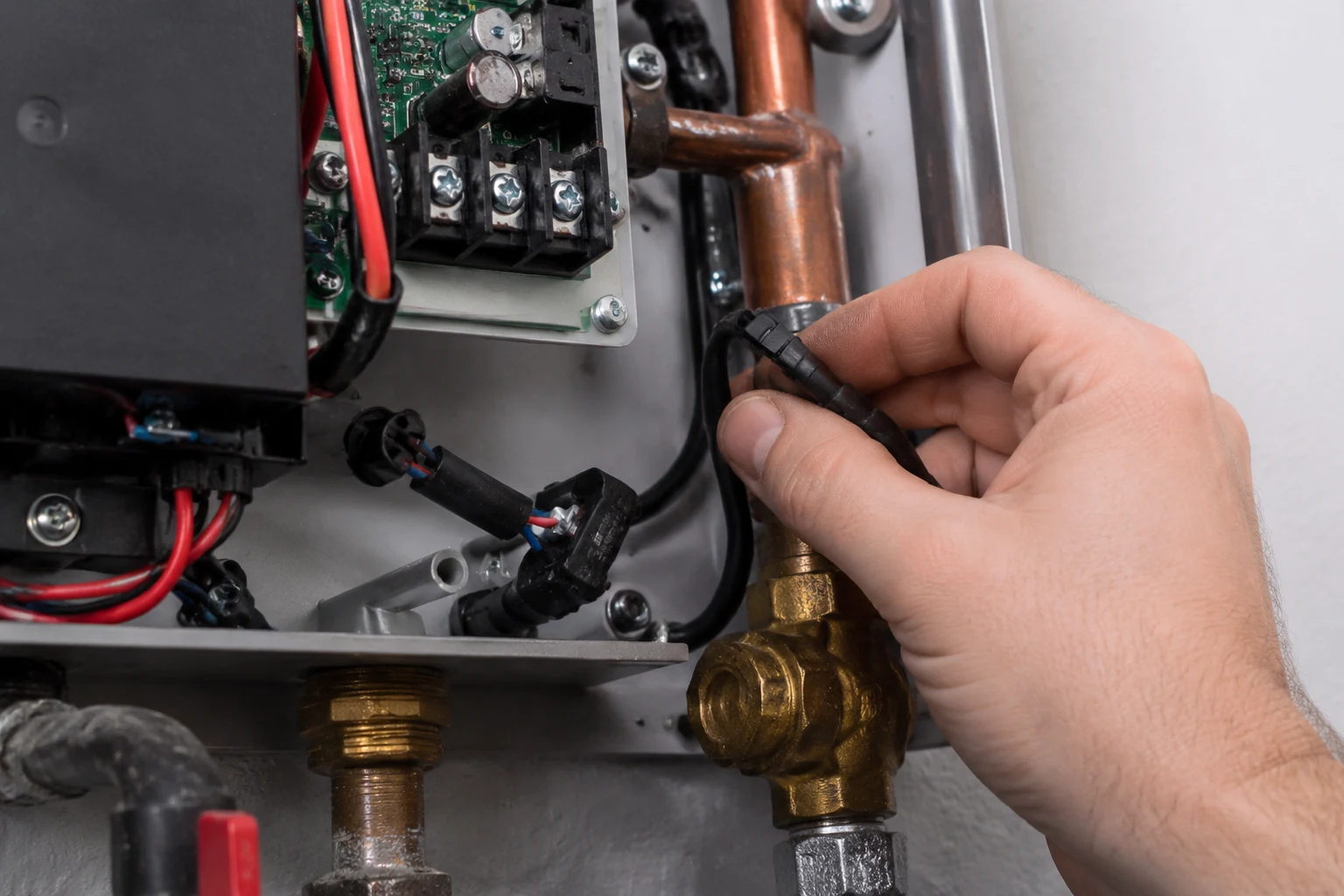
Where the homeowner line sits
Diagnosing E1 is fair game for a careful owner: cut power, verify dead, open the cover, and inspect the inlet thermistor and its wiring. Reseating a connector or cleaning a green pin is low risk and can clear the code outright. The reason EcoSmart and most guides still steer people to a pro for the actual swap is placement, not complexity. The sensor lives inside a 240-volt cabinet close to the element terminals, and the margin for a careless mistake near those terminals is thin. If you are confident killing the power, proving it is dead, and working inside the unit, the swap is a screwdriver and a sub-40-dollar part. If any of that gives you pause, get an electrician or a plumber who works on electric tankless units. Never work inside the heater live, and never jumper or fake the sensor to force normal operation, because then the board is heating your water with no idea how cold it started.
Keeping E1 from coming back
An inlet thermistor fails from three things: age, water quality at the inlet, and a wiring connection that works loose over years of thermal cycling. You cannot stop the sensor from aging, but you can keep the inlet clean. Pull and rinse the inlet screen filter at your annual service so grit and mineral film do not coat the probe or foul the flow the sensor sits in. While the cover is off, reseat the thermistor connector and look for the first hint of corrosion, because catching a greening pin early beats chasing an intermittent E1 on the coldest morning of the year. Descaling the elements on schedule keeps the heater efficient even though it does nothing for the sensor directly. A unit that gets a yearly look-over rarely surprises you with a sensor code out of nowhere, and if E1 does show, you now know it is the inlet thermistor talking, not the flow.
Frequently asked
What does EcoSmart error code E1 mean?
E1 on an EcoSmart electric tankless heater is an inlet thermistor error. The inlet thermistor is a small temperature sensor that reads how cold the water is as it enters the unit. The control board needs that number to decide how much power to send the heating elements, because water arriving at 45 degrees in winter needs far more heat than water arriving at 70 in summer. When the board reads that sensor as open, shorted, or otherwise out of range, it throws E1 and refuses to modulate normally. Note the dispatch you may have seen calling E1 a flow-sensor or no-flow fault is wrong for EcoSmart. Flow problems show up as E5 (high flow rate). E1 is specifically the incoming-water temperature sensor.
How do I reset EcoSmart error code E1?
EcoSmart gives you a documented bypass, not a true reset. Turn on a hot tap so the LED lights up and shows E1. Press and hold the round control knob for about three to five seconds, then release. The display should change to read CE1. Let the water run for two to three minutes and check for hot water. CE1 means the unit is now ignoring the failed inlet sensor and heating to a fixed default of roughly 125 degrees, so you will need to blend in cold water at the faucet to get a comfortable temperature. This gets you hot water while the replacement thermistor ships, but it does not fix anything. The sensor is still bad, and the unit is running blind on the inlet side until you replace it.
Can I fix EcoSmart E1 myself?
It depends on how comfortable you are inside a 240-volt appliance. The diagnosis is simple: open the cover after cutting power at the breaker, find the inlet thermistor at the cold-water inlet, and check its connector for corrosion, a loose pin, or a chafed wire. If a reseated connector clears E1, you are done for free. Swapping the thermistor itself is a modest job, the EcoSmart part is inexpensive, but EcoSmart and most guides point owners toward a pro because the sensor sits close to live element terminals and the fix has to be right. If you are not confident killing the power, verifying it is dead, and working near those terminals, this is a call-a-pro job. Never work in the unit live.
How much does it cost to fix EcoSmart E1?
The part is cheap. An EcoSmart inlet thermistor, sold as the medium or large thermistor depending on your model, runs roughly 15 to 40 dollars. If the problem is just a loose or corroded connector, the fix costs nothing beyond your time. Bringing in a plumber or electrician to diagnose and replace the sensor usually lands around 100 to 250 dollars once you count the trip and labor, more in high-cost metros. EcoSmart electric units carry a strong warranty on the electronics and elements when installed and registered correctly, so before you pay for parts, check whether your thermistor or control board is still covered. A warranty claim can turn a paid repair into a free replacement part.
Will descaling clear EcoSmart E1?
No. Descaling flushes vinegar or a descaling solution through the heating chamber to strip mineral scale off the elements, and on hard water it is worth doing once a year. But E1 is an electrical sensor fault, not a scale or flow problem. The inlet thermistor reads temperature; scale on the elements does not change what a broken sensor reports. A descale will not repair a shorted probe, a corroded connector, or a broken wire. That said, if you have the cover off chasing E1 and the unit has never been flushed, it is a fair time to descale the elements and clean the inlet screen while you are in there. Just do not expect the flush itself to clear the code. The thermistor still has to be fixed.
Why does EcoSmart E1 keep coming back?
A code that returns after the CE1 bypass means the real fault is still live. The usual repeat offenders are the connector and the wire. A pin that looks seated can be backed out or greened with corrosion, so the signal drops in and out as the harness shifts or the unit vibrates. A wire chafed against an edge can open only when it flexes, which a one-time visual check misses. And a thermistor can drift, reading borderline and slipping in and out of range as it warms and cools, which is why a probe that seems fine cold can still throw E1 under load. If you reset to CE1 and the underlying sensor is not replaced, E1 is always waiting behind it. The bypass hides the code, it does not remove the cause.
Is EcoSmart E1 dangerous?
The code itself is a protective response, not a hazard. The inlet thermistor tells the board how cold the incoming water is so it can set the right element power. If that reading is missing or nonsense, the board would be heating water blind, risking scalding or a cold shower. E1 is the unit refusing to guess. Even the CE1 bypass is designed to be safe: it falls back to a fixed 125-degree target rather than an open-loop full-power mode. What you should not do is try to jumper or fake the sensor to force normal operation. The bigger caution here is electrical, not thermal. This is a 240-volt appliance, so the real risk is opening it live. Cut the breaker and confirm it is dead before you touch anything.
What is the difference between E1, E2, and E3 on an EcoSmart?
They are the same family of thermistor faults split by which sensor failed. E1 is the inlet thermistor, the sensor reading incoming cold-water temperature. E2 is the outlet thermistor, the sensor reading the hot water leaving the unit. E3 means the board sees an error on both thermistors at once, which often points at a shared wiring harness, connector, or control board rather than two sensors failing independently. Above those, E4 flags incoming water that is already too hot, around 150 degrees or more, over the unit's design limit, and E5 flags a flow rate higher than the heater can handle. So if someone told you E1 was a flow code, they were describing E5. E1 lives firmly on the temperature-sensor side of the list.