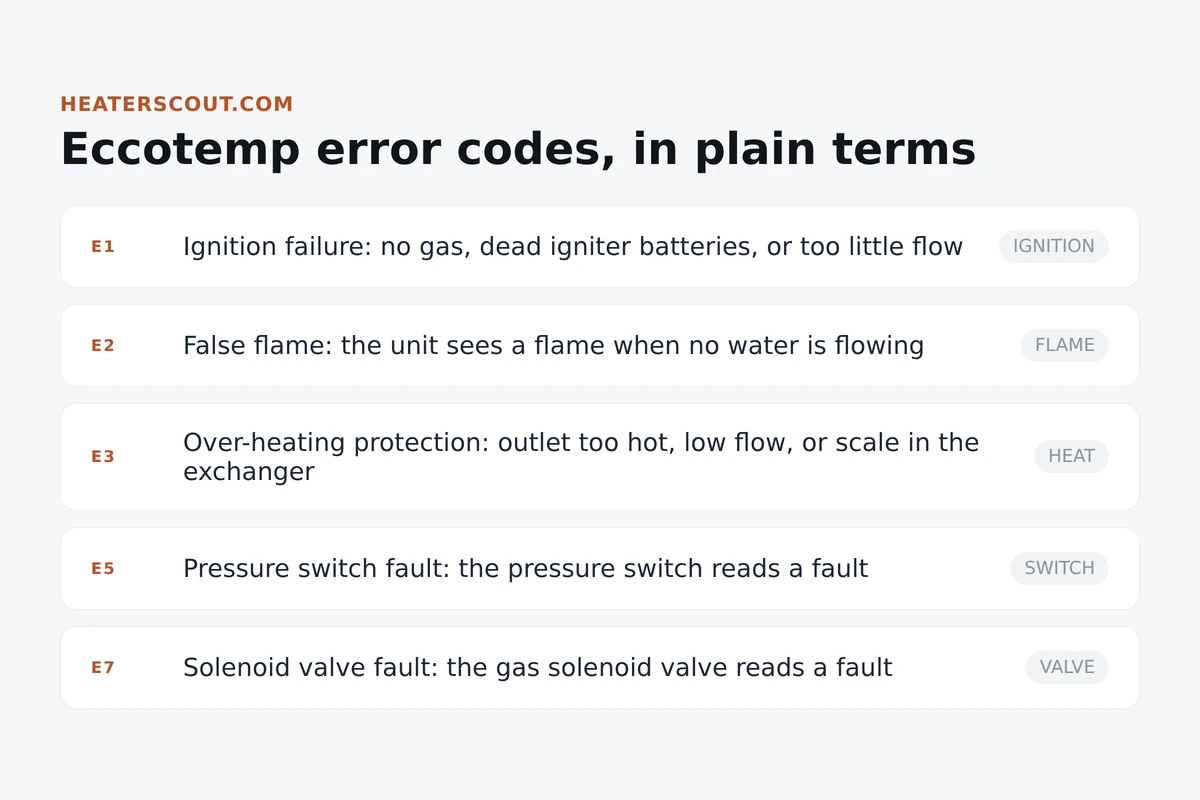
An Eccotemp tankless heater that throws E1 has usually failed at one of three simple things, and on a portable L5, L7, or L10 the very first suspect is a pair of dead igniter batteries, two D-cells on many portable models, so check yours, because those units spark the igniter off battery power. The E-codes on the display are not random. Each one is the unit telling you which safety it tripped and roughly where to look. E1 through E7 map to ignition, false flame, overheat, a pressure switch, and a solenoid valve, and the difference between them decides whether you are swapping batteries in two minutes or descaling a heat exchanger. This page walks the whole family, code by code, in the order you should actually check them.
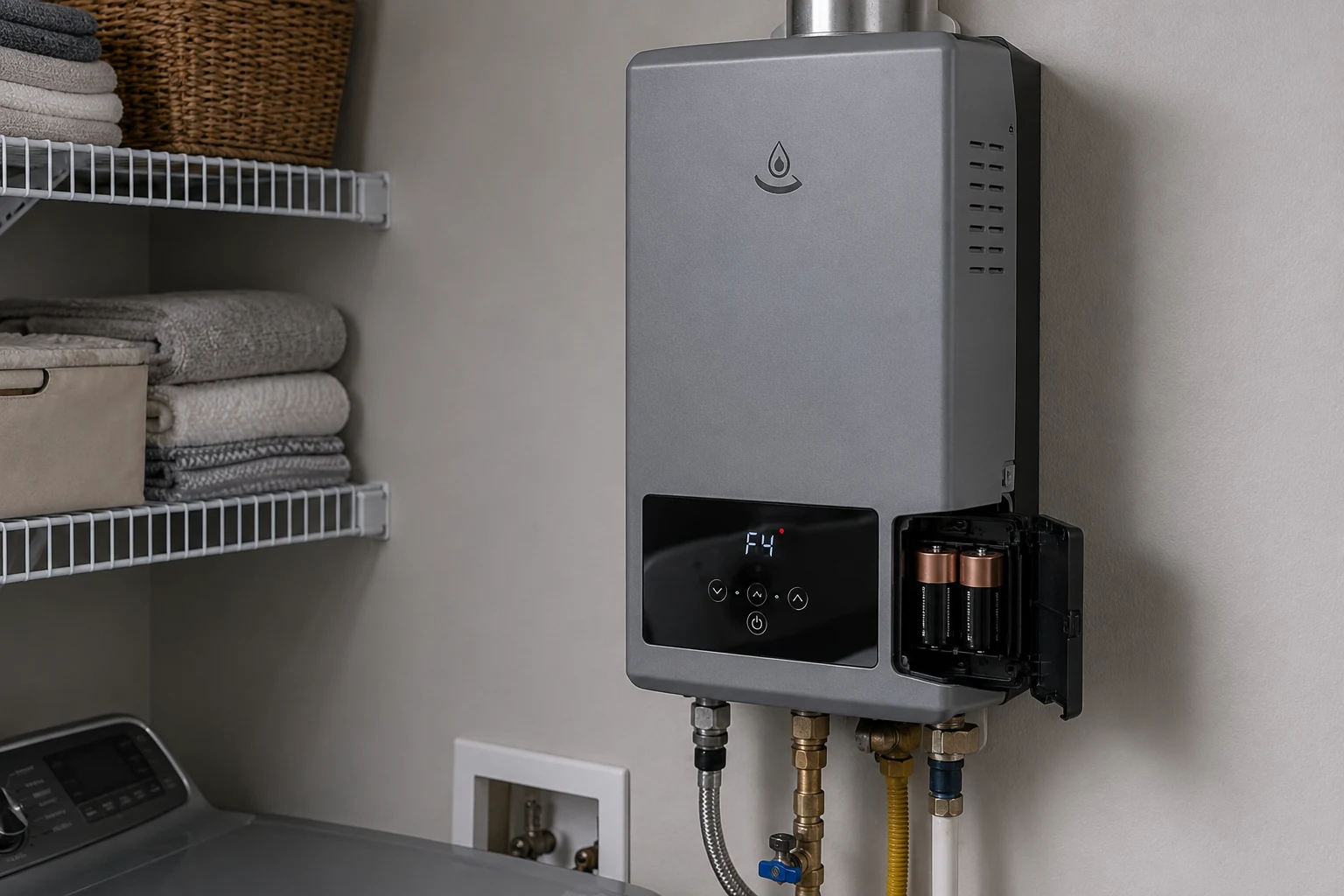
On a portable Eccotemp, replace the ignition batteries, two D-cells on many models, before you do anything else. A tired pair is the most common reason the unit throws a code and will not relight.
| E1 | Ignition failure. No gas, empty or low propane, closed valve, dead igniter batteries on portables, or water flow too low to trigger the burner. |
| E2 | Flame detected when no water is flowing. The unit sees a flame signal with no call for heat, so it locks out on the safe side. |
| E3 | Over-heating protection. Outlet water too hot, flow too low, or scale in the heat exchanger trapping heat. |
| E5 | Pressure switch fault. The pressure switch reads a fault the control board will not run through. |
| E7 | Solenoid valve fault. The gas solenoid valve is not responding as expected, often wiring, connection, or a failed coil. |
| Click, no light | On portables, a rapid igniter click with no light and no number usually means dead batteries or no gas, not a coded fault. |
Venting is not optional
Never run an outdoor portable Eccotemp indoors or in an unvented space. These units exhaust combustion gases, and a portable was built for open-air or properly vented use. An overheat or ignition code is a nuisance; carbon monoxide from running a portable in a closed room is not.
Reading the codes in the right order
Eccotemp built these codes as a safety readout, not a nag light. When the unit will not light or drops its flame, it shuts gas off and shows you a code rather than keep trying blindly. The trick is to work each code in the order that catches the cheap causes first, because the same symptom can come from a dead battery or a scaled heat exchanger, and you do not want to buy a part when a fresh pair of D-cells would have done it. Here is the sequence for the two codes you are most likely to see.
What each code is really telling you
E1 is an ignition failure, and it is the friendliest code on the list because its causes are cheap and quick. The unit tried to light and never confirmed a flame, so it stopped. On a portable, the order is batteries, then gas, then flow. Dead igniter batteries make a faint spark that will not catch. An empty or closed propane tank, or air still in a freshly connected line, gives the igniter nothing to light. And if water moves below about 0.5 gpm the burner never even triggers, so a plugged inlet screen or low pressure mimics an ignition fault exactly. Ninety percent of E1 calls die right there, at batteries, gas, or the inlet screen.
E2 is a false-flame-with-no-flow fault, which is a different animal from E1. The unit detects a flame signal when no water is flowing and there is no call for heat, which should never happen, so it locks out on the safe side. That points at the flame-sense side of the burner rather than gas supply. A flame-sense electrode can read a stray signal, a gas valve can fail to seat and leak a little flame past it, or wiring and grounding at the burner can feed the board a false reading. If you see E2 with the unit sitting idle and no water running, do not touch the igniter batteries. Look at the flame sensor, the gas valve, and the burner wiring.
E3 is the over-heating code, and some models carry E6 as a secondary over-heat protection. E3 means the outlet water or the heat exchanger climbed past the safe limit and the unit cut the burner. It traces to the same two causes most of the time. Low flow is first: a trickle of water through a firing burner overheats fast, so a half-open faucet, a clogged aerator, or a plugged inlet screen will do it. Scale is second: on hard water, mineral buildup coats the heat exchanger, traps heat against the metal, and drives temperature up even at normal flow. Prove flow, set a sane temperature, and descale on hard water before you decide the sensor is bad. E5 is a separate code, a pressure switch fault, not an overheat.
E7 is the solenoid valve fault, and it is the one where the DIY line sits closest to its edge. The gas solenoid valve, the electrically controlled valve that lets gas into the burner, is not responding the way the control board expects. Because a gas valve the unit cannot trust cannot be allowed to run, the unit locks out. On a well-used heater this often traces to a wiring or connection problem at the valve or a failed solenoid coil, and it is less of a plug-and-play fix than swapping batteries. If E7 returns after a clean reset, that is a fair point to call Eccotemp support with your model and serial in hand rather than throwing parts at it.
One thing worth knowing about the whole family: the exact numeric code can shift a little between the portable L-series and the indoor lines like the i12, 45HI, EL22, and 20HI. Some portables flash the igniter light instead of showing a clean number, so a pattern of blinks means the same thing a coded unit would display. That is why the rating label on your specific heater is the authority. If a generic chart online and the legend on your unit ever disagree, trust the unit in front of you. The causes behind each code stay consistent even when the display does not: ignition, a false flame, over-heating, the pressure switch, and the solenoid valve are the buckets Eccotemp codes fall into, and matching the symptom to the bucket matters more than memorizing which number your particular model uses.
Cold weather, propane, and the freeze problem
A code family that catches a lot of Eccotemp owners off guard is the cold-weather one. On liquid propane, the regulator can freeze or ice over in cold, windy conditions, which cuts pressure to the burner. That most often shows up as an E1, because the unit cannot light on starved gas. The fix is placement, not parts: keep the propane tank and its regulator out of freezing wind, and shelter a portable so gusts do not hit the exhaust. If the codes only appear on cold mornings and clear once things warm up, the regulator is the likely culprit.
Freezing is also a threat to the heater itself, separate from the codes. A portable left outdoors through a hard freeze can crack its heat exchanger when trapped water expands into ice, and that is a far worse and more expensive problem than any E-code. If a portable is not protected from a freeze, drain it. And the venting rule holds year-round: a portable exhausts combustion gases and belongs in open air or a properly vented setup, never running in a closed room to escape the cold. Trading a nuisance code for carbon monoxide is never worth it.
When to reset, and when to stop resetting
The reset on an Eccotemp is simple: turn it off and back on. On a portable, that is the power switch; on an indoor unit, the on/off button or a moment of cut power at the outlet or breaker. The point of a reset is to clear a one-time fault so the unit can try again, and it is worth doing exactly once, after you have addressed the obvious cause. On a portable that means replacing the igniter batteries, two D-cells on many portable models, so check yours, first, because resetting on a dead pair just repeats the code. A reset clears the display. It does not fix anything on its own.
Where you stop depends on the code. E1 and the overheat codes are homeowner territory: batteries, gas, flow, temperature, and a descale flush cover the large majority. E2, the false-flame-with-no-flow code, and E7, the solenoid valve fault, are the ones to escalate, because a flame-sense or gas-valve fault that survives a clean reset is a real electrode, wiring, or valve problem rather than a quick swap. Pull the full model and serial off the rating label before any parts call, since the flame sensor, control board, and gas-type parts are keyed to the exact model, and the code meanings shift a little between the portable L-series and the indoor lines. Match the code to its cause, work the cheap causes first, and reset only after you have earned it.
Batteries, then gas, then flow
On a portable, drop in fresh igniter batteries first, two D-cells on many models, so check yours. Then confirm the propane tank is full and open. Then clean the cold inlet screen and prove you have at least 0.5 gpm of flow.
Check the flame sensor and gas valve
The unit sees a flame with no water running, so ignore the igniter batteries. Check the flame-sense electrode, a gas valve that is not seating, and burner wiring or grounding.
Prove flow, then descale
Open the hot side fully, back off a high outlet temperature, and clean aerators. If your water is hard and you have never descaled, run a vinegar flush before you suspect the sensor.
Escalate after one reset
Reset once. If E7 comes back, it is a wiring, connection, or coil fault at the gas solenoid valve, not a quick swap. Call Eccotemp support with your model and serial rather than guessing.
Frequently asked
What does E1 mean on an Eccotemp tankless water heater?
E1 is an ignition failure: the unit tried to light the burner and never saw a flame, so it shut down on the safe side. The usual causes stack from easiest to hardest. On a portable L5, L7, or L10 the first suspect is dead ignition batteries, because those units spark the igniter off battery power, two D-cells on many portable models, so check yours, and a weak pair makes a faint click with no light. Next is gas: an empty or low propane tank, a closed cylinder valve, or a supply line that has not been purged of air. Then flow: if water moves through the unit below about 0.5 to 0.65 gpm the heater never triggers, so a clogged inlet screen or low house pressure looks exactly like an ignition fault. Work them in that order. Fresh batteries, a full and open tank, then a clean inlet screen clears the large majority of E1 calls before you ever suspect the control board.
What is the difference between E1 and E2 on an Eccotemp?
They are different faults, not two stages of the same one. E1 is a failure to light at the start, so the burner never establishes a flame in the first place. E2 is a false-flame-with-no-flow condition: the unit detects a flame signal when no water is flowing, which should not happen, so it locks out on the safe side. That distinction points at different causes. E1 sends you to gas supply, igniter batteries, and activation flow. E2 sends you to the flame-sense side: a flame-sense electrode reading a signal with no call for heat, a gas valve that is not seating, or wiring and grounding at the burner. If you see E2 with the unit idle and no water running, do not chase the igniter batteries. The unit is complaining about a flame it should not be seeing.
How do I reset an Eccotemp tankless water heater?
Turn the unit off and back on. On a portable, flip the power switch off, wait a few seconds, and turn it back on; on an indoor model, use the on/off button or cut power at the outlet or breaker for a moment. That clears a one-time fault so the unit can try again. Before you reset a portable, replace the ignition batteries, two D-cells on many portable models, so check yours, because a tired pair is the single most common reason an Eccotemp throws a code and will not relight, and a reset without fresh batteries just repeats the fault. A reset clears the readout. It does not fix a cause. If the same code comes right back after a clean reset with good batteries and a full gas tank, the fault is real and you need to work the cause behind that specific code.
Why does my Eccotemp keep shutting off with an overheat code?
The overheat code on most Eccotemp models is E3, the over-heating protection, and some units also carry E6 as a secondary over-heat code. It means the water or the heat exchanger climbed past the safe limit and the unit cut the burner. Low flow is the most common trigger: when only a trickle of water moves through a firing burner, that water overheats fast, so a half-open faucet, a clogged aerator, or a plugged inlet screen can all cause it. Scale is the other big one. On hard water, mineral scale coats the inside of the heat exchanger, traps heat against the metal, and drives the temperature up even at normal flow. If your water is hard and you have never descaled the unit, an annual vinegar flush usually clears a recurring overheat code. Set a sane outlet temperature, open the hot side fully to prove flow, and descale on hard water before you suspect the sensor.
What does E7 mean on an Eccotemp?
E7 is a solenoid valve fault: the gas solenoid valve, the electrically controlled valve that lets gas into the burner, is not responding the way the control board expects. The heater treats that as a safety problem because a gas valve it cannot trust cannot be allowed to run, so it locks out rather than risk feeding gas it cannot shut off. On a well-used unit this often traces to a wiring or connection problem at the valve, or a failed solenoid coil. It is less common than the ignition and overheat codes and less of a simple homeowner fix, so if E7 returns after a clean reset, it is a reasonable point to contact Eccotemp support with your model and serial rather than guessing at parts.
Can cold weather cause Eccotemp error codes?
Yes, and it is a cause people miss. On propane, the LP regulator can freeze or ice over in cold, windy weather, which cuts gas pressure to the burner. That most often shows up as an E1 at startup, because the unit cannot light on starved gas. Keep the propane tank and regulator out of freezing wind, and on a portable, shelter the unit from gusts that hit the exhaust. Freezing also threatens the heater itself: a portable left out in a hard freeze can crack the heat exchanger from ice, which is a far worse problem than a code. Drain a portable before a freeze if it is not protected.
My Eccotemp igniter just clicks and will not light, no code. What is wrong?
A rapid click with no ignition light and no numeric code almost always means one of two things on a portable: dead ignition batteries or no gas reaching the burner. The click is the igniter trying to spark. If the batteries are weak the spark is too faint to light, and if gas is off, empty, or the line still has air in it, there is nothing to catch. Swap in fresh ignition batteries first, two D-cells on many portable models, so check yours, then confirm the propane tank is full and its valve is fully open, then purge air by opening the hot tap and letting water and gas demand settle for a few seconds. Those three checks resolve the clicking no-light on the large majority of portable L-series units.
Where do I find the model and serial number on an Eccotemp?
On the rating label on the unit, usually on the side or back of the cabinet on indoor models and on the back panel of a portable. It lists the full model designation, for example L10, i12, 45HI, or EL22, along with the serial number and the gas type the unit is set for, natural gas or liquid propane. Write down both the full model and the full serial before you call Eccotemp support or order a part, because the flame sensor, control board, and gas type conversion parts are keyed to the exact model, and the code meanings can shift slightly between the portable L-series and the indoor lines.