A ten-minute shower at 2 gallons a minute sends 20 gallons of 100-plus-degree water straight into the drain, and almost all the energy you paid to heat it goes with it. That water is still hot when it hits the trap. Drain water heat recovery grabs a chunk of that heat back before it leaves the house, and it does it with a piece of copper pipe and no electricity at all.
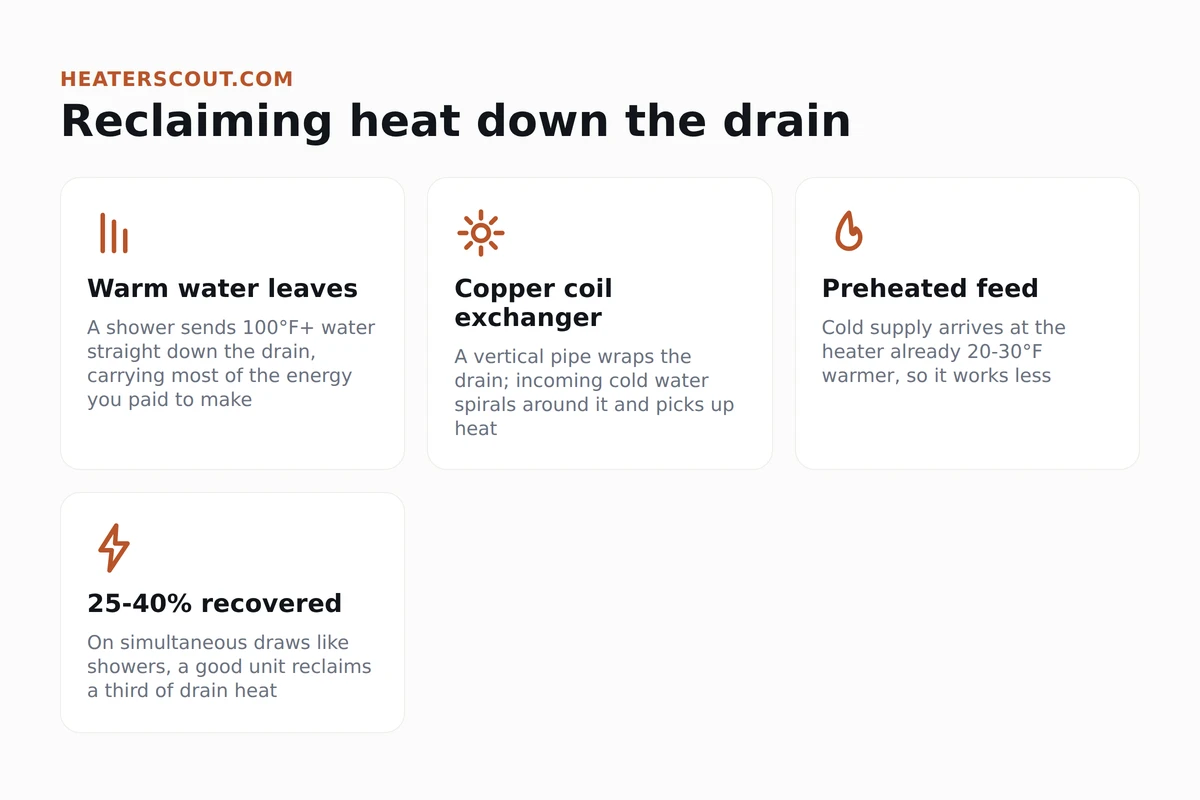
The heat you flush is not gone until it leaves the building. A drain water heat recovery unit is a bet that you can catch a third of it on the way out with a coil of copper and gravity.
Why showers are the whole game
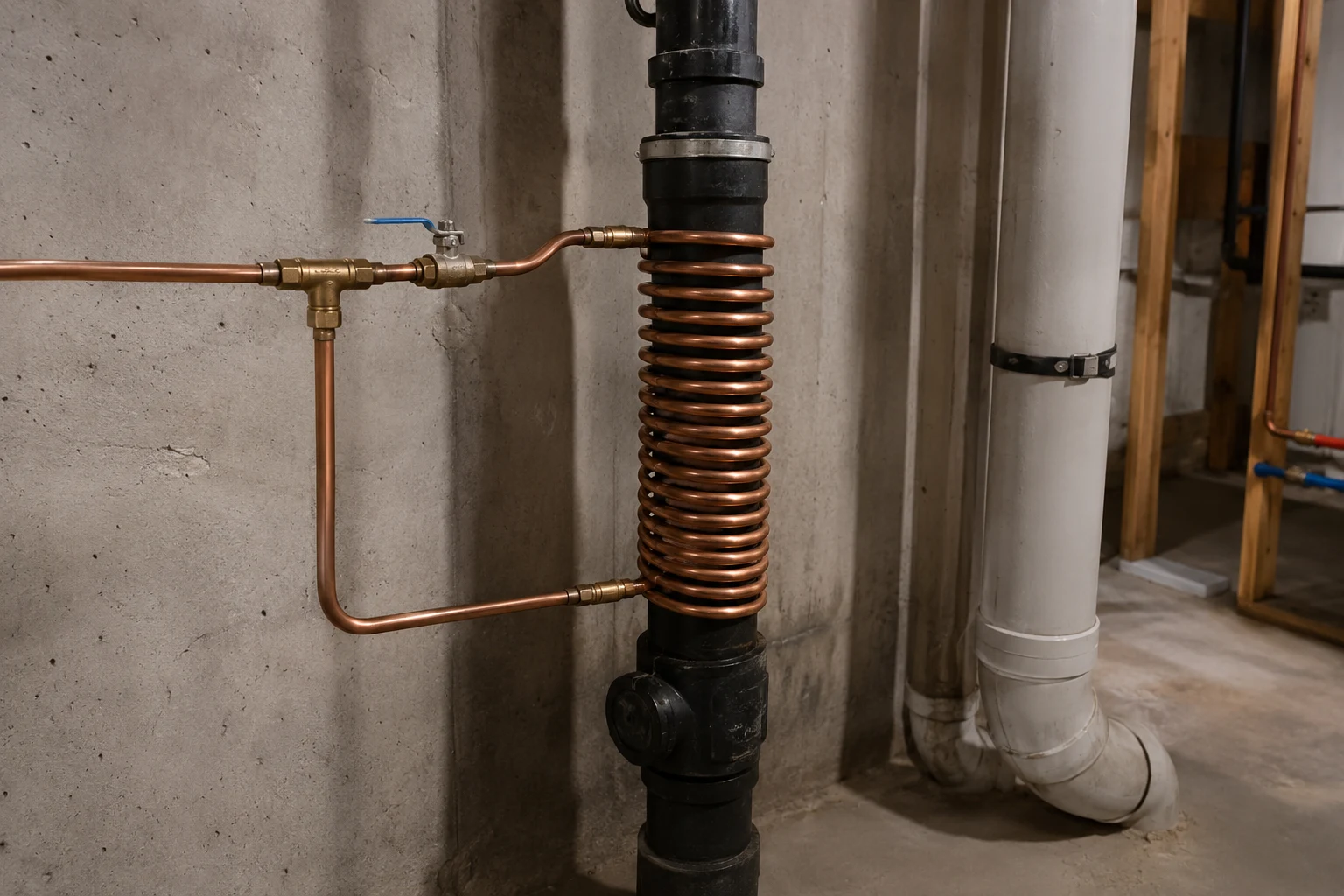
The mechanism only works on simultaneous flow, and that single constraint decides everything about where these units pay off. A gravity-film heat exchanger, often called a GFX, is a vertical section of copper drain pipe with copper supply tubing wound tightly around the outside. Warm water leaving a fixture does not fill the drain, it clings to the inside wall in a thin film and slides down by gravity. That film is where the heat lives, and it is in contact with the pipe wall the entire way down. Cold supply water runs up through the coiled tubing on the outside, and heat crosses the copper from the warm film to the cold feed in real time.
Real time is the catch. The transfer only happens while both streams move at once. A shower is the perfect case: the drain runs hot the whole time the cold supply is being pulled for the mix, so warm-out and cold-in overlap for the full length of the shower. A bathtub is the opposite. You fill it while cold flows, then you sit, then you pull the plug and drain 40 gallons of warm water with no cold supply running to catch it. Dishwashers and clothes washers fill first and drain later, so they miss the overlap too. This is not a small-print limitation, it is the reason the entire product is marketed at showers and why a household's shower habits drive the payback more than anything else.
What actually happens, step by step
Strip away the marketing and a DWHR unit is four things happening in sequence, every one of them passive.
Warm water leaves the fixture
A shower drains 100-plus-degree water. Instead of racing down an empty pipe, it forms a thin film on the inside wall of the copper drain section and descends by gravity, staying in contact with the pipe the whole way.
Cold supply spirals up the outside
Incoming municipal or well water, often 45 to 60 degrees, is routed through the copper tubing coiled around the drain before it goes anywhere else. It runs upward, against the downward drain flow, which is counterflow and squeezes out the most heat.
Heat crosses the copper wall
Copper is an excellent conductor, so heat moves from the warm film through the pipe wall into the cold feed continuously while the shower runs. No pump, no fan, no thermostat is involved.
Preheated water feeds the heater and the valve
The cold feed leaves the coil 20 to 30 degrees warmer. Sent to the water heater it cuts the burner or element runtime; sent to the shower's cold side too, it lets you draw less hot water for the same temperature.
The numbers behind a third off the drain
Effectiveness on these units runs 25 to 40 percent on a typical shower, with the better dual-feed installs at the top of that range. Effectiveness here means the fraction of the available temperature difference the exchanger captures, not a fuzzy efficiency claim. Put concrete numbers on it and the case gets clear fast.
Gravity-film heat exchanger (GFX)
A passive drain water heat recovery device: a vertical copper drain section wrapped in copper supply tubing. Outgoing warm water forms a film on the inner wall, incoming cold water flows counter to it through the coil, and heat crosses the copper wall while both streams run. It has no moving parts, no power, and no controls, which is why it lasts as long as the copper does and needs no maintenance.
Run your own savings
The recoverable heat per gallon is simple physics: recovered = flow times delta-T times 8.33 times effectiveness. The 8.33 is the weight of a gallon of water in pounds, so 8.33 BTU raises one gallon one degree. Take the drain temperature at the exchanger, about 95 degrees by the time water reaches it, subtract your incoming cold temperature, multiply by the exchanger's effectiveness, and you have the BTU each gallon gives back. Multiply by your daily shower gallons, then by 365, and divide by 3412 to turn annual BTU into electric-equivalent kWh. Set the sliders to your household and watch the payback move against a typical $500 to $900 installed price.
Drain water heat recovery savings calculator
Enter your household's daily shower use and water conditions. Output is annual energy and dollars recovered on an electric heater, plus payback against a $500-900 install. Drain temperature at the exchanger is fixed near 95°F. Estimate only; real results vary with plumbing and habits.
Annual energy recovered
0 kWh
Electric-equivalent; gas differs
Annual dollars saved
$0
At your energy rate
Simple payback
--
Against a $500-900 install
—
One thing the calculator makes obvious: shower minutes swing the answer harder than any other input. A single-person condo with a short daily shower may never pay one back, while a family of four running the shower most of the morning can land under a seven-year payback and then bank savings for another decade. The unit does not care how many people live in the house, only how many gallons pass through it warm.
Where it fits, and where it does not
The install decides feasibility. A DWHR unit has to sit vertically, below the shower it serves, on an accessible drain stack, usually in a basement or a first-floor drop below a second-floor bath. A house on a slab with the shower draining horizontally has nowhere to put one without major work, which rules out a big share of single-story homes. Where there is a vertical stack, the job is a plumber cutting in the copper section and soldering the supply connections in the right direction for counterflow. Get the feed direction backward and you lose most of the recovery.
Because it is cutting into both drain and supply, this is a call-a-pro job for most people, and a bad solder joint leaks one or the other. The upside is that once it is in, there is nothing to service, nothing to power, and nothing to fail for 20 years or more. In parts of the country with cold incoming water and high electric rates, that combination of a big temperature difference and expensive energy is exactly where the payback gets short.
Frequently asked
Does a drain water heat recovery unit really cut my water heating bill?
On showers, yes, and the savings are measurable rather than marketing. A good gravity-film unit recovers 25 to 40 percent of the heat leaving in shower drain water, which shows up as cold supply arriving 20 to 30 degrees warmer than it would otherwise. In a high-shower household that lands around 200 to 500 kWh a year on an electric heater. Where it does nothing is bath fills, dishwashers, and clothes washers, because those drain after the fill, not during it. The whole mechanism depends on drain and supply running at the same moment.
Why does a DWHR unit only work while water is running?
The exchanger has no storage. It transfers heat from the warm film sliding down the inside of the drain to the cold water spiraling through the copper wrapped around it, and that transfer only happens while both streams are moving. Run a shower and cold supply and hot drain flow together, so heat crosses in real time. Fill a tub, then pull the plug, and by the time the warm water drains the cold feed has already stopped. That is why plumbers call these simultaneous-flow devices, and why shower-heavy homes are the target.
Where does the preheated water go, to the heater or the shower?
You can plumb it two ways. Feeding the preheated water only to the water heater lowers how hard the heater works but does not change the mixing ratio at the valve. Feeding it to both the heater cold port and the shower's cold side, the more common residential setup, raises the temperature of the cold water at the valve too, so you draw less hot water for the same shower feel. The dual-feed arrangement usually recovers the most on a single shower, which is why most residential installs use it.
How long does a drain water heat recovery unit last?
There are no moving parts, no controls, and no maintenance items. It is a copper drain section with copper tubing soldered around it, so the service life tracks the copper itself, generally 20 years and often much longer. Nothing wears because nothing moves. The only real failure mode is a solder or pipe leak, the same risk as any copper plumbing, which is why the install is a plumbing job rather than an appliance swap. Budget for the unit to outlast the water heater it feeds by decades.
Can I install a DWHR unit myself?
It is a plumbing job, not a plug-in appliance, so most people call a pro. The unit is a vertical section of drain, which means it has to sit below a shower on a vertical stack, and installing it involves cutting into the drain, soldering copper supply connections, and getting the feed direction right so cold flows against the drain flow for counterflow efficiency. A confident DIY plumber can do it, but a mistake leaks either drain water or supply water. On a slab house with no accessible vertical drain below the shower, retrofitting may not be practical at all.
Does drain water heat recovery count toward energy codes or credits?
In several jurisdictions, yes. DWHR is recognized as a water-heating efficiency measure and can earn points in performance-based energy codes and some green-building rating systems, and it has qualified for utility or efficiency rebates in various programs. Rules change by state and year, so check your local energy code and utility before you count on a specific credit. Even without a credit, a unit that recovers a third of shower drain heat for two decades with no maintenance stands on its own economics in a high-shower home.
Does the unit reduce my shower pressure or flow?
No. The copper supply tubing wrapped around the drain is a smooth continuous path with a large enough bore that pressure drop is negligible at shower flow rates. You are not forcing water through a restriction, you are running it through a longer coiled pipe that happens to be warm. Drain side is even less of a concern, since the warm water still falls through the center of the pipe by gravity exactly as it did before. Flow and pressure at the showerhead stay what they were.