Quick answer
You need a thermal expansion tank if your home is a closed system — that is, if the cold water feeding the heater passes through a pressure-reducing valve, a check valve, or a backflow preventer on the main. Those one-way devices trap the extra volume created when water is heated, so pressure climbs with nowhere to go. On a closed system the plumbing code (IPC 607.3, UPC 608.3, and most municipal codes) requires an expansion-control device. If your supply is open straight to the city main, expansion vents backward and no tank is required.
Where house pressure sits and where code steps in
Each heating cycle on a closed system drives static pressure up. Past the code ceiling it climbs toward the T&P valve’s relief point, which is why the exit has to go somewhere.
Code draws the line at 80 psi. Above it, a closed system with no expansion tank can push the T&P valve toward its 150 psi relief point.
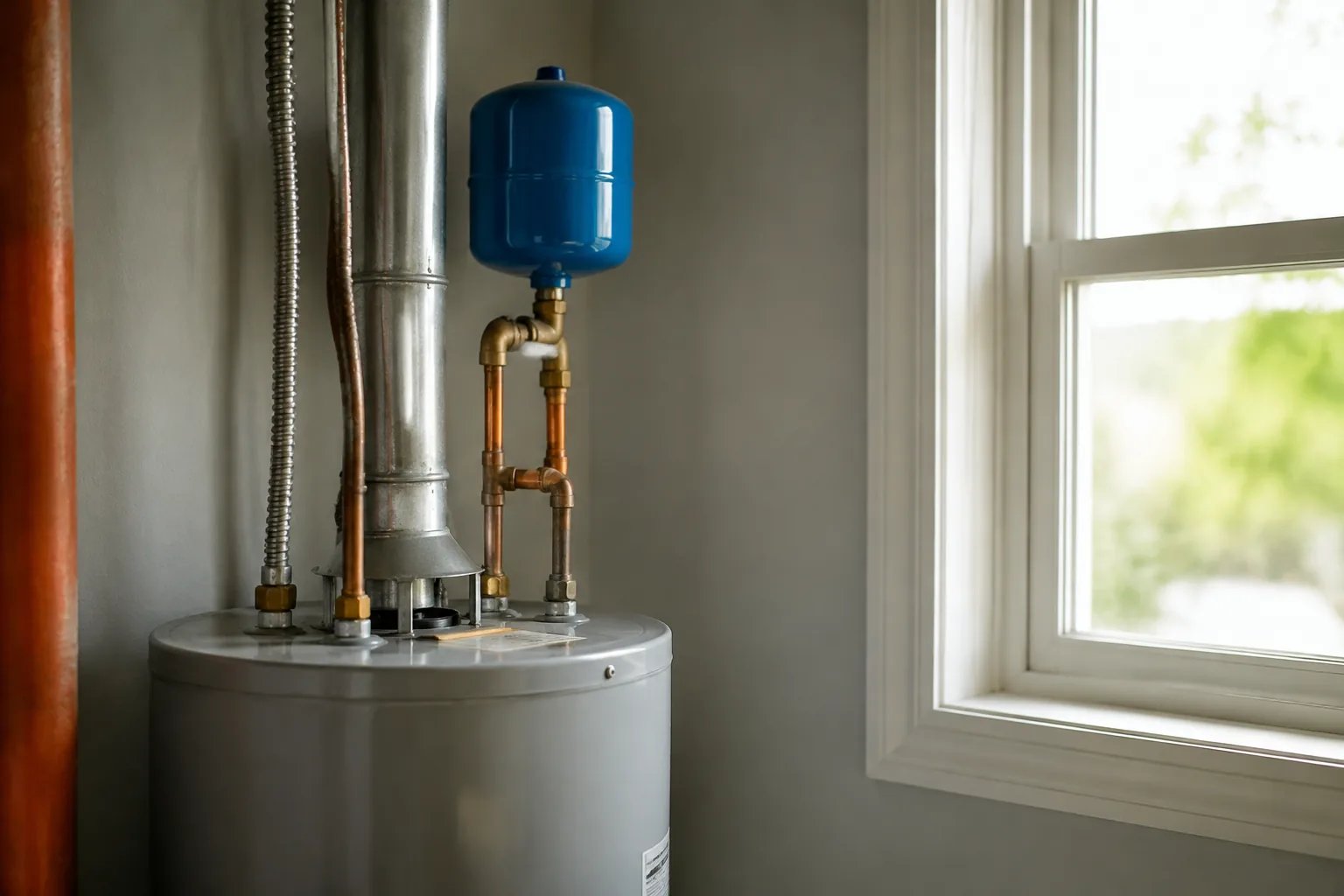
Water expands about 2 percent when you heat it from 50°F to 120°F. In a 50-gallon heater that is roughly a gallon of extra volume with nowhere obvious to put it. Whether that matters in your house comes down to one thing: can that gallon push back out to the street, or is a valve blocking its exit?
What "closed system" actually means
An open system lets water move both directions between your house and the municipal main. When the heater fires and the water swells, the extra volume simply pushes back up the supply pipe into the street, and pressure barely moves. A closed system blocks that path. Somewhere on your main sits a one-way device — a pressure-reducing valve, a check valve, or a backflow preventer — and each of those allows water in but not back out. Utilities increasingly install check valves or backflow preventers at the meter, so many homes became closed systems without the owner ever knowing. Once the exit is sealed, every heating cycle raises static pressure inside the plumbing, sometimes by dozens of psi in a matter of minutes.
Run your numbers
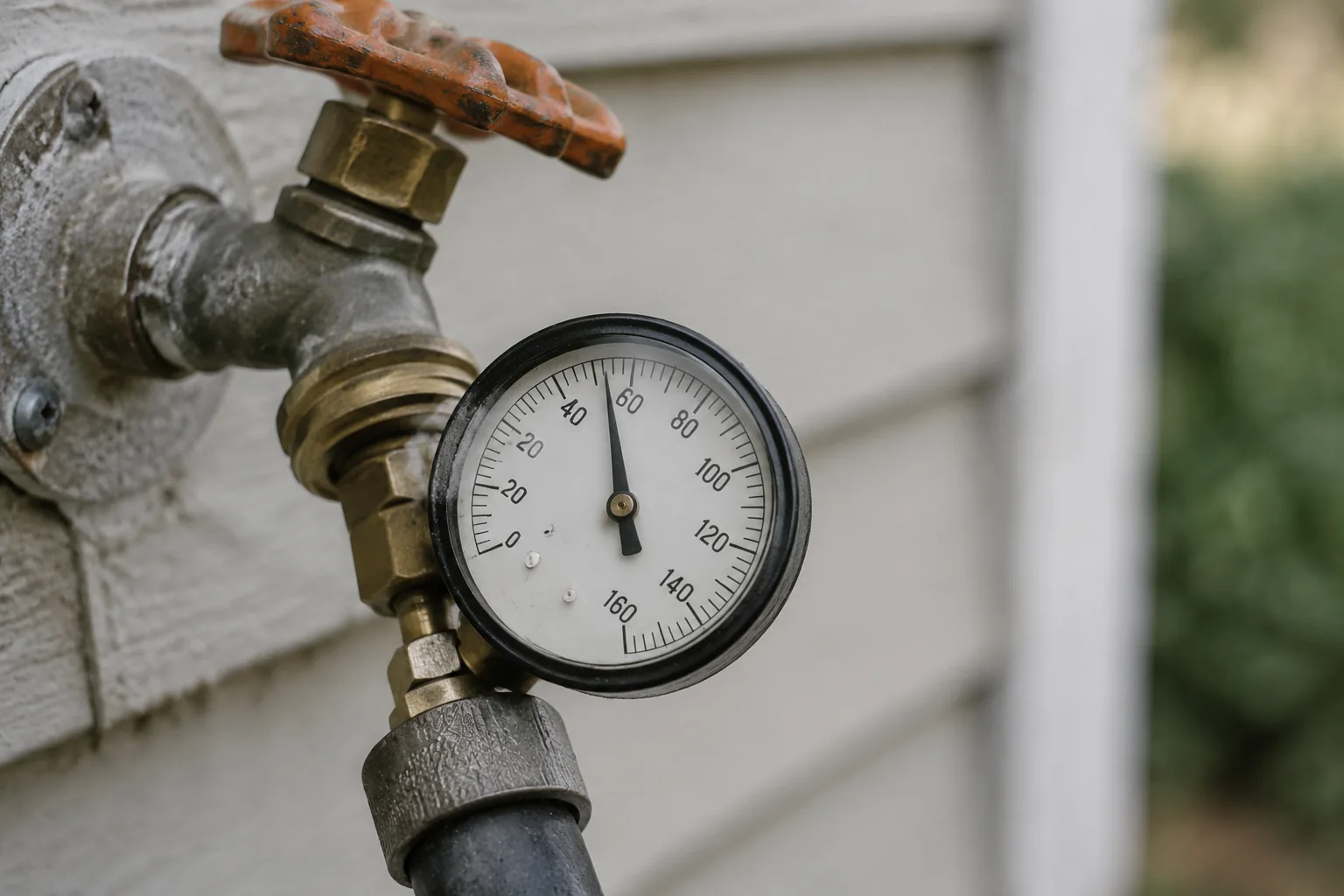
Set the slider to your incoming water pressure — read it off a $10 gauge screwed onto a hose bibb — and flag whether the main has a one-way device. The tool returns a two-part verdict: whether an expansion tank is required, and whether your pressure itself demands a PRV.
Pressure and system verdict
Two inputs, two answers: expansion-tank need and PRV need. Not legal advice — your local inspector has final say.
Expansion tank
—
Pressure-reducing valve
—
The symptoms of missing expansion control
When a closed system has no place to absorb thermal expansion, the pressure has to go somewhere, and it shows up in ways that look like unrelated problems. The classic tell is a temperature and pressure relief valve at the top of the heater that weeps or spits every so often, usually after a hot-water draw when the burner or element kicks back on. People replace the T&P valve, the dripping stops for a week, then it starts again — because the valve was doing its job, dumping pressure the system had no other way to shed. Running toilets are another quiet symptom: a spike drives water past the fill valve, so the tank keeps topping off. You may also hear the pipes bang or knock as pressure surges, and over months the strain shortens the life of faucet cartridges, supply hoses, and the heater itself.
Where the pressure needs to sit
House pressure has a healthy band, and it matters both for comfort and for what the code asks of you. Below about 40 psi, showers feel weak and appliances fill slowly. Above 80 psi, the code draws a hard line: a pressure-reducing valve becomes required, because the odds of blown supply lines, split washer hoses, and hammered fixtures climb fast past that point. Most fixtures are only rated to 80 psi. Here is the catch that ties the whole topic together: installing that PRV to tame high pressure is exactly what turns your home into a closed system. So a house that needed a PRV for pressure almost always needs an expansion tank at the same time. Fix one, inherit the other.
How to size the tank
Sizing is not guesswork, but it is forgiving at the residential scale. The rule of thumb is roughly one gallon of tank acceptance for every ten gallons of heater capacity, then adjusted for your static pressure and how hot you run the heater. A 40 or 50-gallon heater at typical settings is well served by a standard small expansion tank; a large or higher-temperature setup steps up a size. The real variable is pressure: the higher your static pressure, the less room the tank has to absorb expansion, so higher-pressure homes lean toward the larger tank. Manufacturers publish a sizing chart against heater gallons and supply pressure, and the code (IPC 607.3.1) simply says size it so system pressure never exceeds the limit in the pressure section. If you are between sizes, go up. An oversized expansion tank costs a few dollars more and never causes a problem; an undersized one lets the T&P valve weep, which is the exact failure you were trying to prevent.
Why the pre-charge has to match your pressure
This is the single most common installation mistake, and it quietly defeats an otherwise correct tank. An expansion tank has an air-filled side sealed behind a rubber diaphragm, and that air is pre-charged at the factory, often to 40 psi. The diaphragm only starts to accept water once system pressure rises above the air pre-charge. So if your house runs at 70 psi and the tank is still sitting at its factory 40 psi, the diaphragm is already fully compressed at rest, leaving essentially zero absorption capacity — the tank is there, but it does nothing, and the T&P valve keeps dripping as though no tank were installed at all. The fix is to set the air pre-charge to match your static water pressure before you plumb it in. Bleed the system pressure off, put a standard tire gauge on the Schrader valve at the top of the tank, and add or release air with a bike pump until it reads your house pressure — 60 psi house, 60 psi pre-charge. Check it with the water side depressurized, because a pressurized system will give you a false reading. Get that one number right and the tank does its job for years.
What to do next
Screw a pressure gauge onto an outside hose bibb and read your static pressure, then walk the main from the meter inward and look for a bell-shaped PRV, a backflow assembly, or a check valve. Two facts — your psi and whether a one-way device is in the line — decide everything the code cares about here, and the tool above turns those two facts into a clear verdict you can act on.
Frequently asked
How do I know if I have a closed plumbing system?
Walk the main water line from where it enters the house or the meter and look for a one-way device: a bell-shaped pressure-reducing valve, a backflow preventer assembly, or a check valve. Any of those makes it a closed system. Many utilities now install a check valve or backflow preventer at the meter, so if you are not sure, ask your water provider whether one is present at the meter.
Is an expansion tank required by code?
Yes, whenever you have a closed system. Both the International Plumbing Code (Section 607.3) and the Uniform Plumbing Code (Section 608.3) require a thermal expansion control device on a storage water heater fed through a check valve, pressure-reducing valve, or backflow preventer. If your supply is open to the municipal main with no such device, an expansion tank is not required by code.
What happens if I do not install an expansion tank on a closed system?
Pressure from each heating cycle has nowhere to go, so it builds. The most common results are a temperature and pressure relief valve that weeps or discharges, toilets that run on their own, banging pipes, and premature wear on faucet cartridges, supply hoses, and the water heater. People often chase these as separate problems when the root cause is trapped thermal expansion.
What pressure should I pre-charge the expansion tank to?
Match it to your static water pressure. If the house runs at 60 psi, set the tank air pre-charge to 60 psi. Bleed off system pressure first, then check the Schrader valve on the tank with a tire gauge and add or release air until it matches. A factory pre-charge of 40 psi on a 60 or 70 psi house leaves the diaphragm fully compressed and the tank useless, which is why the T&P valve keeps dripping.
When do I need a pressure-reducing valve?
When your incoming static pressure is above 80 psi. The code treats 80 psi as the ceiling, and above it a pressure-reducing valve is required to bring the house down to a safe 50 to 60 psi. Keep in mind that adding a PRV creates a closed system, so a home that needs a PRV for high pressure almost always needs an expansion tank installed at the same time.
What size expansion tank do I need for a 50-gallon water heater?
A standard small residential expansion tank covers a typical 40 or 50-gallon heater at normal settings. The rough guide is about one gallon of tank acceptance per ten gallons of heater capacity, adjusted up for higher static pressure or hotter temperature settings. If you are between sizes, go larger. An oversized tank never causes trouble, while an undersized one lets the relief valve weep, which is the very failure you are trying to avoid.