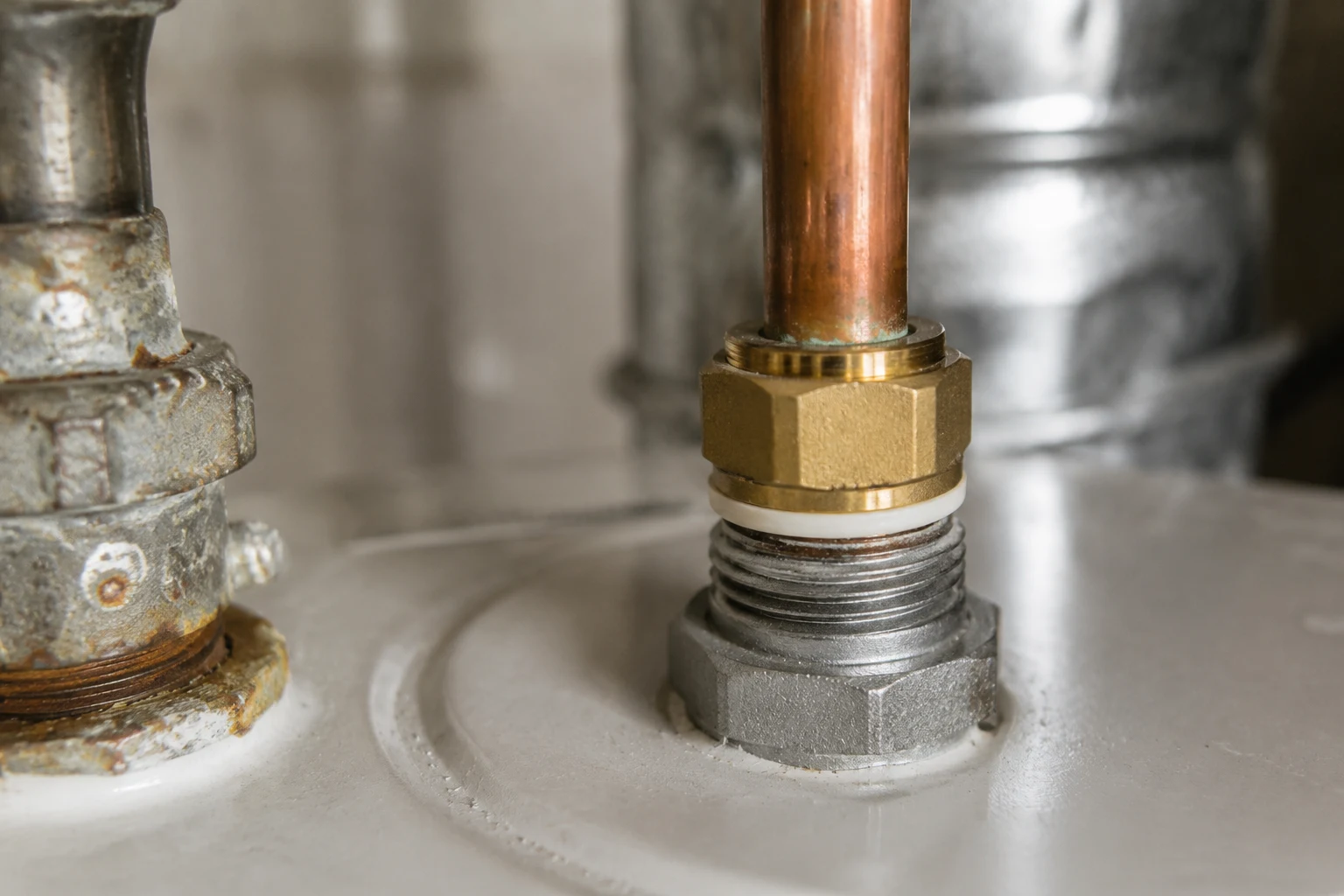
Copper pipe threaded straight onto a steel water heater nipple sets up a tiny battery. The two metals sitting in the same water form a galvanic cell, current flows across the junction, and the less noble metal, the steel, gives up ions and rusts from the threads outward. A dielectric fitting is supposed to break that circuit. The catch is that the most common one, the bolt-on dielectric union, has a habit of clogging and corroding on the inside, which is why a lot of plumbers now reach for brass instead.
What you are looking at when the connection goes bad
Galvanic corrosion at a water heater is quiet for years, then it announces itself as a stain, a green crust, or a drip that looks like the tank is dying. Before you condemn the heater, read the fitting. These are the three things you see at a copper-to-steel junction that has been running long enough to react.
Green or white crust at the joint
Green copper oxide and chalky white deposit right where the copper meets the steel is the signature of a galvanic cell that has been running. The copper stays intact and the steel nipple corrodes, so you get green bloom on the copper side and orange-brown rust scale on the steel threads. It builds slowly and often hides under the pipe insulation, so peel the insulation back at the hot and cold connections and look at the actual threads, not just the pipe.
Weak or dropping hot-water flow
An older dielectric union has a plastic-lined throat that is narrower than the pipe around it. Scale from hard water and rust flakes shed by the corroding steel collect on that plastic ledge and slowly bridge across it. Over five to ten years the ring closes down and hot flow at the tap weakens, sometimes only on the hot side because that is where the union sits. If cold pressure is fine and hot has faded, suspect a clogged union or nipple before you blame the tank.
A weep at the top-of-tank threads
When the steel nipple finally rusts through at the threads, it weeps. The water runs down the outside of the shell and pools at the base, which fools people into thinking the tank shell has failed. Trace it uphill: if the highest wet point is a threaded fitting at the top of the tank, the nipple or union is the leak and the tank may still be sound. If the water starts under the jacket at the bottom with dry fittings above, that is a tank leak and no fitting will fix it.
Two of those three symptoms, the flow choke and the internal rust, come from the very fitting that was installed to prevent corrosion. That is the irony at the center of this topic, and it is worth defining the terms before going further.
Dielectric union
A two-part threaded fitting with an insulating plastic or rubber sleeve and washer clamped between the halves. The insulator keeps the copper side from touching the steel side so no galvanic current can cross the joint. It works electrically, but the same sleeve narrows the bore and gives scale a ledge to build on, so the union is prone to clogging and to internal rust once the insulator degrades or the circuit finds another metal path around it.
Galvanic corrosion
The electrochemical wear that happens when two dissimilar metals, here copper piping and a steel tank nipple, share an electrolyte, which is your potable water. The metals sit at different points on the galvanic series, so a small voltage drives current across the junction. The more active metal, steel, corrodes preferentially and the copper is protected. Break the metal-to-metal contact or put a middle metal like brass between them and the corrosion slows dramatically.

Dielectric union versus a brass fitting
Both approaches solve the same problem, keeping the galvanic cell from eating the steel nipple, but they get there differently and they age differently. The union insulates; the brass demotes the voltage. Here is how they compare in the ways that matter after the first few years.
Dielectric union
- Insulates copper from steel with a plastic or rubber sleeve, so no galvanic current crosses the joint while the insulator is intact.
- Listed fitting that inspectors recognize, which is why it was the cheap code-friendly default for decades.
- Narrow plastic-lined throat restricts flow and gives scale a ledge to bridge, so it clogs over five to ten years.
- Fails quietly: the insulator degrades or a ground path bypasses it, and the steel side rusts behind a fitting that was meant to stop rust.
Brass nipple or adapter
- Brass sits between copper and steel on the galvanic series, so the voltage at each junction drops and corrosion slows to a crawl.
- Full-diameter bore with no plastic ledge, so it does not restrict hot flow or trap scale the way a union does.
- One solid metal fitting with no gasket to degrade, which means fewer parts to fail years down the line.
- May not satisfy a code that names a dielectric union specifically, even though it performs as well or better in practice.
The tank itself has already done part of this work. Open the box on a current Rheem or A.O. Smith heater and the hot and cold ports usually carry heat-trap nipples that are plastic-lined, often blue, with a little plastic ball inside to stop convection. That lining is a dielectric barrier the full length of the nipple, so copper threaded onto the top of a lined nipple never touches steel. The metals are already separated before you add anything, and a second bolt-on union just gives you one more thing to clog.
Confirm what your inspector wants first
Before you buy any fitting, check what your local jurisdiction accepts. The model codes address joining dissimilar metals and expect corrosion protection where copper meets ferrous pipe, but local amendments vary. Some inspectors want a listed dielectric union, some accept a brass nipple or a lined heat-trap nipple as adequate separation, and the wording has shifted across IPC and UPC editions. Ask your building department or a licensed plumber what passes in your area, because the same fitting can pass in one county and get red-tagged in the next.
The fitting options, side by side
There is no single right answer, because part of the decision is your local code and part is how the tank is already built. This table lays out the common ways to make the copper-to-steel connection, what each does well, and where each falls down.
| Option | How it separates the metals | Flow and scaling | Watch out for |
|---|---|---|---|
| Dielectric union | Plastic or rubber insulator between two threaded halves blocks the galvanic circuit. | Narrow lined throat restricts flow and collects scale on the ledge. | Clogs and rusts internally over 5 to 10 years; insulator can be bypassed by a ground path. |
| Dielectric heat-trap nipple | Plastic lining runs the full nipple bore, so copper never touches the steel tank. | Full bore, no ledge; the heat-trap ball is the only slight restriction. | Usually already installed on modern tanks, so a second fitting is redundant. |
| Brass nipple or adapter | Brass sits mid-scale between copper and steel, cutting the galvanic voltage. | Full diameter, no plastic ledge, drains and flows freely. | May not satisfy a code that names a dielectric fitting by type. |
| Brass or copper flex connector | Paired with a brass nipple, gives a middle metal and an easy final tie-in. | Corrugated bore is slightly restrictive but does not trap scale. | Confirm the connector nut lands on brass, not bare steel, or you are back to a galvanic joint. |
| Bare steel nipple to copper | Nothing. Copper meets steel directly. | Full bore until the steel rusts and scale sheds into the line. | The failure case: fast galvanic corrosion of the steel nipple. Do not do this. |
Read the table from the bottom up and the logic is clear. The worst case is nothing between copper and steel, and the union sits only slightly above it because its cure comes with a slow clog. The lined nipple and the brass fitting are the two that hold up, and on most modern tanks the lined nipple is already there. That is why a working plumber will often thread a brass nipple into the port, run brass or copper flex up to the house line, and skip the union entirely, unless the local code forces the union back in.
What this means when you replace a heater or fix a leak
If you are swapping a water heater, look at the nipples that come on the new tank before you buy any extra fittings. A lined heat-trap nipple already gives you dielectric separation, and adding a union on top of it just plants a future clog. If you are chasing a leak on an older install, cut the union out and look inside it before you assume the tank failed; a rust-ringed plastic throat and a corroded steel half tell you the fitting failed, not the shell. Replace it with a brass nipple where code allows, and the next connection will outlast the tank.
Frequently asked
What is a dielectric union on a water heater, and do I actually need one?
A dielectric union is a two-part threaded fitting with a plastic or rubber insulating sleeve and washer sandwiched between the halves. Its job is to keep the copper house piping from touching the steel tank connection, which stops the two metals from forming a galvanic cell in the water. Whether you need one depends on your local code and how the rest of the connection is built. If the tank already ships with dielectric-lined heat-trap nipples, and most Rheem and A.O. Smith tanks do, the metals are already separated inside the nipple and a separate union is often redundant. Many plumbers skip the union and use a brass nipple instead, because brass sits between copper and steel on the galvanic scale and corrodes far more slowly than bare steel. Some amended plumbing codes still call for dielectric separation at the water heater, so check your jurisdiction.
Why do dielectric unions corrode and clog on the inside?
The plastic insulating sleeve that makes the union dielectric also creates a small ledge and a narrower throat right in the flow path. Hard-water scale and rust flakes catch on that ledge, and over five to ten years they build a ring that chokes the opening. At the same time, the union does not always stop corrosion the way it promises. If the insulating washer degrades or the union is wired around by a ground strap or a nearby metal connection, current still flows and the steel side rusts anyway. When you cut an old union out, you often find a rust-clogged plastic ring and a corroded steel half behind a union that was supposed to prevent exactly that.
What is the difference between a dielectric union and a dielectric nipple?
A dielectric union is a separate fitting you add above the tank, with two threaded halves and an insulating gasket between them. A dielectric nipple, often the blue-lined heat-trap nipple that screws directly into the tank ports, has the insulating barrier built into the nipple itself. The lining runs the length of the nipple bore, so copper water piping threaded onto the top of that nipple never makes a metal-to-metal path to the steel tank. Modern Rheem, A.O. Smith, Bradford White, and State tanks usually come with these lined nipples already installed. That is why a good installer will point out that the tank is already dielectrically isolated at the nipple, and a bolt-on union just adds a second restriction for no extra protection.
Can I use a brass fitting instead of a dielectric union?
Yes, and it is what many plumbers now prefer. Brass is an alloy that sits in the middle of the galvanic series, closer to copper than steel is. When you put a brass nipple or a brass adapter between the copper supply and the steel tank, the galvanic voltage across each junction drops, and the corrosion that would have eaten a bare steel nipple slows to a crawl. Brass also has a full-diameter bore, so unlike the plastic-throated union it does not restrict flow or trap scale. Some inspectors accept brass as adequate dielectric separation; others still want a listed dielectric fitting. If code in your area specifically names a dielectric union, brass alone may not satisfy it on paper even though it performs well.
How do I tell whether my water heater leak is the nipple or the tank itself?
Dry everything, then trace the water uphill to its highest wet point. A leak at a corroded nipple or union shows up at the top of the tank around the threaded connections, and the drip runs down the outside of the shell from there. A leak from the tank itself, meaning the steel shell has rusted through, usually shows at the base under the jacket with no obvious source at the top. Feel the fittings at the hot and cold connections for dampness and green or white crust; galvanic corrosion leaves green copper oxide and rusty steel scale right at the junction. If the wetness starts at the nipple, you can often fix it by replacing the nipple and fitting. If it is coming from the bottom of the tank, the tank is done and no fitting will save it.
Do plumbing codes require a dielectric union on a water heater?
It varies by jurisdiction and by code cycle. The model codes, the IPC and the UPC, address the joining of dissimilar metals and call for corrosion protection where copper and ferrous piping meet, but they do not always mandate a specific bolt-on dielectric union at the water heater, and the exact wording has shifted over editions. Many local jurisdictions amend the model code, and some of those amendments still require dielectric separation at the tank. The practical answer is that dielectric isolation of some kind is commonly expected, but that isolation can come from a dielectric nipple, a brass fitting, or a listed dielectric union depending on what your local inspector accepts. Ask your building department or a licensed plumber what passes in your area, because a fitting that is fine in one county gets red-tagged in the next.
If dielectric unions cause problems, why are they still sold and installed?
Because they do the one thing they claim, insulate the metals, and because for decades they were the cheap, code-friendly default. A dielectric union is a few dollars, it threads on fast, and it gives an installer a listed fitting to point at when the inspector asks how dissimilar metals are handled. The problems, internal scaling and eventual corrosion, show up years later and out of sight, so they rarely bounce back on the installer. Plumbers who see a lot of old water heaters have watched enough clogged and rusted unions to move to brass and to lined nipples, but the union is still stocked on every supply-house shelf and still specified in plenty of local codes.