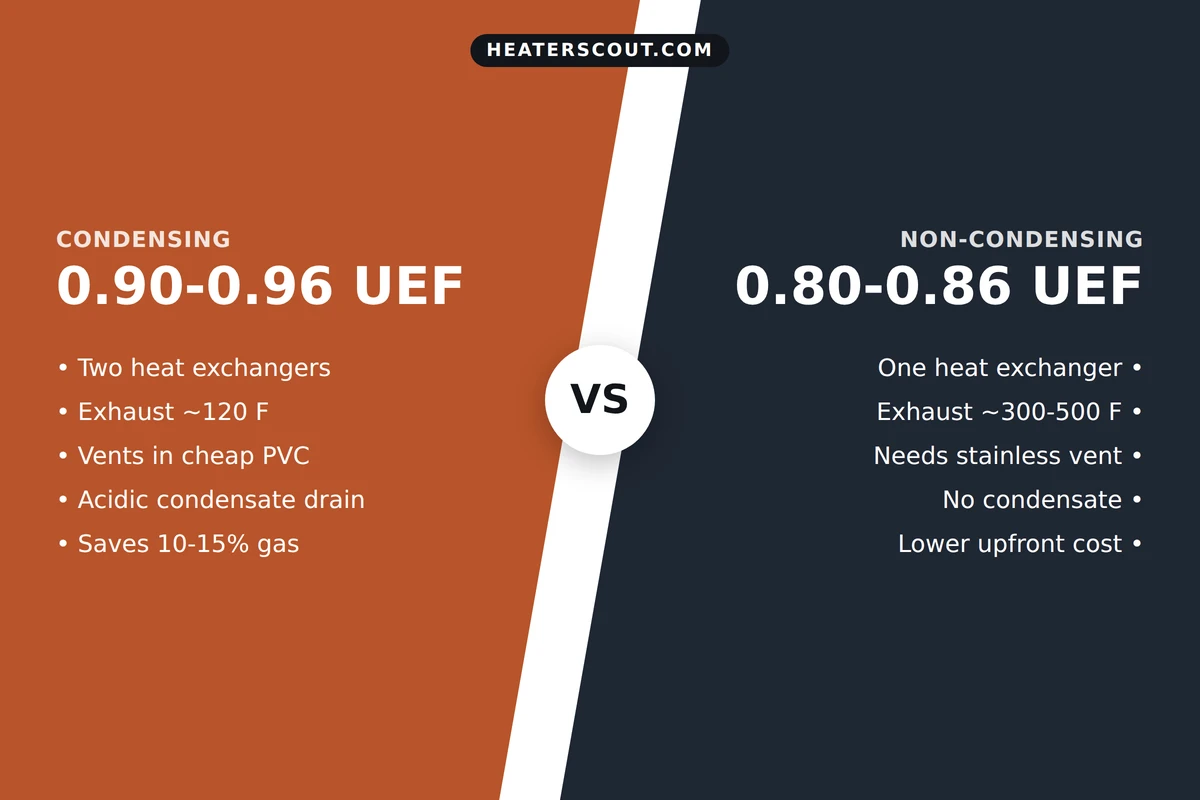
A condensing tankless water heater burns the same gas as a non-condensing one but squeezes 10 to 15 percent more heat out of it, and it does that with a single added part: a second heat exchanger that scavenges heat from the exhaust before it leaves the flue. That one difference sets everything else in motion. It is why condensing exhaust exits at around 120 degrees instead of 300, why it vents with cheap PVC instead of stainless steel, why it drips acidic condensate that needs a drain, and why it costs a few hundred dollars more up front. This page walks the real, physical differences, then shows when the premium pays for itself and when a simpler non-condensing unit is the smarter buy.
Where the numbers come from
Efficiency in a tankless heater is measured as UEF, the Uniform Energy Factor, and the gap between the two designs is not marketing. A non-condensing gas tankless runs around 0.80 to 0.86 UEF because its exhaust leaves hot, several hundred degrees, and much of that heat goes up the vent. A condensing unit lands in the 0.90 to 0.96 range because its second heat exchanger reclaims heat the first one left behind. In real gas bills that shows up as roughly 10 to 15 percent less fuel for the same hot water, which is the number that actually pays back the higher purchase price.
The second heat exchanger
This is the entire difference. In a non-condensing tankless, the burner fires through a single heat exchanger and the leftover heat, still about 300 to 500 degrees, blows out the vent. A condensing unit routes those hot gases through a second, cooler exchanger where they give up more sensible heat and, critically, where the water vapor in the exhaust condenses back to liquid and releases its latent heat. Recovering that latent heat is what pushes efficiency past 0.90 UEF, and it is why the exhaust leaves cool enough for plastic pipe.
Venting: the difference you pay for either way
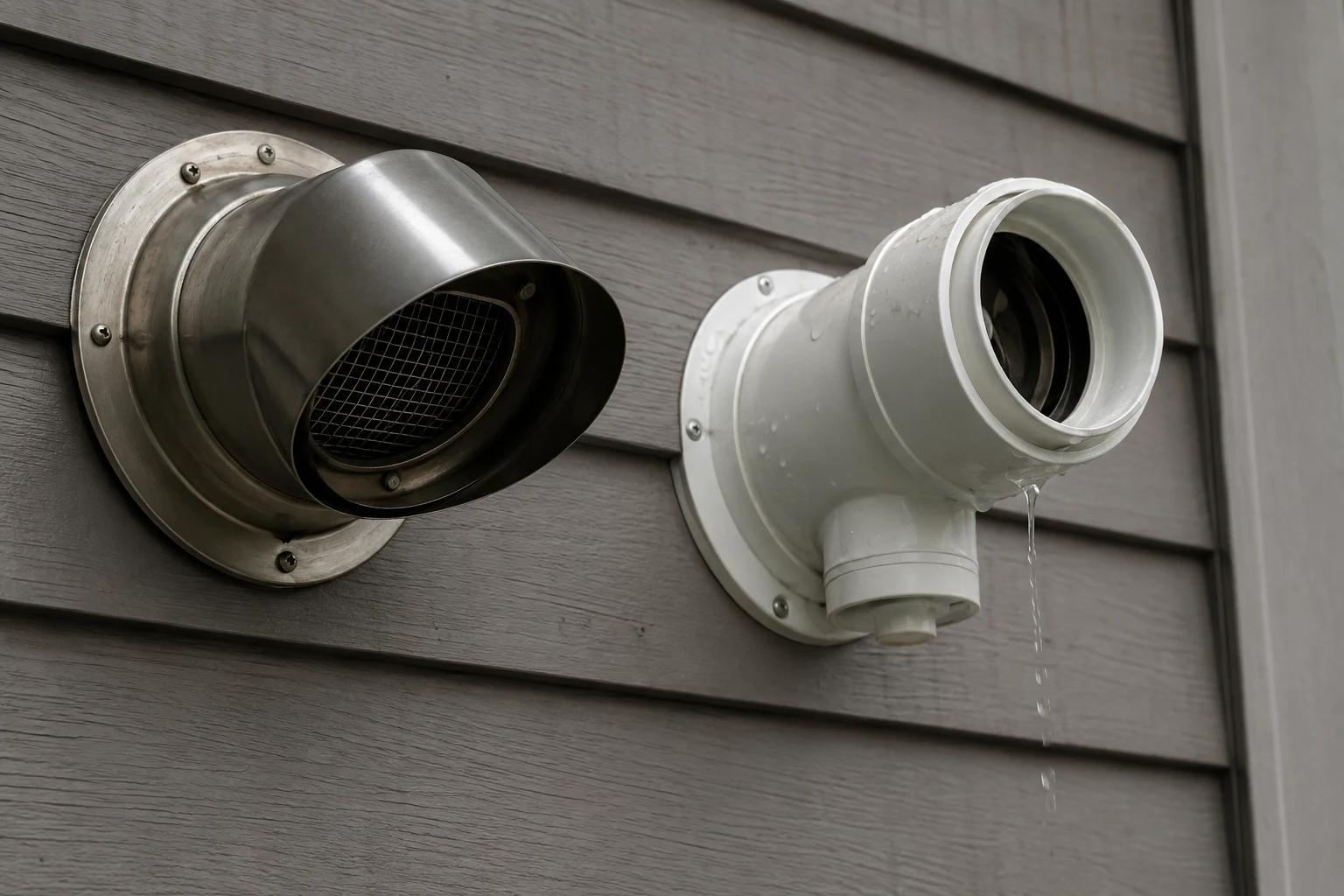
Venting is where the two designs part company at the wall, and it drives a surprising amount of the total install cost. A non-condensing unit's 300 to 500 degree exhaust would melt plastic, so code requires stainless Category III pipe rated for that heat. That pipe is expensive, several times the cost of plastic per foot, and it adds up fast on a long run to an outside wall or up through a roof. A condensing unit's exhaust is cool enough for PVC, CPVC, or polypropylene, which is cheap, glues together in minutes, and is stocked on every plumbing truck. On a short, straight vent the gap is small. On a long or complicated run, the plastic venting can save enough to close the price difference between the two units entirely.
The two units head to head
Here is the same information in one table, so you can see which differences actually matter for your install. Every row traces back to that second heat exchanger and the cooler exhaust it produces.
| Non-condensing | Condensing | |
|---|---|---|
| Heat exchangers | One | Two |
| UEF (efficiency) | ~0.80-0.86 | ~0.90-0.96 |
| Exhaust temperature | ~300-500 F | ~100-140 F |
| Venting | Stainless Category III (costly) | PVC / CPVC / polypropylene (cheap) |
| Condensate | None | Acidic, pH 3-4, needs a drain |
| Neutralizer | Not needed | Often required by code |
| Unit price | Lower | ~$300-600 more |
| Gas use | Baseline | ~10-15% less |
| Parts to fail | Fewer | More (2nd exchanger, drain) |
| Annual descaling | Yes | Yes |
| Gas line | Often 3/4" | Often 3/4" |
Notice what does not change between the columns. Both units modulate their BTU output to match demand, so both give you endless hot water sized to their gpm rating. Both need annual descaling on hard water, because scale forms from your water chemistry, not the exchanger count. Both typically want a 3/4-inch gas line to feed a full-size unit. The choice is not about capacity or maintenance rhythm; it is about efficiency, venting, and the condensate system.
Does a condensing tankless give more hot water than a non-condensing one?
No. Flow capacity is set by the unit's BTU rating and gpm spec, not by whether it condenses. A 199,000 BTU condensing and a 199,000 BTU non-condensing unit deliver about the same gallons per minute at the same temperature rise. Condensing wins on fuel per gallon, not on how much hot water you get at once.
The condensate nobody mentions in the showroom
Condensing efficiency has a byproduct: water. When the flue gas cools enough to condense, it drops out acidic condensate, usually around pH 3 to 4, and that liquid has to be managed. A condensing unit therefore needs a condensate drain line, something a non-condensing unit does not have at all. Where that drain empties decides whether you also need a neutralizer, a small cartridge of limestone chips that raises the pH before the condensate meets your plumbing. Metal drain lines and many municipalities require neutralization; some PVC drains tolerate the acid. The cartridge is inexpensive and its media needs topping up every year or two. It is a genuine bit of extra maintenance and one more failure point, and it is the honest downside of the higher efficiency.
So which one should you buy
The decision usually falls out of your venting run and your hot-water habits, not brand loyalty. Think about how far the exhaust has to travel and how much hot water your household actually pulls in a day.
Lean condensing
- Long or complicated vent run, where PVC savings offset the higher unit price.
- Heavy hot-water use: big family, long showers, high-demand fixtures. The 10-15% fuel savings compound fastest here.
- New construction or a full reroute, where you are running vent from scratch anyway.
- You want the lowest gas bill and plan to keep the unit 10-plus years.
Lean non-condensing
- Short, straight vent run, where stainless pipe stays cheap and the price gap dominates.
- Smaller home or lighter use, where the fuel savings never add up to much.
- A replacement with an existing Category III vent already in place.
- You want fewer parts and no condensate drain to maintain: simplicity over squeezing out the last few percent of efficiency.
One last caution before you shop. Watch the labels. A truly condensing unit publishes a high-0.9 UEF and calls for plastic venting. Condensing-ready can mean a non-condensing unit prepped for an add-on recovery kit, or it can be pure marketing on a unit that still runs in the 0.80s, up to about 0.86. Some hybrid designs sit in between. Do not buy on the badge on the box. Read the UEF number and the venting spec, and let those two facts tell you what you are actually getting. Match the unit to your vent run and your usage, and the right answer usually picks itself.
Frequently asked
What is the actual difference between condensing and non-condensing tankless?
It comes down to one part: a second heat exchanger. A non-condensing tankless has a single heat exchanger, so its burner heats the water once and then dumps the exhaust out the flue at about 300 to 500 degrees, carrying a lot of usable heat with it. A condensing unit adds a second exchanger downstream that lets those hot flue gases give up more of their heat before they leave, including the latent heat released when water vapor in the exhaust condenses back to liquid. That extra recovery is why condensing exhaust leaves at only 100 to 140 degrees and why the unit hits 0.90 to 0.96 UEF instead of 0.80 to 0.86. Everything else people talk about, the cheaper PVC venting, the condensate drain, the higher price, all flows from that one design choice.
Is a condensing tankless water heater worth the extra money?
For most gas households that use a normal amount of hot water, yes, but the math is not automatic. The condensing unit itself costs roughly $300 to $600 more, and it needs a condensate drain and often a neutralizer cartridge. Against that, it burns 10 to 15 percent less gas, and its PVC or polypropylene venting is much cheaper than the stainless Category III pipe a non-condensing unit requires. On a long vent run, the venting savings alone can erase the price gap at install. The payback then comes from the fuel savings, and heavy hot-water users, big families, long showers, recover the premium in a few years while a light user in a small home may never fully cash it in.
Can I vent a condensing tankless with PVC?
Yes, and that is one of its biggest practical advantages. Because condensing exhaust exits at only 100 to 140 degrees, most condensing tankless heaters are approved for PVC, CPVC, or polypropylene venting, which is inexpensive, easy to cut and glue, and something many plumbers already stock. Always match the manufacturer's spec, since some units require CPVC or polypropylene on the first section near the heat exchanger. A non-condensing unit cannot use PVC: its 300 to 500 degree exhaust would soften and fail the plastic, so it needs stainless Category III pipe, which costs several times more per foot and drives up the install on longer runs.
What is the condensate from a condensing tankless and do I need a neutralizer?
When the flue gas cools enough to condense, the water it drops out is acidic, usually around pH 3 to 4 from dissolved combustion byproducts. That condensate has to go somewhere, so a condensing unit needs a drain line, which a non-condensing unit does not have at all. Whether you need a neutralizer, a cartridge of limestone chips that raises the pH before the condensate hits your plumbing, depends on local code and what the drain empties into. Cast iron or metal drain lines and some municipalities require neutralization; PVC drains often tolerate it. A neutralizer cartridge is cheap and needs its media topped up every year or two, so many installers add one by default to protect the drain.
Do both types need annual descaling?
Yes. Scale is a function of your water, not the exchanger design. On hard water, calcium builds up inside the heat exchanger of either type, chokes flow, and eventually triggers error codes or kills efficiency, so both condensing and non-condensing tankless heaters want an annual descaling flush with a pump and a vinegar or descaler solution. A condensing unit has two exchangers, but the primary one is where most scale forms, and the flush covers the water path either way. If you have a water softener you can stretch the interval, but skipping descaling entirely is the fastest way to void a warranty and shorten the life of any tankless heater.
When does a non-condensing tankless make more sense?
When the install is simple and the price gap is not worth chasing. If you have a short, easy vent run straight out a nearby wall, the stainless venting penalty stays small, and the lower upfront cost of the non-condensing unit wins. Smaller homes, lighter hot-water use, second units for a garage or an addition, and replacements where an existing Category III vent is already in place all favor non-condensing. It also has fewer parts, no second exchanger and no condensate system, which means one less thing to fail. If you rarely run enough hot water for the 10 to 15 percent fuel savings to add up, the simpler unit is the honest pick.
What does condensing-ready mean, and is it the same as condensing?
No, and the label trips people up. A truly condensing tankless has the second heat exchanger built in and runs at 0.90-plus UEF out of the box. Condensing-ready usually means something different depending on the brand: sometimes it is a non-condensing unit prepped to accept an add-on recovery kit, sometimes it is marketing for a unit that vents in PVC but does not actually hit condensing efficiency. Do not buy on the badge. Look at the published UEF and the venting spec. If the number is in the 0.80s, up to about 0.86, and it calls for stainless vent, it is non-condensing no matter what the box says. A real condensing unit lists a high-0.9 UEF and PVC or polypropylene venting.