A cold burst in the shower sends people down two very different roads. One ends at a shrug, because the cold water sandwich is normal behavior that fixes itself in seconds. The other ends at a repair, because a tankless heater that throws an error code has stopped on purpose and will keep stopping until someone deals with the cause. The good news is you can tell which road you are on in about ten seconds, and it comes down to three things: whether a code appears on the display, whether the unit beeps or locks out, and whether the water comes back hot by itself.
Quick answer
If the water goes cold for a few seconds and then returns to hot on its own, with no number on the display, no beeping, and no flashing red light, that is the cold water sandwich. It is normal on-demand behavior and needs no repair. If a code shows up, the unit beeps or locks out, or the water goes cold and stays cold, that is a real fault, ignition, venting, flow, or overheat, and it needs troubleshooting. Codes and alarms mean the heater shut itself down to protect you; the sandwich never does that.
Fastest test
The cold water sandwich is silent, brief, and self-healing. A real fault is loud, persistent, and posts a code. If you have to walk over and reset the unit to get hot water back, it was never a sandwich.
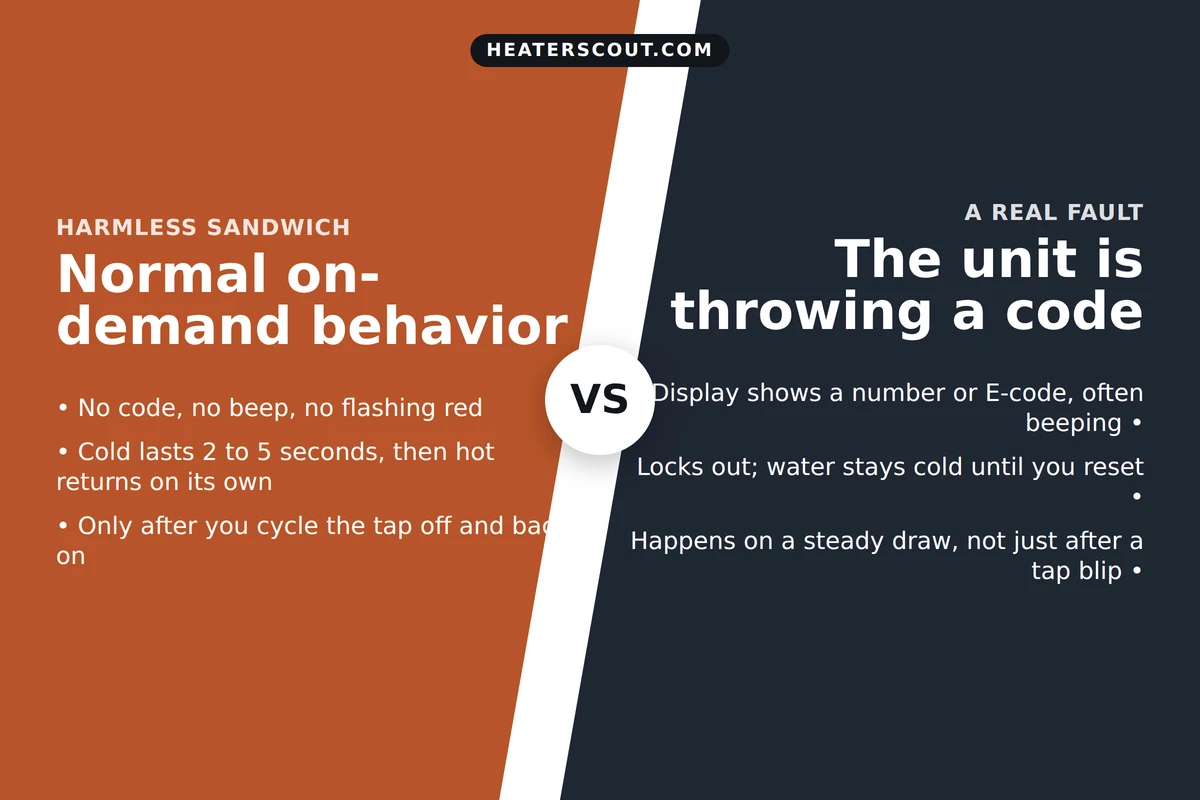
The three questions that settle it
Every tankless heater sold in the US has a control board watching combustion, flow, and temperature. When that board sees something wrong, it does two things: it shuts the burner down and it tells you, usually with a code on the front panel or the wired remote, often with a beep or a red light. The cold water sandwich triggers none of that, because nothing is wrong. So before you assume the worst, answer three questions in order.
First, is there a code on the display? Manufacturers post a two-digit number or an E-code when the unit faults. Rinnai and Rheem use numbers like 11, 12, and 16. Navien uses E-codes like E003 and E110. A blank display with hot water flowing normally afterward means no fault was logged. A code means one was. This is the single most decisive check, so make it first.
Second, did it beep or flash red? A tankless beeps to raise an alarm, and a flashing red light signals a lockout. Neither is part of normal heating. If your cold burst came with a beep or a red light, the board took protective action and you are dealing with a fault. The sandwich is completely silent; you would not know the board was even awake.
Third, did the water recover to hot by itself? This is the behavioral tell, and it is the one you feel rather than read. The sandwich is a brief cold slug, two to five seconds, that gives way to hot without you lifting a finger, because the burner relit on its own the moment flow came back. A fault does not self-heal. The water stays cold, and it stays cold until you power cycle the unit or press reset. If you had to walk over and reset it, it was a lockout, not a sandwich.
When the cold burst is really a fault in disguise
The reason this confusion happens at all is that a few real faults produce a hot-then-cold pattern that feels a lot like the sandwich in the first second or two. The difference shows up right after. Here is what is actually happening under each of the codes people mistake for a sandwich.
Ignition and flame failure are the top offenders. Codes 11 and 12 on Rinnai and Rheem, E003 and E012 on Navien, all mean the burner got a demand signal from the flow sensor but failed to light and hold a flame within its trial window. What you feel is the warm water already in the pipe reaching you first, then cold, because the burner never caught. It mimics the sandwich right up until the point where hot should return and does not. Instead the unit posts the code and often beeps. Common causes are a closed gas valve, an empty propane tank, low gas pressure, or a dirty flame sensor.
Venting faults are next. A code 10 on Rinnai or E110 on Navien means the board read abnormal air pressure and shut the burner off over a blocked intake or exhaust. If the blockage is partial, the burner may cut in and out, throwing cold patches that resemble repeated sandwiches, but each one ends in a lockout code rather than a clean recovery. Flow faults are the third family: if the unit cannot sense enough water moving, it will not fire at all, so ultra-low-flow fixtures or a clogged inlet screen can read as a heater that keeps going cold. Overheat shutdowns round out the four; they trip when the outlet temperature runs away, usually from scale or a flow problem, and they lock out hard.
One code that is not a shutdown at all: the maintenance or descale reminder, such as Rinnai's LC. That is a warning, not a fault. The unit keeps heating while it nags you to flush the heat exchanger. Left long enough, heavy scale does cause temperature swings, but a descale reminder on its own is neither a lockout nor a sandwich. If that is your only message and the water still heats, book a flush and move on.
Key takeaways
- A cold water sandwich posts no code, makes no beep, and shows no red light. Silence is the sign it is harmless.
- A real fault self-announces: a two-digit or E-code on the display, usually a beep or a flashing red light.
- The sandwich recovers to hot on its own in two to five seconds. A fault stays cold until you reset the unit.
- The sandwich only follows a tap cycled off and back on. Cold on a steady, uninterrupted draw points to a fault.
- Ignition codes (11, 12, E003) mimic the sandwich most, because the hot leftover water masks a burner that never lit.
- A maintenance or descale code like LC is a warning, not a lockout; the unit keeps heating while it asks for service.
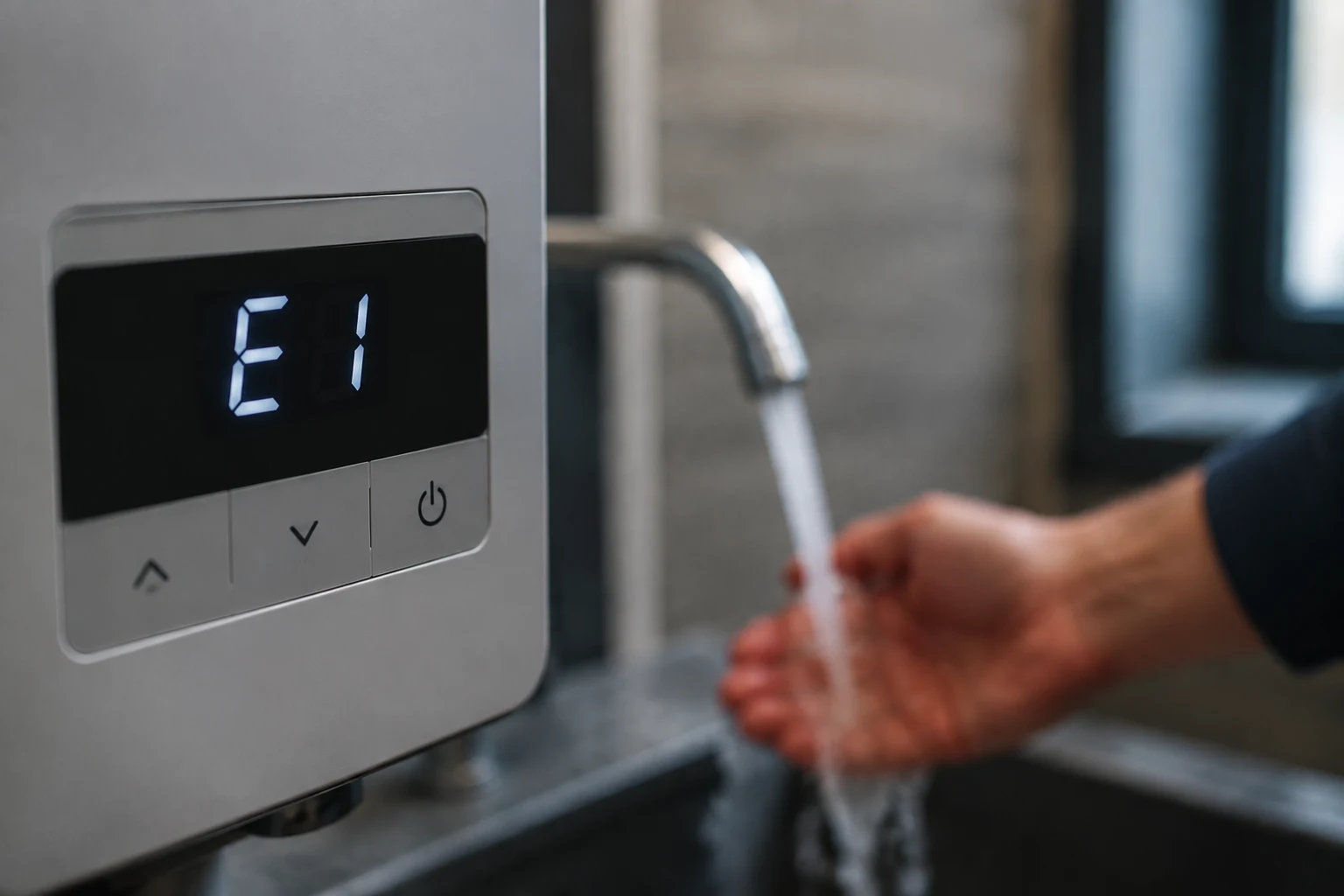
How to run the check in your own bathroom
Reproduce the burst on purpose and watch what the unit does. Open a hot tap and let it run steady for a minute without touching it. If the water stays hot on that uninterrupted draw, the heater is firing fine and your cold bursts are tied to tap cycling, which is the sandwich. Now cut the tap off, wait ten seconds, and reopen it. Feel for a brief cold slug that recovers to hot within a few seconds. That recovering slug, with a clean display, is the sandwich confirmed.
If instead the water goes cold on the steady draw, or it goes cold and does not come back, walk to the unit and read the panel or the wired remote. A number, an E-code, a beep, or a red light all confirm a fault, and the specific code points you at the family: ignition, venting, flow, or overheat. Note the exact code as it displays, because that is what a tech or a code lookup needs. A sandwich gives you nothing to note, which is itself the answer.
The line between the two is not fuzzy once you know where to look. Normal on-demand heating is quiet and self-correcting. A protected shutdown is noisy, sticky, and documented on the display. When the cold water keeps arriving on a steady flow, or arrives with a code, stop treating it as a quirk and start treating it as a repair.
Frequently asked
How do I know if my cold water is a sandwich or an error code?
Look at the display and listen. The cold water sandwich leaves no trace: no number on the screen, no beeping, no flashing red light, and the water comes back hot within a few seconds without you doing anything. A real fault announces itself. Most tankless units post a two-digit number or an E-code on the front panel or remote when they lock out, and many beep or flash a red light at the same time. The other tell is recovery. A sandwich self-heals in seconds because the burner relights on its own. A fault does not; if the water goes cold and stays cold until you power cycle or press reset, that is not a sandwich, that is a lockout. If you never touched the tap and the water still went cold on a steady flow, lean toward a fault and check the display.
Does the cold water sandwich show an error code?
No. That is the single clearest way to separate the two. The cold water sandwich is normal operation, the expected side effect of a burner that only fires while water flows and needs a couple of seconds to relight after a brief shutoff. Normal operation does not trip the control board's fault logic, so nothing appears on the display and no alarm sounds. If you are seeing a code like 11, 12, E003, or E110, or hearing a beep, the board has detected an actual problem, ignition, venting, flow, or overheat, and that is a different animal from the sandwich. Codes mean the unit stopped on purpose to protect itself, and they will keep coming back until the cause is fixed.
Why does my tankless go cold and beep during a shower?
Beeping is an alarm, not a normal sound. A tankless heater beeps to flag an error or a leak, so a cold shower paired with beeping is a fault, not a cold water sandwich. Pair the beep with whatever number is on the display. If it is an ignition code such as 11 or 12, the burner tried to light and failed, often a gas supply issue or a dirty flame sensor, and the water went cold because the flame never established. A venting code like 10 or E110 means the unit shut the burner off over a blocked intake or exhaust. Either way the beep tells you the board took protective action. A true sandwich is silent, brief, and gone before you could even find the display.
My tankless gives a cold burst every time I turn the tap off and on. Is that a fault?
Almost certainly not. A cold burst that appears only when you cycle the tap off and back on, and only lasts a few seconds before the water snaps hot again, is the textbook cold water sandwich. You shut the flow off, the burner cut out, the water sitting in the exchanger and pipe cooled, and that cooled slug reaches you right before the burner relights. It is tied to your tap habits, it is bounded to a few seconds, and it leaves no code. What would flip it into fault territory is if the cold arrived on a steady, uninterrupted draw, if it stayed cold instead of recovering, or if a code or beep showed up. None of those describe the tap-cycling burst, so that one is the harmless sandwich.
The water went cold and stayed cold. What does that mean?
Water that goes cold and stays cold is not a sandwich. The defining trait of the sandwich is that hot returns on its own within seconds; the cold is a brief slug, not a permanent state. Cold that persists means the burner is not running, and on a tankless that usually points to a lockout. Walk to the unit and read the display. A code plus a red light or beep confirms a fault: ignition failure if the burner cannot light, a venting or flame-sensor problem, a flow issue if the unit is not sensing enough water, or an overheat shutdown. No code but still cold can be a gas supply problem, a tripped breaker, or no ignition at all. Either way, persistent cold is a troubleshooting job, while the sandwich needs nothing because it already fixed itself.
What tankless error codes get mistaken for a cold water sandwich?
The ones that produce a cold-then-nothing pattern early in a draw. Ignition and flame-failure codes are the usual culprits: Rinnai and Rheem 11 and 12, Navien E003 and E012. In those cases the unit sends warm leftover pipe water first, then the burner fails to light, so you feel hot-then-cold much like a sandwich, except the hot never comes back and a code posts. A blocked-vent code such as 10 or E110 can do the same if the burner keeps cutting out. An inlet thermistor fault (code 25, E025) can make delivery temperature wander. The separator is always the same three questions: did a code appear, did it beep or lock out, and did the water recover to hot by itself. Yes to the first two, or no to the third, means fault, not sandwich.
Is an LC or maintenance code the same as a fault that makes water cold?
No, and it is worth knowing the difference. Codes like LC on a Rinnai are maintenance or descale reminders, a warning that scale has built up in the heat exchanger, not a hard shutdown. Many brands split their messages into two buckets: warning codes that let the unit keep running while nagging you to service it, and fault codes that lock the burner out. A descale reminder can eventually cause temperature swings if you ignore it long enough, because scale hurts heat transfer, but on its own it is not the cold water sandwich and not a lockout. If your only symptom is a maintenance code and the water still heats, schedule a flush. If the water is actually going cold, look for a lockout code instead.