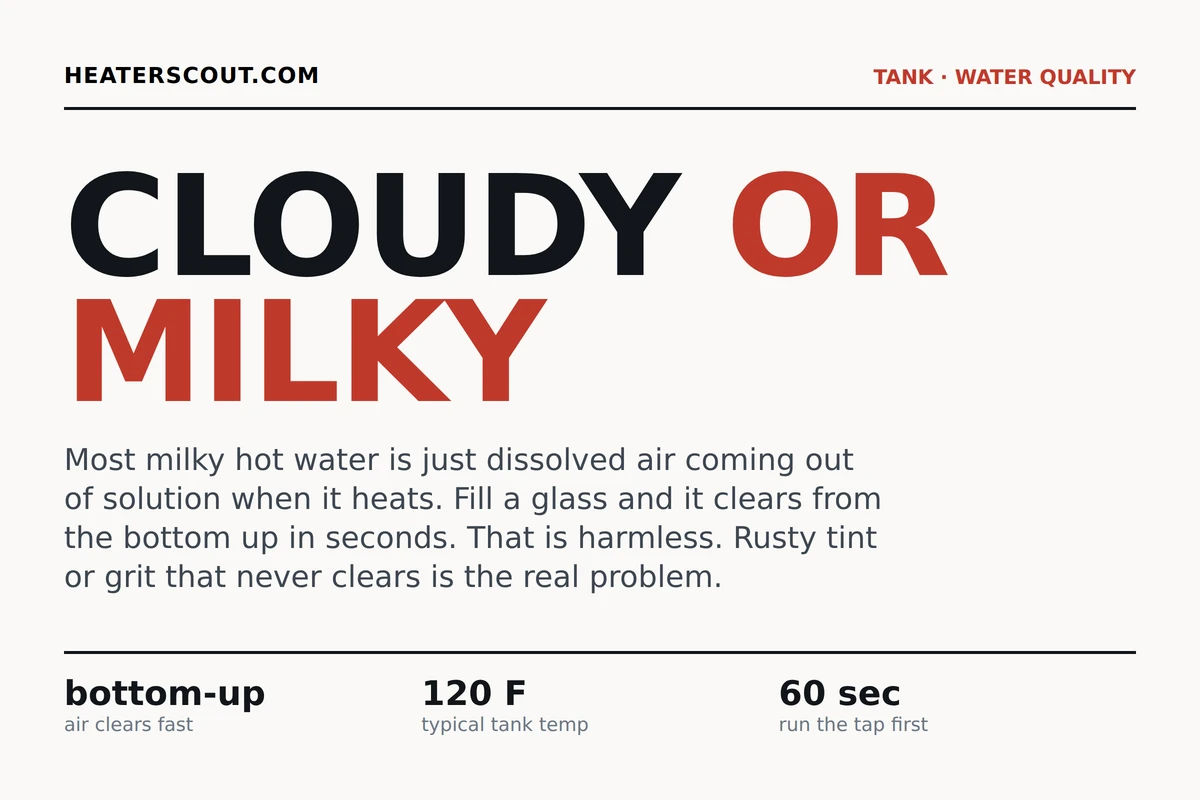
Fill a glass from the hot tap and it looks like watered-down milk, then a few seconds later it is crystal clear from the bottom up. That is the single most common water-heater scare that turns out to be nothing. Cold water holds a lot of dissolved air, and when your tank heats it toward 120 degrees, that air comes out of solution as a cloud of microscopic bubbles the moment the pressure drops at the faucet. It clears bottom-up in seconds and leaves clean water. The trick is telling that harmless version apart from the two that actually mean something: hard-water minerals that stay cloudy, and rust or sediment that comes out tinted. Same milky look, three very different causes.
Dissolved-air cloudiness
Tiny bubbles of oxygen and other gases that were dissolved in cold, pressurized water and came out of solution when the water was heated in the tank. It looks milky at first and then clears from the bottom of the glass upward within a few seconds. It is harmless, it is not a heater fault, and it is the cause behind the large majority of cloudy hot water complaints.
Harmless air vs something worth checking
Every case of cloudy or milky hot water comes down to one of two verdicts. Either it is dissolved air, which clears itself and needs nothing, or it is minerals or rust, which stay in the glass and point at your supply or your tank. The glass test sorts them in about ten seconds. Here is how the two sides look on the signs you can actually see.
Harmless: dissolved air
- Clears from the bottom up within a few seconds and leaves clean water.
- Comes from gas-rich cold water heated in the tank, not a heater fault.
- Common right after plumbing work or a tank refill that trapped air.
- Nothing to fix. Run the hot tap 30 to 60 seconds if you want it gone faster.
Worth checking: minerals or rust
- Stays cloudy with a white film means hard-water minerals, safe but hard.
- Brown or rusty tint or grit that settles means sediment or corrosion.
- A metallic smell with the tint points at an aging tank and anode rod.
- Flush the tank, test water hardness, and check the anode rod for wear.
Hot side only, or both hot and cold?
Where the cloudiness shows up narrows the cause fast. If only the hot water is milky and the cold runs clear, the tank and the heating are in the story, and air is by far the likeliest reason, especially right after a plumbing repair or a tank refill that trapped air at the top of the heater. If both the hot and the cold come out cloudy, the heater is not the culprit at all. The problem is riding in with your incoming supply, which usually means hard-water minerals or air already dissolved in the utility or well water before it ever reaches the tank.
Milky that only shows on the hot side and only for a day or two after work on the plumbing is trapped air purging out, and it clears on its own. Milky on the hot side that never clears, week after week, is the version worth a closer look: it can be dissolved minerals cooking out of hard water in the tank, or an anode rod reacting as it corrodes. That is when you stop waiting it out and start flushing and checking the rod.

When cloudy water is actually telling you something
Air and hard water are both safe to use. The case that earns a real response is the one with color and grit. A rusty or brown tint, a metallic smell, or visible particles that settle to the bottom of the glass point at sediment built up on the tank floor or corrosion working on the steel inside an aging heater. Left alone, heavy sediment insulates the burner, wastes gas, and can start the tank rumbling, while a spent anode rod stops protecting the tank and lets the steel rust from the inside. None of that is an emergency the day you notice it, but it is the difference between a heater with years left and one on its way out.
The response is a tank flush to clear the sediment and an anode-rod check to see how much protection is left. If the water still comes out tinted after a full flush, or the rod is eaten down to its steel core wire, the tank itself is aging and you are watching for the day it needs replacing. Milky that never clears and carries no tint is the gentler warning: usually just hard-water minerals, worth a hardness test but not a repair.
The verdict
Run the glass test first. If the hot water clears from the bottom up in a few seconds and leaves clean water, it is dissolved air and there is nothing to fix. Cloudiness that stays with a white film is hard-water minerals, safe but worth a hardness test. A brown or rusty tint, grit, or a metallic smell is the one to chase: flush the tank, check the anode rod, and set the temperature at 120 degrees F. Nine times out of ten it was just air.
The 10-second glass test
Run the glass test before you do anything else. Fill a clear glass from the hot tap and set it on the counter. If it clears from the bottom up in a few seconds and leaves clean water with no film or grit, it is air and you are done. If it stays cloudy or settles out a tint, work back through the two causes above.
Frequently asked
Why is my hot water cloudy but my cold water is clear?
That split points straight at dissolved air, and it is the most common reason of all. Cold water leaves your utility or well under pressure and holds a lot of dissolved oxygen and other gases. When that water sits in the tank and gets heated toward 120 degrees, the gas can no longer stay dissolved, so it comes out as a cloud of tiny bubbles the instant the pressure drops at your faucet. Cold water skips the tank and the heat, so it stays clear. The proof is quick: fill a clear glass from the hot tap and watch it. If the cloudiness clears from the bottom up within a few seconds and leaves clean water and no residue, it is air. Nothing is wrong with the heater and nothing needs fixing.
Is milky hot water safe to drink?
If it clears from the bottom up in a few seconds, yes, it is just air and it is completely safe. Air bubbles change nothing about the water itself. The cases worth a second look are the ones that do not clear. If the glass stays cloudy after a minute and leaves a white film or scale on the glass, that is dissolved minerals from hard water, still safe but a sign your water is hard. If the water carries a brown or rusty tint, a metallic smell, or visible grit that settles to the bottom, that is sediment or corrosion, and while a little is not a health emergency, it means the tank needs attention. Trust the glass test over a guess: bottom-up clearing is the safe, boring answer.
Why did my hot water turn cloudy after plumbing work?
Because the work let air into the lines. Any time a plumber shuts off the supply, drains a section, swaps a valve, or the tank gets refilled, air gets trapped in the pipes and at the top of the water heater. For the next day or two that trapped air rides out with your hot water and looks milky. It clears itself as the system purges. You can speed it along by opening the hot side of every faucet in the house for a minute or two, starting with the highest one, to let the air burp out. If it is still milky a few days later with no more plumbing done, then look past the air explanation to hardness or sediment.
Does cloudy hot water mean my water heater is going bad?
Usually not. Plain air-bubble cloudiness that clears bottom-up says nothing bad about the heater at all. The version that does hint at a failing heater is different: water with a rusty or brown tint, a metallic or rotten-egg smell, or grit you can feel and see settling out. That points at heavy sediment on the tank bottom or at corrosion inside the tank, often with a spent anode rod that is no longer protecting the steel. Flush the tank, and if the water still comes out tinted or the anode rod is eaten down to the core wire, the tank is aging. So the cloudiness itself is rarely the alarm. The color and the grit are.
How do I get rid of cloudy or milky hot water?
First figure out which kind you have with the glass test, then match the fix. If it clears bottom-up, it is air and you do not need to do anything, though running the tap 30 to 60 seconds and bleeding trapped air from the hot taps clears it faster. If it stays cloudy with white residue, that is hard water, so cleaning the faucet aerators helps the flow and a water-hardness test tells you whether a softener is worth it. If it is tinted or gritty, drain and flush the tank to clear sediment and check the anode rod for corrosion. Match the fix to the cause and you will not waste a service call on plain air.
Why is my hot water cloudy only at one faucet?
A single cloudy faucet usually means a clogged or aerating faucet aerator, not a heater or supply problem. The little screen at the tip of the spout traps grit and mineral scale, and as it clogs it can whip air into the stream and make the water look milky at that one tap while every other faucet runs clear. Unscrew the aerator, rinse out the screen, soak it in vinegar if it is scaled, and reinstall it. If the cloudiness moves with the aerator or clears once it is cleaned, that was the whole story. If every hot tap in the house is cloudy, look at the tank and the incoming supply instead.