A Bradford White that stops making hot water sends you two clues before you touch a wrench: the little status light on the gas control and the way the hot water actually behaves at the tap. Bradford White builds solid residential tanks, but every brand fails in a handful of predictable ways, and the gas models carry an electronic control called the ICON system that blinks a code instead of just going dark. This page triages the six or seven symptoms homeowners actually run into, tells you which are a ten-minute fix and which mean a part, and hands off the two deep ones to their own guides.
The short version
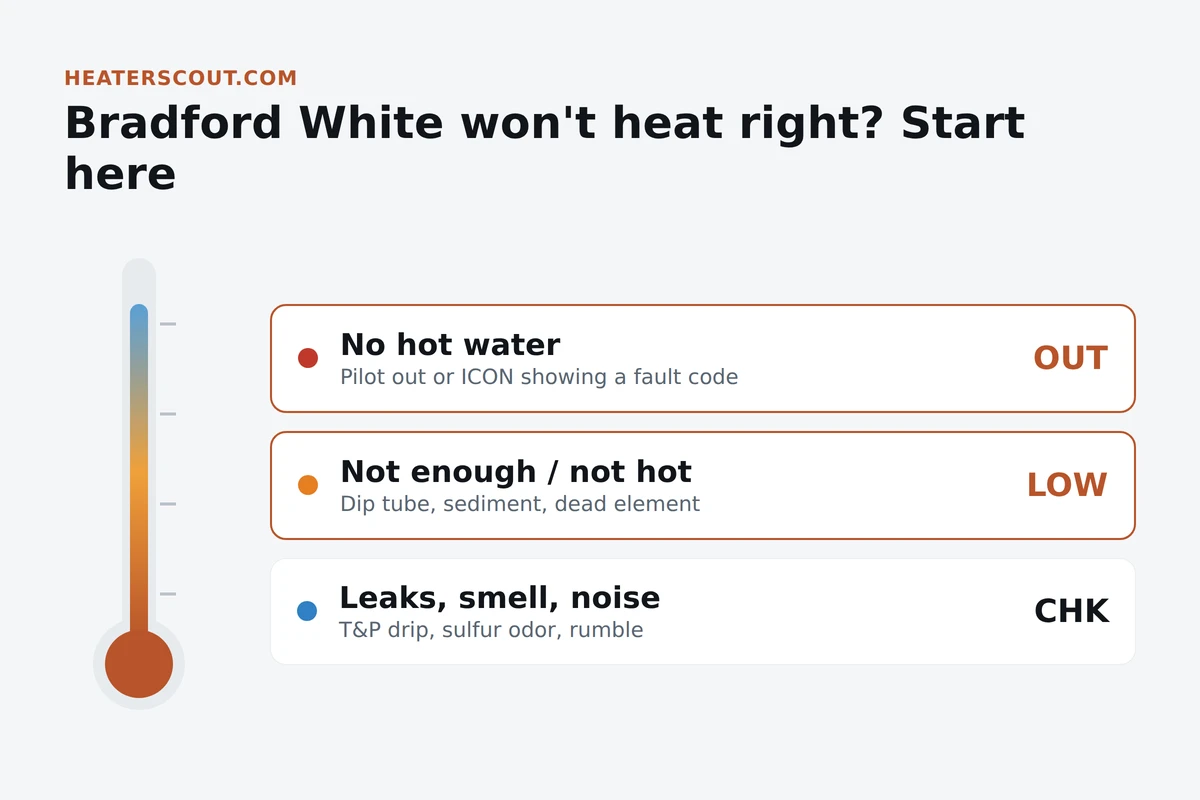
Start with the symptom, not the part. No hot water on a gas Bradford White means the pilot is out or the ICON status light is flashing a fault, so read the light first. Not enough hot water points at a broken dip tube, a dead electric element, sediment, or a thermostat set too low. A dripping pipe is the T&P relief valve doing its job, so find the pressure or heat behind it rather than capping it. Smell is the anode rod, noise is sediment, and both are maintenance rather than failure. Match the symptom to the row below, then decide if it is a flush, a part, or a call.
First move on a gas unit: read the ICON status light
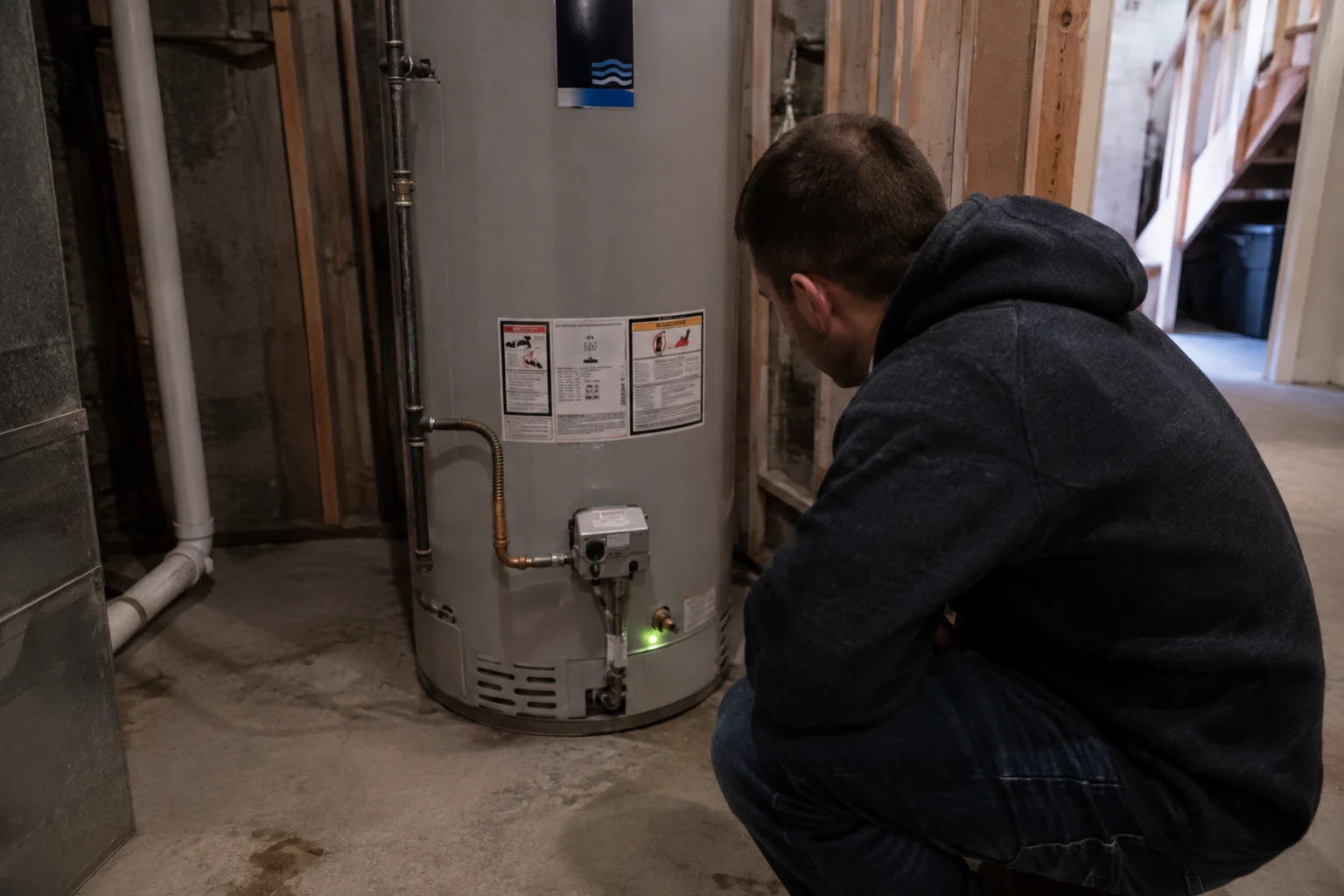
Bradford White's gas controls use an electronic module they call the ICON system. On a standard atmospheric-vent tank it is self-powered: there is no plug and no batteries. A thermopile at the pilot turns the pilot flame's heat into a small DC voltage, and that voltage runs the control and holds the main gas valve open. A small LED on the front of the gas valve is the whole system reporting status, and reading it is the fastest triage you have.
Normal is boring on purpose. One flash every few seconds with a three-second pause means the unit is in standby and satisfied, or the knob is in the pilot position. A quick double-flash strobe means the thermostat is calling for heat and the burner should be running. If the LED is on solid and steady, the control knob is in the off position, and you wait for the light to go out before relighting. No light at all means the pilot is not lit. Faults begin at two flashes, and the meanings come straight from Bradford White's service guide for atmospheric-vent ICON units.
ICON system
Bradford White's electronic gas control valve. On an atmospheric-vent tank it needs no external power: a thermopile at the pilot generates roughly 20 to 30 millivolts to run the control and hold the gas valve open. The onboard LED blinks a status or fault code. There are two generations, ICON 1.0 and ICON 2.0, and they use different code tables, so match the code to your unit's generation using the serial date code (TA, meaning January 2019, and later is 2.0).
Bradford White's own service guide for atmospheric-vent ICON units lists the fault codes plainly. Two flashes is a weak pilot signal, so verify the pilot is lit and check the thermopile voltage and the wire connections at the gas valve. Three flashes means the valve did not see the water warm up in the expected time, which sends you to the temperature probe ohms and to confirming water is not running through the tank. Four flashes is high tank temperature and five is a thermostat sensor fault, both pointing at the temperature probe or the gas valve cover that carries it. Seven flashes is an outright gas valve fault: reset it once, and if it returns, the valve is finished. Eight flashes means the pilot is still lit with the knob in off, which is a gas pressure or valve problem. Six flashes only appears if a leak-detect accessory module is fitted.
The light flashes differently than the codes above. What now?
Two reasons that happens. First, power-vent and power direct-vent Bradford White models use a longer, separate code table that adds pressure-switch, blower, and flammable-vapor sensor codes, so a fan-equipped unit will not match the atmospheric-vent list. Second, ICON 1.0 and ICON 2.0 read slightly different tables. Confirm your vent type and generation, and if the count still does not fit, call Bradford White technical support with your model and serial number.
No hot water at all
On a gas unit this splits cleanly by what the light does. No light means the pilot has gone out, so you relight it following the printed instructions on the tank and watch whether it holds. A pilot that lights while you hold the knob and dies the instant you release it is not making enough millivolts to hold the gas valve, which shows up as a two-flash weak-pilot code. That is its own repair with a specific test sequence, covered in the Bradford White pilot guide. A seven-flash gas valve fault means the control itself has faulted: reset it once, and if it comes back, the valve is done.
On an electric Bradford White, no hot water usually starts at the reset button. The high-limit switch on the upper thermostat has a red reset button, and if it has tripped, the tank is stone cold and the button clicks back in. Kill the 240-volt breaker before you open either access panel. A tripped high limit is a symptom, not a cause: if it trips a second time, something is overheating the tank, so do not keep pressing it. Turn the breaker off and test the thermostats and elements, or call a pro. Repeatedly resetting a tank that keeps cutting out on high limit is how a bad thermostat becomes a scald hazard.
Not enough hot water, or not hot enough
This is the second-most common complaint and it has four usual suspects. Check them in order of how easy they are to rule out.
Leaks: figure out where before you panic
Not every drip is a dying tank. The most common water you find is at the T&P relief valve, and that valve is a safety device, not a leak in the ordinary sense. It opens and dribbles when pressure or temperature inside the tank climbs too high. The usual reasons are house water pressure above about 80 psi, a closed plumbing system with a check valve or pressure-reducing valve and no expansion tank to absorb the swell of heated water, an actual overheat, or a valve that has simply worn out. The fix is to address the pressure or heat, or replace a worn valve with a matching one. What you never do is cap it.
Never cap the T&P valve
The temperature and pressure relief valve is the one thing standing between an overheating tank and an explosion. If it is dripping, find and fix the reason it is relieving, or replace the valve. Never plug, cap, or install a shutoff on the T&P discharge line to stop a drip.
Water at the base of the tank is the serious kind. If it is coming from the tank body itself, and not from a fitting, a drain valve, or condensation on a gas unit that is just heating cold water, the inner tank has likely rusted through and no repair brings it back. That is a replacement. Before you conclude that, dry everything, run a cycle, and watch where the water actually starts, because a weeping drain valve or a loose supply nipple looks like a tank leak until you trace it.
Smell and noise: maintenance, not failure
A rotten-egg smell in the hot water is hydrogen sulfide, produced when anaerobic bacteria react with the magnesium or aluminum sacrificial anode rod inside the tank. The anode is there to corrode instead of the steel, so you do not want to remove it, but you can change what it is made of. Flushing and disinfecting the tank clears the smell short term; swapping to a zinc, aluminum-zinc alloy, or powered anode stops it coming back. Only the hot side smelling is the giveaway that it is the heater and not the well or supply.
Popping and rumbling while the burner or element runs is sediment. Water trapped under the mineral crust on the tank bottom boils and forces steam up through the layer with a knock. It is loud but rarely urgent. Draining and flushing clears it. On a gas tank, letting sediment build unchecked also insulates the water from the flame and overworks the burner, so a yearly flush earns its keep.
Water too hot
If the hot side is scalding, the first stop is the thermostat, set it back to 120F and measure at the tap after the tank recovers. If the water keeps climbing past where the dial is set, the ICON may throw a four-flash high-tank-temperature code or a five-flash thermostat sensor fault, both of which point at the temperature probe or the gas valve reading the tank wrong. On an electric unit a thermostat stuck closed keeps an element firing past setpoint. Scalding water is not a wait-and-see problem in a house with kids or older adults, so if the temperature does not track the setting, cut the fuel or breaker and test the controls.
Frequently asked
How do I read the blinking status light on my Bradford White water heater?
The small LED on the gas control valve is the ICON system talking to you. On an atmospheric-vent gas model, one flash every few seconds with a pause is normal standby, and a fast double-flash strobe means the thermostat is calling for heat. Faults start at two flashes: two is a weak pilot signal, three is the gas valve not seeing the water warm up in the expected time, four is high tank temperature, five is a thermostat sensor fault, seven is a gas valve fault, and eight means the pilot is still lit with the knob in off. Count the flashes, then the three-second pause, then count again to be sure. One catch: power-vent and power direct-vent models use a longer, different code table that adds pressure-switch, blower, and flammable-vapor codes, so match the count to your unit type. If the light shows nothing at all, the pilot is out.
Why won't the pilot on my Bradford White stay lit?
On a Bradford White single-pilot gas unit there is no cord and no batteries. The pilot flame heats a thermopile that generates roughly 20 to 30 millivolts, and that tiny voltage is what holds the gas valve open. If the pilot lights while you hold the knob but dies the moment you let go, the thermopile is not making enough millivolts, the pilot flame is weak or not wrapping the sensor, or a wire connection at the gas valve is loose or corroded. A status light showing two flashes points straight at a weak pilot signal. The other classic cause on the newer sealed-combustion designs is a starved combustion chamber from a clogged flame-arrestor screen at the base of the tank. This is deep enough to have its own page, so use the Bradford White pilot guide for the full test-and-fix sequence.
My Bradford White makes hot water but I run out fast. What is wrong?
Running out sooner than the tank should allow usually comes down to three things. A cracked or shortened dip tube is the sneaky one: the cold inlet is supposed to dump to the bottom, but a broken tube lets cold water short-circuit to the top and mix straight into your hot outlet, so the tank feels half-size. On an electric model a dead lower element leaves only the upper element working, which heats the top third and then quits, giving you a short burst of hot followed by cold. And on any tank, years of sediment on the bottom take up volume that used to be water. Check the thermostat is at 120F first, then flush the tank, then chase the dip tube or element depending on fuel.
Water is dripping from the pipe on the side or top of my Bradford White. Is that normal?
That pipe is the temperature and pressure relief valve discharge, and it is a safety device, not a nuisance. An occasional drip during a heavy heating cycle can be normal thermal expansion, but a steady drip or a run means something real: house water pressure over about 80 psi, a closed plumbing system with no expansion tank so the heated water has nowhere to expand, the tank actually overheating, or a T&P valve that has worn out and no longer seals. Never plug, cap, or screw a fitting into a T&P discharge to stop the drip. That turns your water heater into an unvented pressure vessel. Find out why it is relieving, and if the valve itself is bad, replace it with a matching part.
Why does the hot water from my Bradford White smell like rotten eggs?
The smell is hydrogen sulfide gas, made when naturally occurring anaerobic bacteria in the water react with the magnesium or aluminum sacrificial anode rod that protects the tank from rust. It is a nuisance, not usually a health hazard, and it lives in the hot side because that is where the anode and the warmth are. Flushing and disinfecting the tank knocks the smell down, but it comes back as long as the same anode and bacteria are present. The lasting fix is to swap the magnesium or aluminum anode for a zinc, aluminum-zinc alloy, or powered anode, which does not feed the reaction the same way. Do not just yank the anode out and leave it, though. Without an anode the steel tank corrodes far faster.
What does it mean when my Bradford White rumbles or pops while heating?
Popping, knocking, or a low rumble almost always means sediment has settled on the bottom of the tank. Water gets trapped under the mineral layer, boils, and the steam bubbles force their way up through the crust with a pop. It is loud but rarely an emergency by itself. The fix is to drain and flush the tank to clear the sediment. If a gas tank keeps building sediment fast, that bottom crust also insulates the water from the burner, which wastes fuel and can overheat the tank steel over time, so it is worth staying ahead of with a yearly flush rather than ignoring.
How do I know if I have ICON 1.0 or ICON 2.0, and does it matter?
It matters because the two generations read their status-light codes from different tables, so the same flash count can mean different things. The tell is the serial number date code on the rating plate. A date code of TA, which is January 2019, or anything later is ICON 2.0; earlier units are ICON 1.0. If you are matching a blink code to a meaning, confirm the generation first, and when in doubt call Bradford White technical support with the model and serial number so you are reading off the right chart.