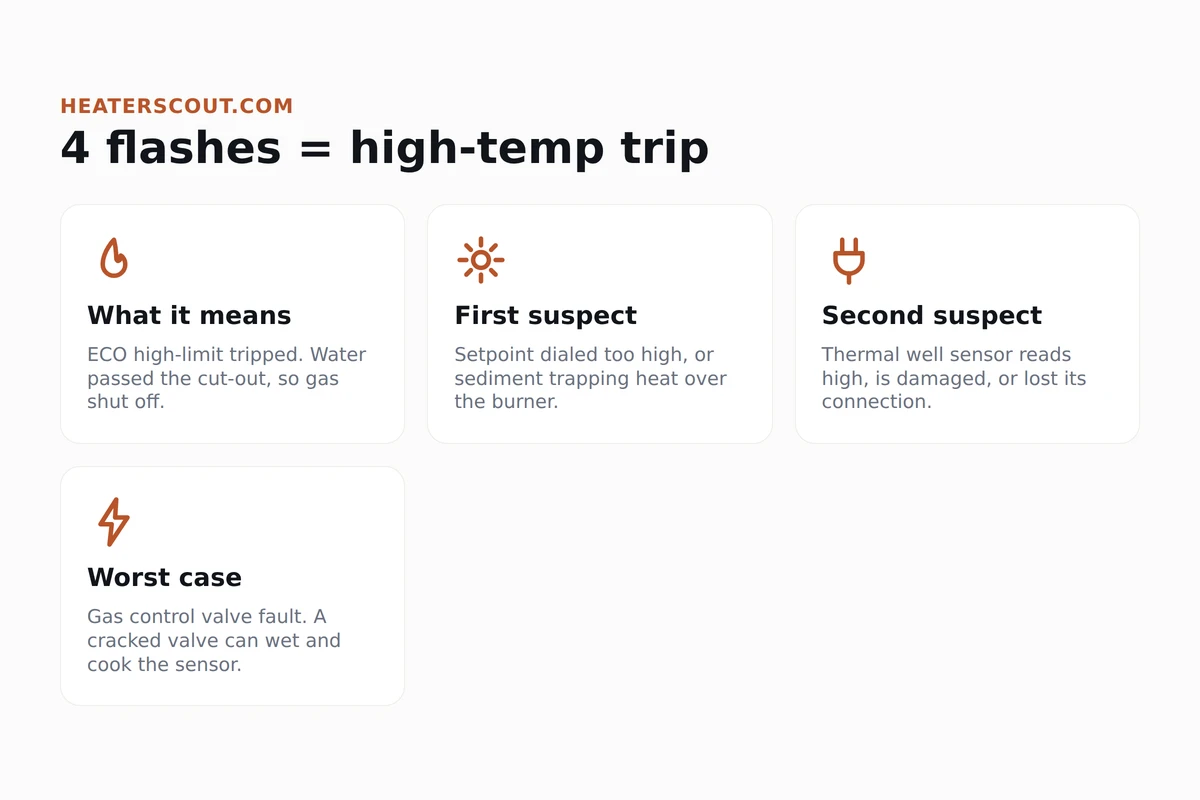
Four quick flashes, a pause of about three seconds, then four quick flashes again. On a Bradford White ICON gas control that pattern is not a suggestion, it is the heater telling you it already shut the gas off. The control saw the water pass its ECO high-temperature limit and cut the burner as a safety response. What makes the four-flash code tricky is that it does not always mean the water was genuinely too hot. Sometimes the tank really overheated, and sometimes the sensor that watches the temperature just lied about it. Telling those two apart, in the right order, is the whole job.
Quick answer
Four flashes on a Bradford White ICON control is a high tank temperature (ECO) trip: the water passed the energy cut-out limit, so the control shut off the pilot and main gas. Reset it by turning the temperature knob to its lowest setting for at least six seconds, then back to your setpoint. But reset once, not repeatedly. If it returns, work the cause in order: setpoint too high, sediment trapping heat, a thermal well sensor reading high or disconnected, and finally the gas control valve itself.
Reset once, then diagnose
Do not keep resetting a four-flash code to force the burner back on, and never jumper or bypass the sensor. This is a real high-temperature safety trip. If the water at a tap is scalding, turn the gas control knob to OFF and leave it off until you have found the cause. Repeated ECO trips are a fault to diagnose, not a nuisance to silence.
What the ICON control is actually reporting
The status light sits on the ICON gas control valve at the base of the tank, and it reports faults by flash count, each burst separated by a roughly three-second pause. Four flashes is the high-temperature code. In Bradford White's own words the water rose past the ECO, the energy cut-out high limit built into the control, so the control immediately turned off the pilot and the main gas valve. On a power-vent model the blower usually keeps running until you reset. The ECO is not a thermostat you can adjust; it is a fixed upper safety limit that exists to cut the gas before the water gets dangerously hot.
Here is the part the generic blog posts skip. Four flashes means the control believes the water crossed that limit, not that the water is provably too hot right now. The control only knows what the thermal well sensor tells it. If the sensor reads high because the water really is hot, the trip is honest. If the sensor reads high because it is damaged, poorly seated, or the gas valve is failing, the trip is a false alarm from a real fault. Both show four flashes. So the code splits into two worlds, genuine over-temp and sensor-or-valve fault, and your job is to figure out which one you are in before you buy anything.
Confirm your generation first
Before you match any flash count to a meaning, check which ICON generation you have, because Bradford White revised the flash tables between them. Read the serial number off the rating label. A date code before TA, which is January 2019, is ICON 1.0. A date code of TA or later, January 2019 onward, is ICON 2.0. For the four-flash high-temperature code the meaning holds across both generations, so you are safe here, but if you end up cross-checking other counts on the same unit, use the chart that matches your generation rather than a one-size list off the internet.
The verdict
Four flashes is a high-temperature ECO trip. Reset once with the knob-to-minimum-for-six-seconds move. If it comes back, chase the causes cheapest first: lower the setpoint, flush sediment, check the thermal well sensor connection, then suspect the gas control valve. Genuine scalding-hot water means shut the gas off and stop resetting.
The reset, done right
Bradford White gives a simple reset for the ECO trip: rotate the temperature control knob to its lowest or minimum setting, leave it there for at least six seconds, then turn it back to your normal setpoint. That signals the control to clear the high-temperature lockout. It works when the trip was a one-time event, say the tank briefly overshot after a big draw and recovery.
Many techs prefer the fuller cool-down cycle, and it is worth knowing because it also lets the water near the sensor actually cool before you retry. Turn the gas control knob to OFF and wait a full five minutes. Set the knob to PILOT, hold it in to let gas flow to the pilot, and press the igniter button until the pilot lights and holds. Then return the knob to your setting. If the pilot will not stay lit or the four-flash returns immediately, the water was not the problem, the sensor or valve is, and no amount of resetting will change that. This is the line where you stop cycling the knob and start diagnosing.
Cause order, cheapest first
The four-flash code has a clear cost ladder. Climb it from the bottom so you do not spend three hundred dollars on a valve when the fix was a dial and a garden hose.
Setpoint too high. If the temperature knob is turned toward the hot end, the water sits close to the ECO limit all the time, and a normal heating cycle can nudge it over, especially with a sensor that reads a little high. Back the dial to about 120 degrees. That is the recommended setting for scald safety anyway, and on a lot of units it makes the four-flash disappear for free. Give it a day at the lower setpoint before you decide it did not work.
Sediment trapping heat. Hardness scale settles on the tank bottom directly over the burner. That layer insulates the water above it and lets the metal and the water right at the bottom, where the sensor well often sits, run much hotter than the water at the top. The result is a heater that trips the ECO even though your hot water never felt scalding. Draining and flushing the tank, or doing a fuller descaling if you are on hard water, clears this. If you have never flushed the tank and you are getting four flashes, do this before you touch the sensor.
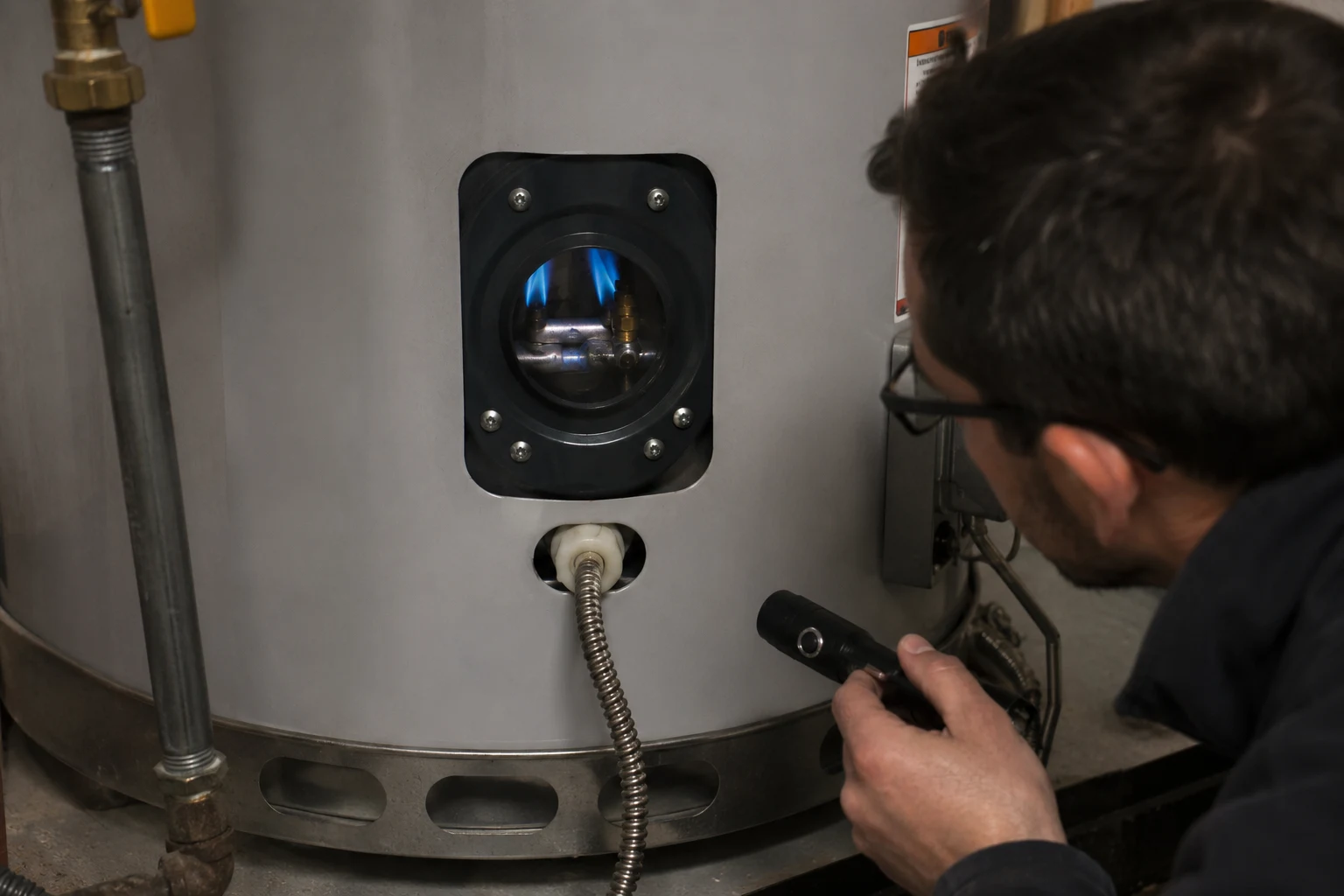
Thermal well sensor. Behind the gas valve is a well with a temperature sensor in it, and the control reads the water temperature from that sensor. If the sensor is reading high, sitting loose in the well, or has a corroded or unseated connector, the control gets a false high reading and trips. Checking the connection is homeowner work: with the gas off, remove the gas valve cover, usually two Torx screws, and confirm the sensor lead is fully seated and clean. A loose plug alone can throw this code. Replacing the sensor is a bigger job and the part runs about 85 to 90 dollars.
Gas control valve. The valve is the expensive end and, importantly, it can be the hidden cause behind a bad sensor. If the valve develops a hairline crack, water can seep into the well and cook the sensor, which then reads high and trips the four-flash. Replace only the sensor in that case and you are back in a week. So before you buy a sensor, look for water in the well. A repeating four-flash on a tank that is at 120 degrees, freshly flushed, with a clean sensor connection, points at the valve, and that is a licensed-plumber job because it means draining the tank and disconnecting gas.
DIY versus calling a pro
The split follows the cause ladder. Lowering the setpoint and flushing the tank are squarely homeowner work, and between them they resolve a large share of four-flash codes at zero or near-zero cost. Checking the sensor connection under the valve cover is also fair game if you are comfortable working around gas with the gas fully off. Where most people should stop is anything that means draining the tank and pulling the sensor or the valve. Replacing the gas control valve in particular involves disconnecting the gas supply, and getting that wrong is a leak or worse.
Setpoint and sediment
Back the dial to 120 degrees and flush the tank. Free to cheap, no gas work, and it clears a large share of four-flash trips. Give it a day at the lower setting before deciding.
Sensor connection check
Gas fully OFF, pull the two-screw valve cover, reseat and clean the sensor lead. A loose or corroded plug alone can throw four flashes. No draining, no gas line, just the connector.
Sensor or valve replacement
Draining the tank, pulling the well, or swapping the gas control valve is licensed-plumber work. Check for water in the well first, and check warranty before you buy the valve.
Warranty, parts, and the safety rule that matters most
Pull the model and serial number before you spend a dollar. Bradford White tanks carry a 6 to 10 year warranty, and a defective gas control valve or temperature sensor is frequently covered on a claim, which can turn a valve replacement into a labor-only bill. The ICON gas control valve runs about 228 to 375 dollars OEM, the temperature sensor about 85 to 90, and a plumber replacing the valve typically bills 300 to 500 dollars parts and labor. Those numbers are the reason you climb the cause ladder from the bottom instead of assuming the worst.
The rule that outranks all of it: a four-flash is a high-temperature safety trip, so do not defeat it. Resetting once to confirm a one-time event is fine. Resetting over and over to keep a burner running through a genuine over-temperature condition is how people get scalded and how a small fault becomes a bigger one. If the water at a tap is scalding hot, or the code returns immediately after a clean reset on a properly set, flushed tank, shut the gas control knob to OFF and get a tech. The control is doing its job. Your job is to find out why it had to.
Frequently asked
What does 4 flashes mean on a Bradford White water heater?
On a Bradford White ICON gas control, four quick flashes separated by a roughly three-second pause is a high tank temperature fault. The control saw the water climb past its ECO, the energy cut-out high limit, and it immediately shut off the pilot and the main gas as a safety response. On a power-vent unit the blower usually keeps running until you reset the control. The catch is that four flashes does not always mean the water is actually too hot. The same code fires when the thermal well sensor reads high, is damaged, or lost its connection, and when the gas control valve itself is failing. So read it as a high-temperature report from the control, then work out whether the water was truly overheated or the sensor lied about it. Confirm the count against the chart on your own unit, because Bradford White changed the flash tables between the ICON 1.0 and 2.0 generations.
How do I reset a Bradford White 4-flash code?
Bradford White's own instruction is to rotate the temperature control knob to its lowest or minimum setting and leave it there for at least six seconds, then turn it back to your normal setpoint. That tells the control to clear the ECO trip. A lot of field techs use the fuller cool-down cycle instead: turn the gas control knob to OFF, wait a full five minutes for the water near the sensor to cool, set the knob to PILOT, hold it in to let gas flow, press the igniter button, and once the pilot holds, return the knob to your setting. Either method clears a one-time trip. Neither one fixes a cause. If the water genuinely overheated because of a high setpoint or a sediment-packed tank, the code comes right back until you fix that. Reset once to confirm, not as the repair.
Why does my Bradford White keep flashing 4 times after I reset it?
A four-flash code that returns after a clean reset is telling you the cause is still there. Work it in order. First, the setpoint: if the dial is toward the hot end, back it to about 120 degrees, because a high setpoint plus a slow-recovering sensor can trip the ECO on a normal heating cycle. Second, sediment: a layer of hardness scale on the tank bottom traps heat right over the burner and drives local temperature past the limit even when the water up top is only warm, so flush the tank. Third, the thermal well sensor: if it reads high or is loose in its well, the control thinks the water is hotter than it is. Fourth, the gas valve. A repeating four-flash on a tank at a sane setpoint, flushed clean, with a good sensor connection points at the sensor or the valve, and that is where a licensed tech takes over.
Is a 4-flash code on a Bradford White dangerous?
The trip itself is the safety system working. The ECO high limit exists to cut the gas before the water gets dangerously hot, and four flashes means it did exactly that. Scalding is the real risk behind it: water above about 140 degrees can scald quickly, and a genuine over-temperature event means someone at a tap could have gotten hurt. The dangerous move is not the code, it is defeating it. Do not keep resetting a four-flash to force the burner back on, and never jumper or bypass the sensor to make the heater run through the warning. If the water at the tap is scalding hot, shut the gas control knob to OFF and leave it off until you have found and fixed the cause. A control that trips the ECO repeatedly is not a nuisance to silence, it is a fault to diagnose.
Can I fix a Bradford White thermal well sensor myself?
Partly. Checking the sensor is homeowner-friendly: with the gas off, you can pull the gas valve cover, usually two Torx screws, and confirm the sensor lead is fully seated and the connector is clean, because a loose or corroded connection alone can throw a four-flash. What is not casual DIY is replacing the sensor or the well, since on many ICON units the temperature sensor is closely tied to the gas control valve assembly, and getting at the well can mean draining the tank. The sensor part runs around 85 to 90 dollars. If a cracked valve has been leaking water into the well and cooking the sensor, replacing just the sensor is a temporary fix, the valve is the real problem. Confirm whether water is present in the well before you spend on a sensor.
How much does it cost to fix a Bradford White 4-flash code?
It ranges from free to a few hundred dollars depending on the cause. Backing off the temperature setpoint costs nothing. Flushing sediment costs an hour and a garden hose. A thermal well sensor is roughly 85 to 90 dollars for the part. The ICON gas control valve is the expensive end, about 228 to 375 dollars for an OEM valve, and a plumber replacing it typically bills 300 to 500 dollars parts and labor because the tank has to be drained and the gas line disconnected. Before you buy any part, pull the model and serial number off the rating label and check the warranty. Bradford White tanks carry a 6 to 10 year warranty, and a defective gas control valve or sensor is often covered, which can drop a valve job to labor only.
How do I know if I have ICON 1.0 or 2.0?
Read the serial number off the rating label. Bradford White encodes the manufacture date in the serial, and the date code letters tell the generation. Units with a date code before TA, which corresponds to January 2019, are ICON 1.0. Units with a date code of TA or later, January 2019 onward, are ICON 2.0. It matters because Bradford White revised the flash-code tables between the two, so a count that means one thing on a 1.0 valve can map slightly differently on a 2.0. For the four-flash high-temperature code the meaning is consistent across both, but if you are cross-checking other counts, confirm against the chart for your generation rather than a generic list. When in doubt, the label and manual on the heater in front of you win.