A Bradford White that quits making hot water is usually telling you what is wrong before you touch a tool. On the gas models the ICON control valve blinks a status code at the base of the tank, and the count between the pauses points straight at the fault. On the electric models a single red reset button behind a panel explains most dead units. The work is sorting the things a homeowner can safely check, the flash count, the pilot, the temperature dial, the reset button, from the few failures where the right move is to shut it down and call a licensed tech.
Figure out which heater you have
Gas or electric changes everything. Gas Bradford White units carry the ICON gas control valve with a status light near the floor. Electric units have two thermostats and a red ECO reset behind the upper access panel. Sort this before you diagnose anything.
Gas: count the ICON status light
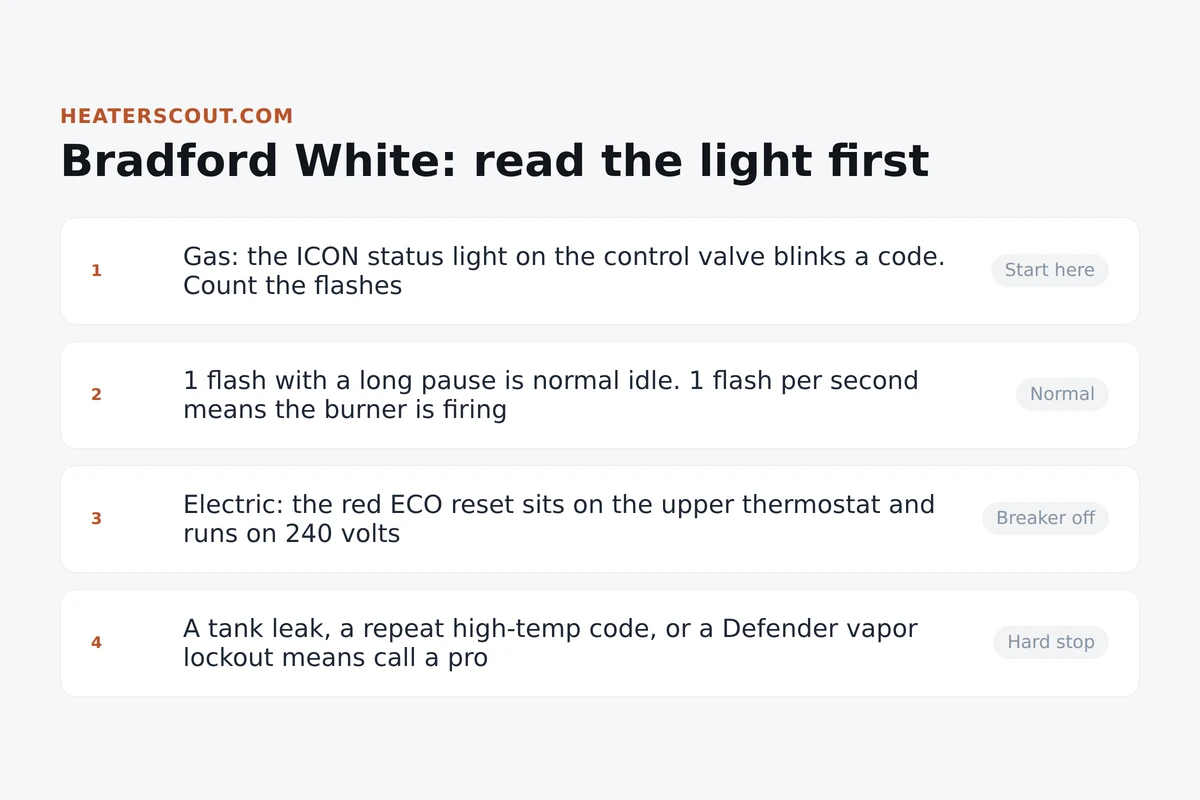
One flash with a long pause is normal idle. One flash per second is the burner firing. A repeating group of two or more flashes with a three second pause is a fault code. Count it and match it to the chart on your heater's label.
Confirm your ICON generation
The serial date code tells you ICON 1.0 or 2.0. It matters because the tables differ, ICON 1.0 uses a three, seven, and eight flash that 2.0 does not. Read the count off your own unit, not a generic list.
Electric: check the ECO reset, breaker off
No status light on electric. The red button on the upper thermostat is the high limit reset, and it lives on 240 volts. Kill the breaker first, then look.
The short version
Two signals start every Bradford White diagnosis. On gas, the ICON status light: one flash with a long pause is normal, a repeating two, four, five, or six flash pattern is a fault code you read off the heater's own label. On electric, the red ECO reset on the upper thermostat, pressed only with the breaker off. A tank leak code, a repeating high temperature code, a Defender vapor lockout, and any gas smell are the hard stops where you call a pro.
| Gas, no LED | No pilot or heater not running. Relight per the label; if nothing lights, check gas supply and the pilot orifice. |
| Gas, 1 flash + long pause | Normal idle. Knob in pilot or thermostat satisfied. Nothing wrong. |
| Gas, 1 flash per second | Normal. Thermostat calling for heat, burner firing. |
| Gas, 2 flashes | Weak pilot signal. Verify the pilot, clean it, check thermopile voltage. Below ~400 mV under load, replace the thermopile. |
| Gas, 4 flashes | High tank temperature. Check setpoint, temp probe, and heat migration. Repeat trips are a call-a-pro. |
| Gas, 5 flashes | Thermostat sensor fault. Check the probe connection; a confirmed fault usually means a new gas control valve. Pro job. |
| Gas, 6 flashes | Tank leak flagged by an accessory module. Treat a real tank leak as replace, not repair. |
| Gas, 3 / 7 / 8 flashes (ICON 1.0) | 3 = no temp rise in time; 7 = gas valve fault; 8 = pilot stays lit with the knob off. All point at the valve. |
| Gas, solid light on | Control shutting down because the knob was turned off. Wait for the light to go out before relighting. |
| Electric, no hot water | Tripped ECO, or a failed element or thermostat. Reset once, breaker off; a repeat trip means diagnose. |
| Electric, runs out fast | Dead lower heating element, or heavy sediment cutting usable volume. |
| Water too hot | Dial above Hot (120 F), or a failed thermostat sticking the heat on. |
| Leak at the TPR valve | Thermal expansion or a worn valve. Replace it, add an expansion tank if it recurs. Never cap it. |
| Leak at the tank base | Tank corroded through, or a six flash leak code. Not repairable. Replace the unit. |
| Rumbling / popping | Sediment on the tank floor. Drain and flush, even with Hydrojet. |
No hot water: read the light, then the reset
No hot water is the call that starts most of these, and the first fork is fuel type. On a gas Bradford White, go to the ICON status light on the gas control valve near the floor. One flash with a long pause is the heater at rest and healthy, one flash per second means it is firing, and a repeating group with a three second pause is a code. Two flashes is a weak pilot, four is high tank temperature, five is a sensor fault that usually ends at the gas valve, and six is a tank leak. Count yours and match it to the chart on the heater, because ICON 1.0 and 2.0 number a few codes differently.
On an electric Bradford White with no hot water there is no status light. The usual culprit is the ECO, the red high temperature reset on the upper thermostat. Kill the breaker first, because that panel sits on 240 volts. With the power off, fold the insulation back, press the red button until it clicks, and close everything up before restoring power. If the reset holds, you are done. If it trips again within a day, the water is overheating from a stuck thermostat or a shorted element, and that is where you stop resetting and get it diagnosed.
Pilot, thermopile, and the Defender system
A pilot that will not stay lit is the classic gas complaint, and on a Bradford White it ties to the two flash code. Relight the right way: knob to off, wait five to ten minutes, knob to pilot, hold the pilot button down, and click the piezo igniter until the flame catches. Keep holding about a minute so the flame heats the thermopile, then release. If the pilot dies when you let go, the thermopile is weak or the flame is small and dirty; a healthy thermopile holds enough millivolts under load to keep the valve open, and below roughly 400 the valve drops out. Clean the pilot, make sure the flame wraps the tip, retest. A pilot that holds but the burner still will not run points at the valve.
The Defender Safety System is worth understanding before you chase a lockout in circles. It is Bradford White's flammable vapor ignition resistant design, a sealed chamber with a Screen Lok flame arrestor and a vapor sensor, so the heater shuts down rather than igniting gasoline or solvent fumes that pool near the floor. Bradford White makes theirs resettable without parts. The catch is that a lockout is not a reset and forget. It sensed vapor, so the honest fix is to find the source, clear it, ventilate, and only then reset per the manual. A second lockout means an ongoing vapor problem and a licensed tech.
Temperature, TPR, leaks, and sediment
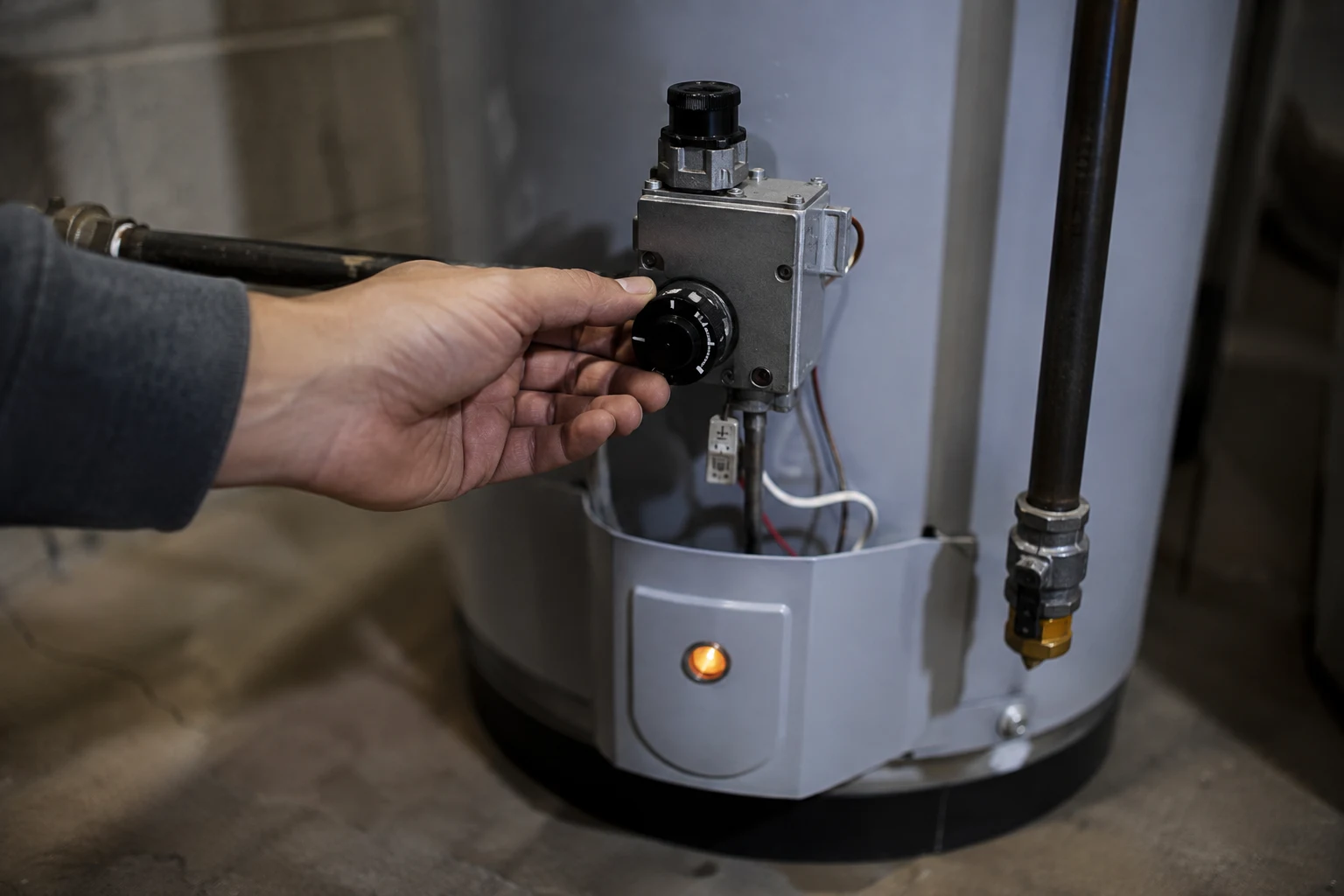
If the water comes out scalding, check the setting before you assume a failure. On a gas Bradford White the dial on the ICON valve runs Low, Hot, then A, B, C, and Very Hot. Hot is about 120 F, each letter steps roughly ten degrees, so C lands near 150, and factory is 120 where most homes should leave it. On electric there are two thermostats behind the upper and lower panels, both set to the same point with a flat screwdriver, breaker off. Water hotter than the dial says, or that will not turn down, is a failing thermostat, not a setting.
Where a leak shows up decides everything. A little water dripping from the temperature and pressure relief valve during a heating cycle can be normal thermal expansion, but a TPR that drips steadily means the pressure is too high or the valve is worn. It is the tank's last line safety device, so never plug or cap it. Replace it, and if a new valve keeps discharging, the house needs a thermal expansion tank. The one leak you cannot fix is water weeping from the body of the tank, or a six flash leak code, which means the steel has corroded through and the tank needs replacing. Keep a drip pan with a drain under it so a slow leak goes somewhere safe.
Rumbling and popping is sediment on the tank floor, water flashing to steam under mineral scale. Bradford White's Hydrojet dip tube stirs the bottom to slow that buildup, but it does not replace a flush. Drain and flush once a year, more on hard water. Let it go and the scale cooks hard and capacity drops for good.
- Gas leak or a smell of gas near the heater, leave and call the gas utility, do not flip switches.
- A Defender flammable vapor lockout that trips again after you clear the room and reset.
- A four flash high tank temperature that returns, or an electric ECO that trips a second time in a day.
- A five flash sensor fault or, on ICON 1.0, a seven flash gas valve fault that stays after a reset.
- A six flash tank leak code, or water weeping from the body or bottom of the tank.
- A TPR valve that keeps discharging after a new valve and an added expansion tank.
- Any 240 volt electrical work beyond pressing the reset button with the breaker off.
The stop-and-call-a-pro line
Plenty of this is homeowner work: relighting a pilot, resetting an ECO once, turning the dial back from scalding, flushing sediment, checking a thermopile. The line worth respecting is where a fault keeps coming back or where the failure is the tank or the safety system. A four flash high temperature that returns, or an electric ECO that trips twice, both mean the water is overheating, and repeated resets just wear out a safety device. A five flash sensor fault and a seven flash gas valve fault end at the gas valve. A six flash leak code or water from the body of the tank is a replacement. A Defender lockout that keeps tripping is a vapor problem in the room. None of those are dial and reset jobs.
Everything above that line is a reasonable afternoon for a careful homeowner with the breaker off and the manual open. Everything below it is where a licensed plumber or gas tech earns the call, because the failure mode is a burn, a flood, or a combustion problem. On a gas Bradford White the tie breaker is always the flash chart on your own unit, read against the right ICON generation.
Frequently asked
What do the flashing lights on my Bradford White gas water heater mean?
The status light on the ICON gas control valve at the base of the tank is a diagnostic display you read by counting flashes between the pauses. On a current ICON 2.0 control, one flash with a long four second pause is normal idle, and one flash every second means the burner is firing. A repeating group with a three second pause is a fault: two flashes is a weak pilot signal, four is high tank temperature, five is a thermostat sensor fault that usually means the gas valve, and six is a tank leak picked up by an accessory module. Older ICON 1.0 controls add a three flash, a seven flash gas valve fault, and an eight flash. Match the count to the chart on your own heater, not a number off the internet.
How do I know if I have ICON 1.0 or ICON 2.0?
It is the serial number date code on the rating label. Bradford White uses a two letter month and year code at the front of the serial, and a date code of TA, January 2019, and later is generally ICON 2.0. Before that is ICON 1.0. The two share the common codes, two for a weak pilot, four for high temperature, five for a sensor fault, but ICON 1.0 also uses a three flash, a seven flash gas valve fault, and an eight flash, and times its normal patterns differently. If your serial sits on the changeover, Bradford White says to call technical support or check the manufacture date in their contractor app. The chart on your label is the tie breaker.
Where is the reset button on a Bradford White electric water heater?
It is the red button on the upper thermostat, the high temperature cutoff everyone calls the ECO, behind the upper access panel with the insulation folded back. Turn off the breaker before you touch anything in there, because those terminals sit on 240 volts and the reset does nothing to change that. With the power off, press the red button until it clicks, then close it all up before restoring power. A gas Bradford White has no red button; the same overheating shows up as a four flash high tank temperature code. On electric, if the reset holds you are done. If it trips again within a day, the water is genuinely overheating from a stuck thermostat or a shorted element, and that is a stop and diagnose, not a keep resetting.
Why won't my Bradford White pilot light stay lit?
Relight the right way first: knob to off, wait five to ten minutes, knob to pilot, hold the pilot button down, and click the piezo igniter until the flame catches. Keep holding about a minute so the flame heats the thermopile, then release. If the pilot dies the moment you let go, the cause is usually a weak thermopile or a small dirty pilot flame, which is what the two flash code means. A healthy thermopile holds enough millivolts under load to keep the gas valve open, and below roughly 400 the valve drops out. Clean the pilot, make sure the flame wraps the tip, and retest. If the pilot will not light at all, suspect a clogged orifice or pilot tube, a bad igniter, or no gas at the valve.
What is the Defender Safety System and can I reset it?
The Defender Safety System is Bradford White's flammable vapor ignition resistant design: a sealed combustion chamber, a Screen Lok flame arrestor at the base, and a vapor sensor, so that if gasoline or solvent fumes pool near the heater, the control shuts the burner down instead of igniting them. Bradford White is the brand that makes theirs resettable without parts, where most make you replace a fused cutoff. But a lockout is not a reset and forget. It sensed vapor, so the real fix is to find and remove the source, a gas can, paint thinner, a spill, ventilate the space, and only then reset per the manual. If it locks out again, stop and call a licensed tech, because you have an ongoing flammable vapor problem in the room.
Does the Hydrojet system mean I never have to flush my Bradford White?
No, and that is the common misread. Hydrojet is a cold water dip tube with jet ports that stir the bottom of the tank as new water comes in, so sediment stays suspended and washes toward the drain instead of caking on the floor. It reduces buildup, it does not eliminate it. Bradford White still calls for draining and flushing the tank once a year, more on hard water. Think of Hydrojet as making each flush more effective, not as a self cleaning tank. Skip flushes for years and you still get rumbling, lost capacity, and faster failure on an old tank.
When should I replace my Bradford White instead of repairing it?
Age plus the kind of failure decides it. A residential tank typically lasts eight to twelve years, and past that the math tilts toward replacement. The clearest replace it sign is water weeping from the body of the tank, or a six flash leak code, which means the steel has corroded through. A four flash high temperature that keeps returning, or an electric ECO that trips over and over on an old unit, leans the same way. Repairs make sense on a younger tank: a weak thermopile, a pilot that will not hold, a shorted element, a worn TPR valve, a tired anode rod. The judgment call is a gas control valve on a ten year old heater, where the valve plus labor approaches a chunk of a new unit.