A single slow flash with a long pause on a Bradford White water heater is not a fault, it is the ICON control telling you the heater is idle and healthy. The trouble is that the number that means danger on one heater can mean normal on another, because Bradford White changed the ICON flash tables in January 2019. A two-quick-flash strobe is normal heating on an older ICON 1.0 and a nonexistent pattern on a newer ICON 2.0, while a seven-flash gas-valve fault exists only on 1.0. This page maps both tables, shows how to tell which one your heater speaks, and routes every fault count to the part most likely behind it.
Key takeaways
- The ICON status LED sits on the gas control valve. One flash with a long pause is idle-and-fine; a steady one-per-second on ICON 2.0 is the burner firing normally.
- Flash meanings changed between ICON 1.0 (pre-2019) and ICON 2.0 (Jan 2019 and later). Your serial date code decides which table you read: TA and later is 2.0.
- Two flashes is a weak pilot signal on both generations, the cheap end: pilot assembly or thermopile, around $110.
- Four flashes is high tank temperature on both, a real over-temp trip. Check setpoint, sediment, temperature probe, and plumbing heat migration before the valve.
- Seven and eight flashes exist only on ICON 1.0 (gas-valve faults). ICON 2.0 stops near six and folds valve trouble into the 2-flash and 5-flash codes.
- Reset once with the knob, wait for the LED to go out, then relight. If the same count returns, stop resetting and diagnose the cause.
Why the same flash count means two different things
ICON stands for Bradford White's intelligent gas control, a valve with a small microprocessor that runs the pilot, the burner, and a self-diagnostic routine and reports its state through a single status LED. The system has gone through two generations, and they do not flash the same. ICON 1.0 shipped before January 2019. ICON 2.0 shipped from January 2019 onward. Bradford White marks the changeover with the serial date code TA. That two-letter prefix on the serial number is your Rosetta Stone: TA or later reads the 2.0 table, before TA reads the 1.0 table. If your serial sits right at the boundary, confirm with Bradford White technical support or the For The Pro contractor app before you trust a count.
The practical trap is the normal-operation patterns. On an ICON 1.0, when the thermostat calls for heat and the burner is firing, the LED runs a strobe of two quick flashes. People see that rapid double-blink, assume it is a fault code, and start chasing a problem that does not exist. On an ICON 2.0 that same call-for-heat state shows as one flash every second, a slower and calmer rhythm. Meanwhile a genuine two-flash fault, a weak pilot signal, has a distinct three-second pause between bursts. Rhythm is everything: idle is one flash and a long pause, active heat is either a steady one-per-second or a quick strobe depending on generation, and a fault is a burst of counted flashes with a three-second gap.
The ICON flash-code map, both generations
This table pulls the codes straight from the Bradford White quick service guide and sets the two generations side by side so you can see where they agree and where they diverge. Read the column that matches your serial. Where a cell says normal, the light is not reporting a problem.
| LED pattern | ICON 1.0 (pre-2019) | ICON 2.0 (Jan 2019+) | Where it points |
|---|---|---|---|
| No LED | No pilot / not running | No pilot / not running | Relight per the label |
| 1 flash + long pause | Idle: knob in pilot or thermostat satisfied | Idle: knob in pilot or thermostat satisfied | Normal, no fault |
| Call-for-heat rhythm | Strobe: two quick flashes | One flash every second | Normal, burner firing |
| 2 flashes + 3 sec | Weak pilot signal | Weak pilot signal | Pilot / thermopile / wiring |
| 3 flashes + 3 sec | No temp rise in proper time | (not used) | Damper / heat delivery |
| 4 flashes + 3 sec | High tank temperature | High tank temperature | Setpoint, sediment, temp probe |
| 5 flashes + 3 sec | Thermostat sensor fault | Thermostat sensor fault | Temp probe / gas-valve cover |
| 6 flashes + 3 sec | Water leak (accessory module) | Tank leak (accessory module) | Leak detection, replace tank |
| 7 flashes + 3 sec | Gas valve fault | (not used) | Reset once, then replace valve |
| 8 flashes + 3 sec | Pilot lit while knob OFF | (not used) | Replace gas valve |
| Solid / continuous ON | Knob OFF | Control shutting down / knob OFF | Not an error, wait for it out |
Notice the shape of the difference. ICON 1.0 spreads gas-valve trouble across a three-flash no-temp-rise code, a seven-flash valve fault, and an eight-flash stuck-pilot code. ICON 2.0 deletes all three and pushes that logic into the two-flash weak-pilot and five-flash sensor codes, so its list is shorter and stops around six. If you are counting seven or eight flashes, you are on 1.0, full stop. If you never see a strobe and the burner-firing state is a steady one-per-second, you are on 2.0.
The numbers that matter
A few figures anchor how you triage an ICON code. The serial boundary tells you which table applies, and the part prices tell you how hard to work the cheap end of the chart before you touch the valve.
The pricing gap is the whole reason to diagnose before you buy. A two-flash weak-pilot code that turns out to be a tired pilot assembly is a hundred-dollar part and an hour of work. Jumping straight to the gas valve on the same symptom is two hundred fifty dollars plus draining the tank and breaking the gas connection. The ICON 2.0 valve, part 415-52907-01 or -02 depending on the connection size, replaces the older ICON 1.0 valve 239-47463 series, so a 1.0 heater usually gets upgraded to the 2.0 valve when it fails. Before buying either, pull the model and serial off the rating label and check the warranty, because the gas control valve is a covered part on most Bradford White gas heaters for several years.
What each fault count actually is
Two flashes is a weak pilot signal and the friendliest fault on the list. The control is not getting enough voltage from the thermopile, the sensor the pilot flame heats to power the valve. Usually the pilot is weak, dirty, or partly out, so it fails to bathe the thermopile tip. Confirm a strong blue pilot flame, clean and reseat the leads at the gas valve, and if a meter reads low thermopile voltage under load, replace the pilot assembly. Bradford White lists the gas valve as the backup suspect only if the pilot and thermopile are good.
Four flashes is high tank temperature, a real over-temperature trip on both generations. The service path is to check the temperature probe resistance, confirm the water actually exceeded the setpoint, and rule out heat migration in the plumbing before condemning parts. Dial the setpoint toward 120 degrees and flush sediment first. Five flashes is a thermostat sensor fault, where the control cannot trust its own temperature reading; because that probe lives in the gas-valve cover, a genuine five-flash often ends in a cover-with-probe or full valve replacement. Three flashes, an ICON 1.0-only code, means the valve did not see the tank temperature rise in the expected time, which points at heat delivery, a stuck damper on damper-equipped models, or a burner not doing its job.
The high counts are ICON 1.0 territory. Seven flashes is a gas valve fault: reset once, and if it returns, replace the valve. Eight flashes means the pilot stayed lit with the knob in the off position, another valve replacement. On both generations, six flashes reports a leak detected by the accessory leak module, and that is not a repair code, it is a signal the tank itself may be failing. These are the codes where warranty and a licensed tech matter most.
ICON System
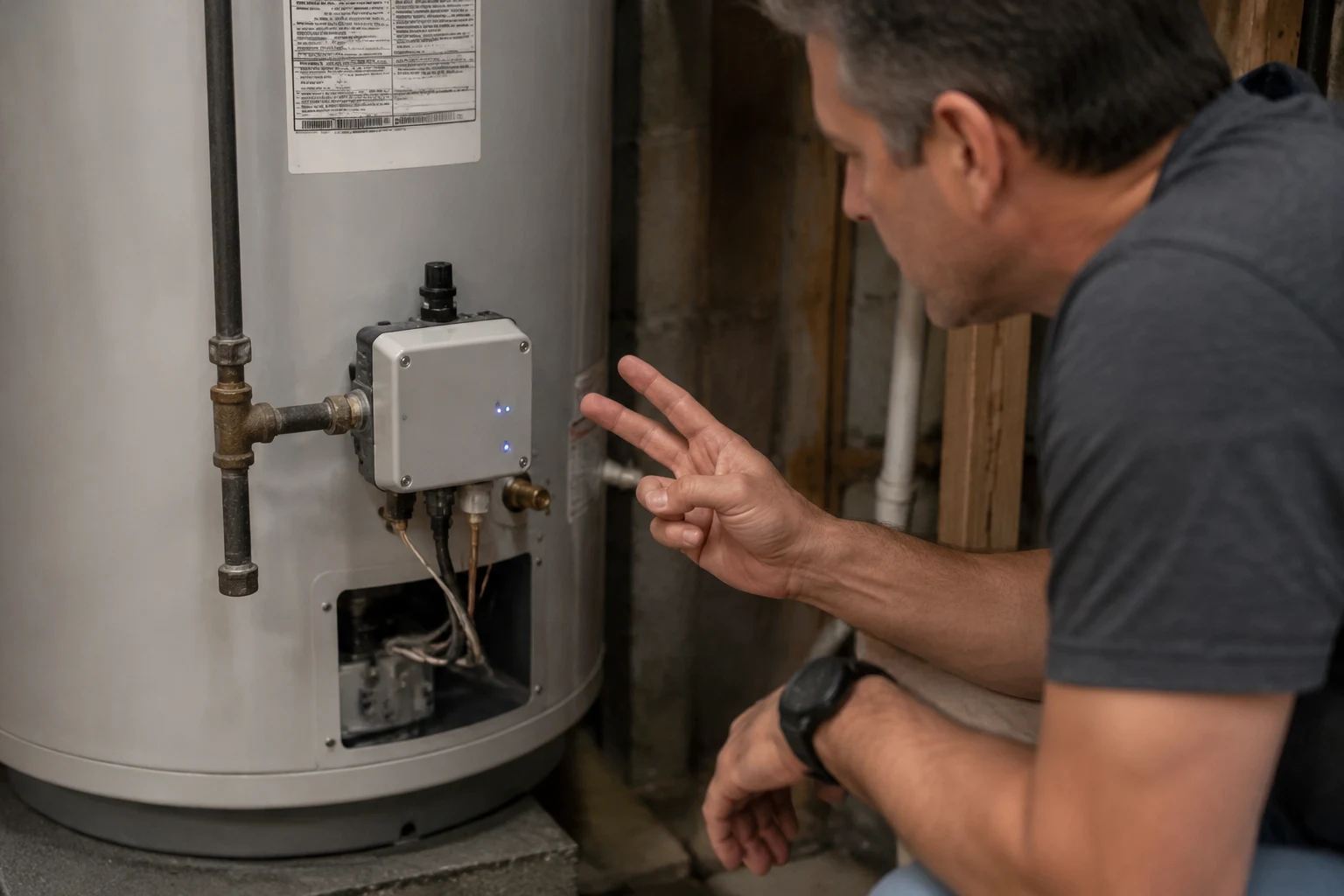
Bradford White's intelligent gas control: a microprocessor-driven gas valve that runs the pilot and burner, monitors tank temperature through an integral probe, and reports its state through a single status LED. One slow flash with a long pause means idle and healthy; a burst of counted quick flashes separated by a roughly three-second pause is a fault code. The system has two generations, ICON 1.0 (before January 2019) and ICON 2.0 (serial date code TA and later), and their flash tables differ: 1.0 uses a two-quick-flash strobe for normal heating and runs fault counts up to eight including dedicated gas-valve codes, while 2.0 uses a steady one-per-second heating rhythm and stops around six. Bradford White atmospheric ICON heaters are also FVIR designs with a ScreenLok flame arrestor, so combustion-air and flammable-vapor problems surface through the high-temperature and cleaning paths rather than a separate color track. Always confirm the generation against the rating label on the heater in front of you.
Reset, and where the DIY line sits
The soft reset is the same across these codes and worth doing once before spending money. Turn the ICON gas control knob to OFF and wait until the status LED stops glowing. That solid-on light after you turn the knob off is the control powering down, not a fault, and relighting before it finishes can scramble the sequence. Once the LED is out, relight the pilot per the instructions printed on the water heater and return the knob to your setting. There is no separate red ECO button on an ICON gas valve the way there is on an electric heater; the knob cycle is your reset.
Where you stop depends on the count. The two-flash weak-pilot job is squarely homeowner work with a screwdriver, a wrench, a multimeter, and a cheap pilot assembly. The four-flash high-temp code starts as homeowner work, backing off the setpoint and flushing sediment, and only becomes a pro job if it returns on a clean, correctly set tank. Five, seven, and eight flashes are the valve, and swapping an ICON gas control valve means draining the tank and breaking the gas connection, which is where most people call a licensed plumber. A six-flash leak code is not a repair at all; it is a heater on its way out.
One habit protects you from all of it: read the count off the LED, note it and the LED rhythm, then confirm the meaning against the chart printed on your heater and the serial date code before you buy a part. On a heater built right at the January 2019 changeover, the same seven flashes could be a real gas-valve fault or a miscounted normal state depending on the generation, so the label on the appliance in front of you always wins over a generic table. From here, each fault count has its own page that walks the full test-and-fix path, so once you have your count and your generation, follow it to the code that matches.
Frequently asked
What does the blinking light on my Bradford White water heater mean?
The small status LED near the base of the ICON gas control valve is a diagnostic readout, and the flash pattern is the code. One flash followed by a long pause means the heater is idle and fine, either the knob is in the pilot position or the thermostat is satisfied. A steady one-flash-per-second rhythm on an ICON 2.0 means the burner is firing normally. The pattern you care about is a repeating burst of quick flashes with a roughly three-second pause between bursts, because that is a fault code. Two flashes is a weak pilot signal, four is high tank temperature, five is a thermostat sensor fault. Count the flashes in one burst, wait through the pause, and confirm you get the same count again. Then match it to the chart for your control generation, because the meanings shifted between ICON 1.0 and 2.0.
How do I know if I have ICON 1.0 or ICON 2.0?
Read the serial number date code on the rating label. Bradford White uses a two-letter month-year code at the front of the serial, and the code TA corresponds to January 2019. Units built in TA and later run ICON 2.0; units built before TA run ICON 1.0. This matters because the flash tables are not identical. On ICON 1.0 a strobe of two quick flashes is normal heating and the fault counts run all the way to seven and eight, including a dedicated gas-valve fault. ICON 2.0 dropped several of those and rolled gas-valve trouble into the two-flash weak-pilot and five-flash sensor codes, topping out around six. If your serial sits right at the TA boundary, the safest move is to confirm the control generation with Bradford White technical support or the For The Pro contractor app before you order a part.
Can I reset the ICON gas valve myself?
For a soft reset, turn the ICON gas control knob to OFF and wait until the status LED stops glowing before you do anything else. On the valve, a solid or continuously ON light after you turn the knob off is not an error, it is the control powering down, and relighting before it finishes can confuse the sequence. Once the LED is out, follow the lighting instructions printed on the water heater to relight the pilot and return the knob to your setting. That clears a one-time event. What it does not do is fix a real cause. If the same flash count comes back after a clean relight, the fault is repeating and resetting again just delays the diagnosis. A high tank temperature code or a gas-valve fault that keeps returning is a stop-and-diagnose situation, not a reset-and-hope one.
What does 2 flashes mean on a Bradford White ICON?
Two flashes with a three-second pause is a weak pilot signal on both ICON 1.0 and ICON 2.0, which makes it one of the few codes that reads the same across generations. The control is not seeing enough voltage from the thermopile, the little sensor the pilot flame heats to power the valve. Most of the time the pilot is weak, dirty, or partly out, so it does not wrap the thermopile tip the way it should. Check that the pilot is lit and burning a strong blue flame, clean and reseat the wire connections at the gas valve, and if a meter reads low thermopile voltage under load, the pilot assembly is the usual fix. Bradford White lists the gas valve itself as the second possible part if the pilot and thermopile check out, but start with the cheap end. The pilot assembly runs around one hundred dollars versus roughly two hundred fifty for the valve.
What does 4 flashes mean on a Bradford White water heater?
Four flashes with a three-second pause is a high tank temperature indication on both ICON generations. The control sensed the water climbing past its limit and shut the burner down, the ICON equivalent of a high-limit or ECO trip. Bradford White's own service action is to check the temperature probe resistance in ohms, confirm the tank temperature actually exceeds the setpoint, and verify there is no heat migration in the plumbing, meaning hot water sneaking back into the tank from a recirculation loop or a crossed hot and cold connection. Before you suspect the valve, dial the setpoint back toward 120 degrees and rule out the plumbing. If the probe reads out of spec, the fix is the gas valve cover with the integral temperature probe, and in some cases the whole gas valve. Do not keep resetting a four-flash code, since it is a genuine over-temperature safety trip.
What does 7 flashes mean on a Bradford White ICON?
Seven flashes is an ICON 1.0 code, not an ICON 2.0 one, which is a perfect example of why generation matters. On a pre-2019 ICON 1.0 unit, seven flashes with a three-second pause is a gas valve fault: the control is reporting an internal failure. Bradford White's guidance is to reset the valve once, and if the fault persists, replace the gas valve. On an ICON 2.0 unit you will not see seven flashes at all, because that generation stops around six and folds gas-valve trouble into the weak-pilot and sensor codes. So if you are counting seven flashes, you are almost certainly on ICON 1.0, and you are looking at a valve replacement, roughly a two-hundred-fifty-dollar part before labor, unless it is still under the warranty that covers the gas control valve on most Bradford White gas heaters.
Is a blinking ICON light dangerous?
The blinking itself is the safety system working, not the hazard. Some codes are harmless to diagnose, like the two-flash weak-pilot code, which just means the burner will not fire until you restore thermopile voltage. Others are real safety trips you do not defeat. Four flashes is a high tank temperature shutdown, and six flashes on a unit with the accessory module means a tank leak was detected, which is a replace-the-heater conversation, not a reset. Bradford White atmospheric gas heaters are also FVIR designs with a ScreenLok flame arrestor, built to stop ignition of flammable vapors, so if the heater keeps starving for combustion air or nuisance-tripping, treat stored gasoline, paint thinner, or a clogged arrestor as suspects and never store flammables near the unit. The dangerous move is bypassing a sensor or forcing the burner to run through a repeating warning. If a high-temp, leak, or valve code keeps returning, shut the gas off and call a licensed plumber.
Why does my Bradford White ICON keep flashing the same code?
A repeating flash count means the underlying condition is still present, not that the control is stuck. A reset clears the display but not the cause, so if two flashes returns you still have a weak pilot or thermopile, and if four flashes returns you still have an over-temperature condition or a drifting probe. The pattern to watch for is a code that clears on relight and then comes back within minutes or hours, because that is the control catching a real, ongoing fault. Chase the cause the chart points to rather than resetting in a loop. A weak pilot that keeps tripping usually needs a new pilot assembly or a cleaning; a high-temp code that keeps tripping on a correctly set, sediment-free tank points at the temperature probe or the gas valve. If you have relit twice and the same count returns, stop resetting and diagnose.