An F7 on a Bosch tankless display is not telling you the burner is on fire when it should be off. It is telling you the control board sees a flame signal while the unit is sitting in standby, before any gas has flowed. Bosch calls it false flame, and the name is honest: nine times out of ten there is no flame at all. A conductive path, usually a film of condensate or soot on a metal rod the size of a matchstick, is leaking a tiny current that the board mistakes for fire. The unit locks out on purpose, and the fix usually starts with a drain line and a dry rag, not a new circuit board.
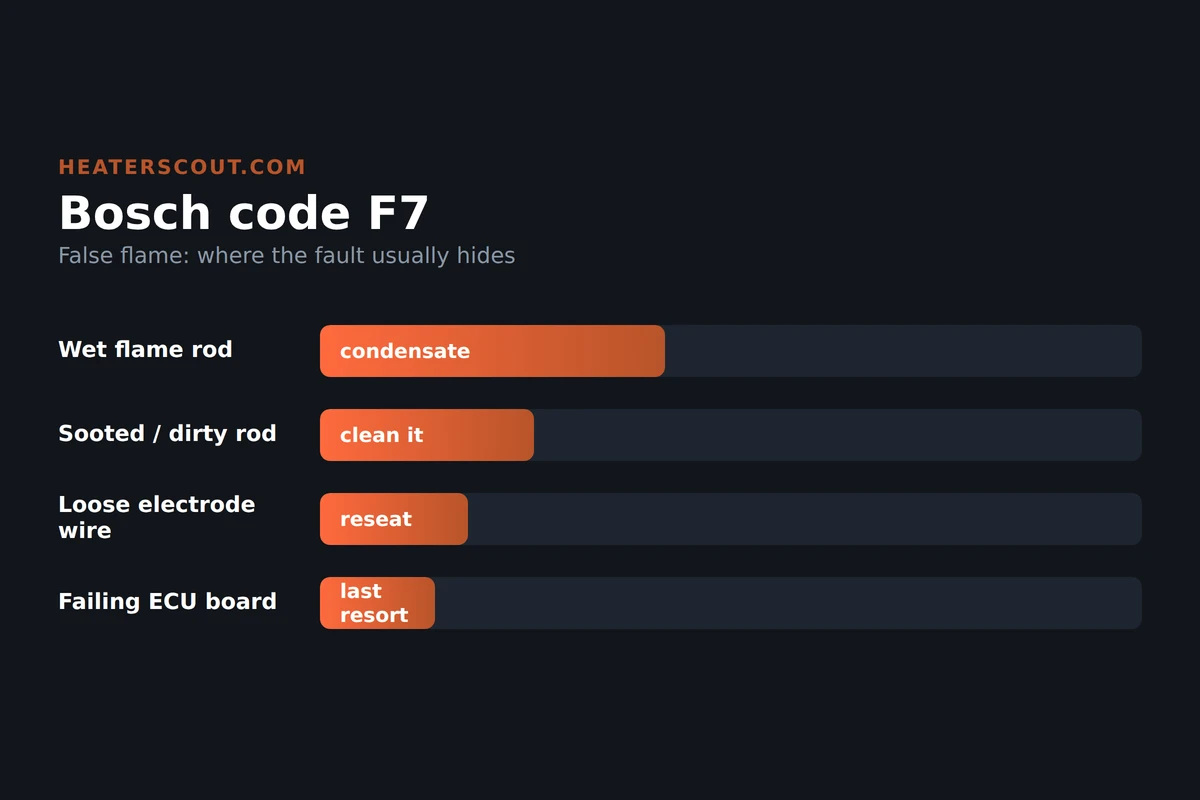
F7 right after a cold start or reset
On the condensing Greentherm units this points straight at condensate. Water on the flame rod's ceramic base bridges current to ground and reads as flame. Check the condensate trap and drain first, then dry the electrode area.
F7 keeps returning after every reset
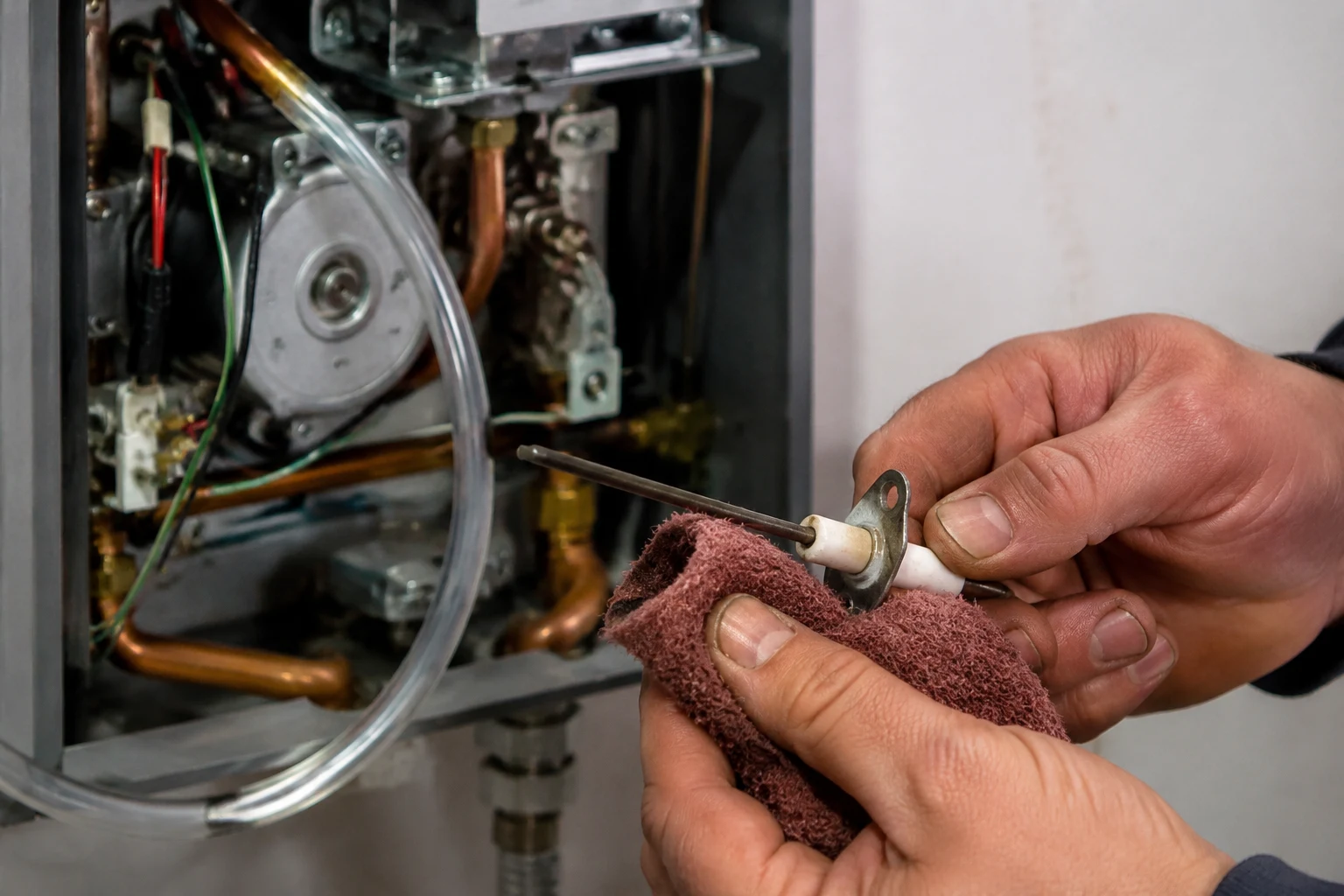
A rod that will not stay clear means the false path is still there: a sooted rod, a cracked insulator, or a loose electrode wire feeding a phantom signal. Inspect the rod and reseat every connection at the burner and the board.
F7 holds after condensate and wiring check out
If the drain is clear, the rod is clean, and the wiring is tight but F7 still latches, the ionization circuit or the ECU is at fault. Bosch's guidance is to replace the control unit only after the electrodes and cable are verified. That is a licensed gas tech's call.
Bosch code F7
A false-flame fault. The electronic control unit is detecting a flame ionization signal when the unit is in standby, before the gas valve opens. It means the board reads flame current with no fire present, usually because condensate, soot, or a wiring fault has created a conductive path across the flame rod. F7 sits in the F2, F3, F7, F8 group of ECU and flame-detection faults, cleared by holding the On/Off button for about 3 seconds.
How Bosch senses flame, and how it gets fooled
The logic behind F7 makes the fix obvious once you see it. A Bosch tankless proves flame with a single metal electrode, the flame ionization rod, that sits at the edge of the burner. Flame conducts electricity, barely, and it conducts in one direction better than the other. The control unit pushes a small AC voltage down the rod and looks for a rectified current returning through the flame to the grounded burner. A real flame produces a steady microamp-level signal. No flame should produce nothing. That is the entire safety premise: current means fire, no current means no fire.
F7 is what happens when that premise breaks in standby. Something creates a conductive path across the rod while the burner is off, so the board reads current it can only interpret as flame. Condensate is the usual bridge, water pooling on the ceramic insulator or the electrode connections and leaking to ground. Soot, corrosion, or a wire arcing at a connector does the same thing. The board is not broken and there is no fire. The sensor is being lied to.
The fix, cheapest first
Bosch's own troubleshooting for F7 runs from the reset, through the electrodes and cable, to the control unit as the last step. Work it in that order and do not order a board because a code scared you.
What a homeowner should and should not touch
Resetting the code, clearing the condensate drain, and drying and reseating the flame rod area are fair game for a careful homeowner who is comfortable shutting off gas and opening a sealed unit. Those are the moves that clear most F7 faults, and none of them involve setting gas or defeating a safety. The line you do not cross is the flame-sensing circuit itself. Do not jumper it, do not bypass it, and do not force the unit to run past an F7. That circuit exists so the heater never assumes fire that is not there.
Should I check the venting too?
Yes, briefly. Bosch requires the correct sealed vent for the condensing Greentherm units, single-wall AL29-4C stainless with proper condensate traps, and a venting or condensate problem is exactly what wets the flame rod. If the vent or trap is wrong or damaged, water management inside the unit fails and F7 keeps coming back. Confirm the install matches Bosch's venting spec, and if it does not, that is a licensed installer's fix, not a reset.
Reading the code the way a tech does
A licensed tech does not guess at F7, they measure it. The single most useful reading is the flame ionization current with the burner off. On a healthy Bosch tankless that number should sit at zero in standby. Any current with no gas flowing is the false path the code is complaining about, and its size and behavior point at the cause. A steady low leak that appears right after a cold start smells like condensate bridging the ceramic insulator. A signal that jumps around when you wiggle the electrode harness is a wiring fault, a shorting wire or a corroded connector. A reading that stays put after the rod is bone dry and the wiring is tight is what finally implicates the control unit. The meter turns a scary board-level code into a short decision tree.
It is also why forcing the unit to run past F7 is a bad trade. You would be overriding the one circuit trying to tell you the sensor cannot be trusted right now. Fix the false path instead of muting the alarm.
When it really is the control unit
Bosch's F7 guidance ends the same way for a reason: if the code persists after the electrodes and cable check out, replace the ECU. That is the honest last step, not the first. A control unit that misreads a clean ionization signal is real but uncommon, and it is the most expensive part in the heater. Before anyone spends board money, the condensate trap should be flowing, the flame rod should be dry and clean with an intact ceramic holder, and every electrode connection should be tight. Only when all of that holds and F7 still latches does the board become the suspect. A tech can confirm it by watching the ionization reading with the burner off, where a healthy circuit should read zero.
Keeping F7 from coming back
F7 is largely a maintenance and moisture story, so prevention lives in the condensate and combustion path. On condensing Greentherm units, keep the condensate trap and drain clear so acidic water never backs up onto the flame rod. Add a flame-electrode inspection to the annual service: pull the rod, check the ceramic for cracks, clean any soot, and confirm the connections are tight and dry. Keep the intake and exhaust clear and correctly vented so combustion stays clean and the rod does not sooty up between services. Descaling still matters for the heat exchanger, but it does nothing for F7, so treat the combustion side as its own annual checklist. A dry, clean rod on a clear drain is a code that rarely returns on the coldest morning of the year.
Frequently asked
Can I reset Bosch code F7 myself?
Yes, clearing F7 is a homeowner job. On the Bosch tankless units that use this code, the Therm 940 ES and the condensing Greentherm 9000 series, you clear the F2, F3, F7 and F8 group of faults by pressing and holding the On/Off button on the front panel for about 3 seconds. If the panel does not respond, kill power at the breaker or unplug the heater, wait two to three minutes, then restore power. That power cycle resets the electronic control unit and drops the latched code. The important part is what happens next. F7 is a false-flame fault, so if the flame rod is wet, fouled, or a wire is loose, the board will read a phantom flame signal again the next time it checks itself in standby, and F7 comes right back. The reset buys you a clean slate to watch, not a repair.
What does false flame actually mean on a Bosch tankless?
It means the control board is seeing an ionization signal at the flame rod while the unit is sitting idle, before the gas valve has opened. A tankless proves flame by sensing the tiny electrical current that a real flame conducts. That check runs both ways. The board wants a signal when the burner is lit, and it wants zero signal when the burner is off. F7 fires when the board reads current with no gas flowing, which it interprets as flame that should not exist. In almost every real-world case there is no fire at all. A conductive path has formed across the flame rod, usually from condensate, soot, or a wiring fault, and the board cannot tell that false path from a genuine flame. The safety logic assumes the worst and locks the unit out.
Which Bosch models throw code F7?
F7 shows up on Bosch's US gas tankless line. The Therm 940 ES, Bosch's high-capacity non-condensing indoor unit, lists F7 in its error diagnostics, and the condensing Greentherm 9000 series carries the same F2, F3, F7, F8 electronic-control and flame-detection group. Because the Greentherm units are condensing, they produce acidic condensate inside the unit, which is exactly why a plugged condensate trap is a top suspect on those models. Older Bosch and AquaStar point-of-use heaters use a different fault scheme, so if your display shows F7 confirm the model first. The reset and the checks below apply to the modern Therm and Greentherm tankless units that share this code family.
Why does condensate cause a false flame reading?
The flame rod senses flame by passing a small current from the rod, through the flame, to the grounded burner. Water conducts electricity. If condensate collects on the ceramic insulator at the base of the flame rod, or on the electrode connections, it creates a conductive bridge that leaks current to ground even with the burner off. The board reads that leakage as an ionization signal and calls it flame. This is why F7 loves cold starts and the minutes right after a reset on condensing Greentherm units. The condensate trap and drain line are supposed to carry that acidic water out. If the trap is dry, cracked, or the drain is clogged, water backs up and wets the wrong parts. Clearing the drain and drying the electrode area fixes a real share of F7 faults on condensing units.
How much does it cost to fix Bosch F7?
If it is a wet flame rod from a clogged condensate drain, the fix costs nothing but the time to clear the trap and let the electrode dry. If the flame rod or its ceramic holder is sooted, cracked, or chipped, a genuine Bosch flame electrode or ionization rod runs roughly $30 to $70 for the part, and a tech visit to diagnose and replace it usually lands around $150 to $400 once you count the trip and labor. The expensive path is the electronic control unit. Bosch's own guidance says replace the ECU if F7 persists after the electrodes and wiring check out, and that board can run $300 to $700 for the part alone depending on model. That price gap is the whole reason you work the cheap causes first. The board is genuinely the last suspect, not the first.
Will descaling clear Bosch code F7?
No. Descaling flushes vinegar or a descaling solution through the heat exchanger to strip mineral scale off the water passages. F7 lives entirely on the combustion and electronics side of the unit, at the flame rod and the control board. Scale in the waterways has nothing to do with a false flame signal. Keep descaling on schedule for the health of the exchanger and to hold flow rate, but do not expect a flush to touch this code. The moves that clear F7 are checking the condensate trap, drying and inspecting the flame rod, reseating the electrode wiring, and, if all that holds, having a tech read the ionization circuit and, worst case, replace the ECU.
Is Bosch F7 dangerous, and can I keep using the heater?
The code itself is a protection doing its job. False-flame detection exists so the unit never assumes fire is present when it is not, and never keeps a gas valve armed on a bad signal. When F7 latches, the heater refuses to run rather than take a risk, so you lose hot water but nothing unsafe is happening. The danger is in bypassing it. Never jumper or defeat the flame-sensing circuit to force the unit on. If a reset and a condensate and wiring check do not hold, that points at the flame rod, the ionization circuit, or the ECU, and that is licensed gas tech territory. If you ever smell gas or see scorching around the electrodes, shut the unit down at the gas valve and call a pro before doing anything else.