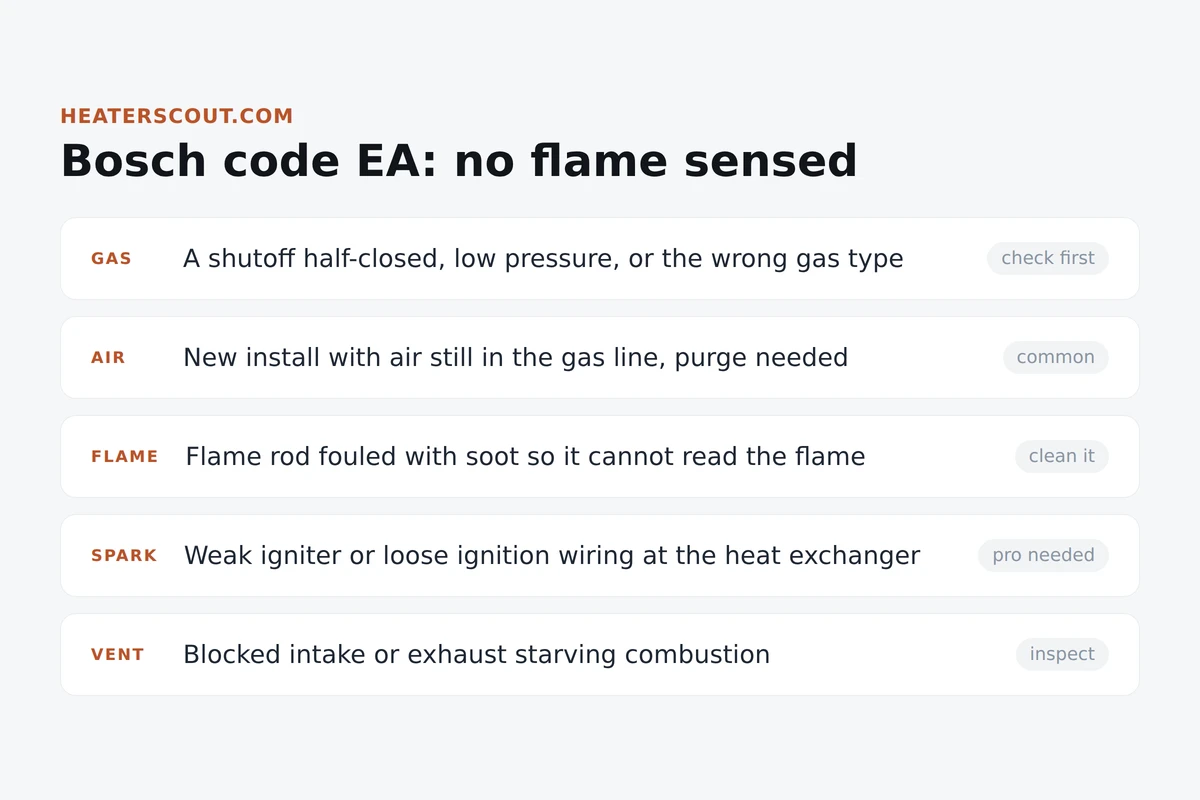
Bosch code EA shows up when the unit tried to light, failed to sense a flame three times, and gave up. The igniter sparks, the gas valve opens, but the flame rod never confirms a live flame, so after three attempts the control board locks the burner out and posts EA. It is a no-flame lockout, and the two most common reasons behind it are boring on purpose: the gas is not fully getting there, or the flame rod cannot read the flame that is actually burning.
Work it in this order
EA has a natural sequence, and jumping past the easy checks wastes a service call on something a homeowner could have caught. Do the safe steps first, reset once between them, and watch whether the unit holds a full cycle. If EA clears after a step, you found it; if it comes back after the homeowner-safe checks, hand it to a licensed tech.
Which EA are you looking at
Not every EA has the same story, and the pattern tells you where to look. Match your situation to one of these before you start pulling covers.
It is a new install or just had gas work
Air in the gas line is the top cause of EA on a fresh unit. The first ignition attempts get air instead of gas and the flame never catches. Purge it by cycling a hot tap on and off several times, and confirm the gas type is set correctly.
It ran fine for years, then started throwing EA
On an older unit, a flame rod slowly fouled with soot is the usual find. It stops reading the flame current and reports no flame even when the burner lights. Cleaning the rod restores the signal, but it sits behind the cover next to live gas, so it is a cover-off, gas-off job for a tech.
EA shows up when another gas appliance runs
If the furnace or range firing at the same time triggers EA, suspect low gas pressure under combined load. The line reads fine at rest and sags below the minimum firing pressure when demand climbs. Measuring that takes a manometer.
Bosch EA (no flame detected)
A flame-detection lockout. The unit ran its ignition sequence, the flame rod never confirmed a live flame, and after three failed attempts the control board closed the gas valve and posted EA. The code names a symptom, no flame sensed, not a single failed part. On the Greentherm condensing line the manual splits ignition failure (EA) from flame lost during operation (EC); on older AquaStar and Therm units EA covers the general no-flame case.
What EA is really reporting
The flame rod is a small metal electrode sitting in the flame path. It proves a flame is present by reading the tiny ionization current a flame conducts. When the board opens the gas valve and sparks the igniter, it expects that current to appear within a set window. If it does not, the board counts a failure, and three failures in a row means it stops trying and posts EA. That three-strike logic is why EA is a lockout, not a momentary fault.
Because the rod cannot tell the difference between no flame and a flame it cannot read, EA spans two situations. Either the burner never lit, which points at gas supply, air in the line, a weak igniter, or venting, or it lit fine but the rod is too fouled to sense it. Sorting those two apart is most of the diagnosis.
| What the board reports | No flame detected within the ignition window |
| Trigger | Three failed light attempts in a row, then lockout |
| Newer Greentherm split | EA = ignition failure, EC = flame lost while running |
| Top cause on a new install | Air in the gas line, needs purging |
| Top cause on an older unit | Soot-fouled flame rod misreading the flame |
| Reset | Hold On/Off 3+ seconds, or power-cycle at the disconnect |
| Homeowner-safe | Gas valves open, gas type, vent clear, purge air, reset |
| Needs a licensed tech | Flame rod, igniter, wiring, gas pressure, gas valve, board |
| Typical repair cost | $100–$200 diagnostic; $150–$600 with parts |
The causes, ranked, and who fixes each
Sources line up on the short list and the rough order. Gas supply leads, air in the line is right behind it on new installs, the flame rod is the top find on older units, then the igniter and wiring, venting, and finally the gas valve and control board as last resorts. Each row splits homeowner-safe from licensed work, because that line matters more with EA than most codes: almost everything past the easy checks sits next to live gas.
Gas supply off, low, or wrong type
A shutoff left half-closed, low inlet pressure, an empty propane tank, or a unit set for the wrong gas will all stop a clean light. Confirming valves are open and other gas appliances work is homeowner-safe; measuring inlet pressure under load takes a manometer and a tech. Rough cost: $0 to check, $150 to $400+ if the line needs work.
Air in the gas line
The classic new-install EA. The first ignition attempts get air instead of gas so the flame never catches. Purge by cycling a hot tap on and off several times, or have the installer bleed the line. Homeowner-safe to try. Rough cost: $0, or a short service call if the installer does it.
Fouled or poorly grounded flame rod
Soot film insulates the rod so it cannot read the flame current, and the board sees no flame even when the burner lights. The top cause on older units. Cleaning with a light abrasive restores it, but it sits behind the cover, so it is tech work. Rough cost: $100 to $300.
Weak igniter or loose ignition wiring
A worn igniter that sparks poorly, or a loose connection at the three ignition wires on the lower front of the heat exchanger, can stop the flame from establishing. A tech re-seats the connections or swaps the igniter. Rough cost: $150 to $350.
Blocked or restricted venting
Ice, debris, a nest, or an intake pulling in its own exhaust starves combustion so the flame will not hold. Inspecting the exterior terminations is homeowner-safe; clearing a blockage inside the vent run is not. Rough cost: $0 to inspect, up to $300 to clear.
Faulty gas valve or control board
A gas valve that delivers unstable flow, or a board that misreads the flame signal, is the last thing checked because it is the rarest. Diagnosis and replacement are licensed work. Rough cost: $300 to $600+.
Why the flame rod is not a wipe-and-go job
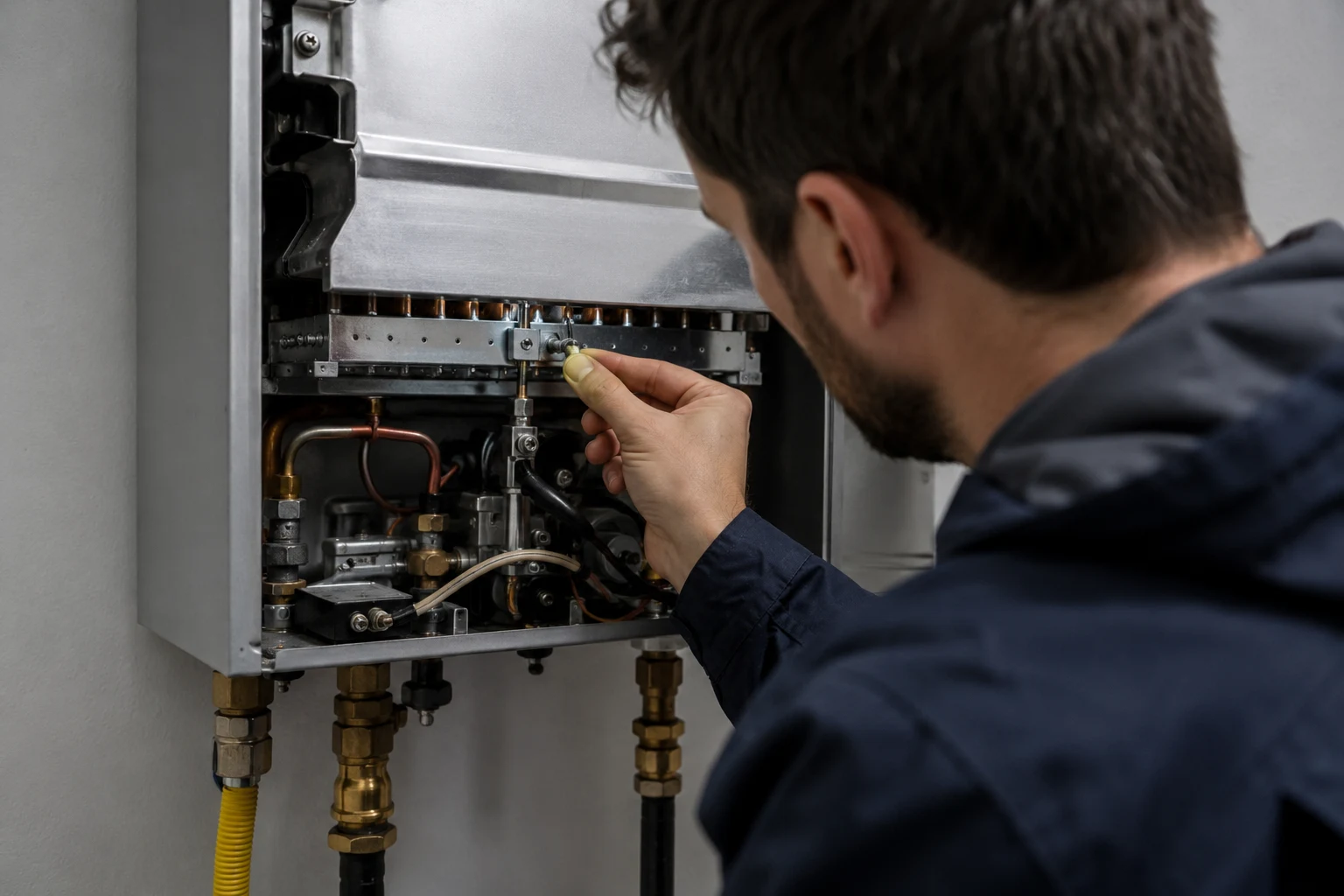
On an older Bosch that suddenly throws EA, the flame rod is the first thing a good tech suspects, and it is the fix homeowners most want to do themselves. The cleaning is simple in principle. The rod picks up a black soot film from years of combustion, that film insulates it, and the board stops reading the flame current even while the burner is lit. Rub the surfaces that touch the flame with a light abrasive, a folded new bill or fine steel wool, re-seat the rod with a clean, tight ground, and the signal usually comes right back.
The reason it is still a technician task is location. The rod sits inside the sealed combustion area behind the front cover, inches from the gas valve and the burner. Reaching it means shutting off the gas, opening a sealed portion of the unit, and working around live gas fittings. Bosch and most installers are blunt about not opening the combustion chamber yourself.
When the answer is gas pressure
If the safe checks do not clear it and the flame rod is clean, gas pressure is the common finding, and it is the reason DIY ends here. The unit can light fine at rest and still fail the moment it draws its full BTU load, or the moment a furnace and a range fire on the same line. The pressure sags below the minimum the burner needs, the flame never establishes, and the board locks out on EA. Diagnosing it means putting a manometer on the inlet and reading the pressure while the burner fires at full capacity, and correcting it means resizing the gas line. Both are licensed gas work.
Keeping EA from coming back
Most repeat EA traces to things annual service catches before they lock the unit out. A yearly maintenance visit cleans the flame rod and the intake path, checks the igniter and its wiring, and verifies gas pressure under load. If EA first appeared after adding a gas appliance or running a longer line, have an installer confirm the gas line is sized for the full combined demand, not just the water heater sitting idle. Keep the vent terminations clear, and if the unit is new and throwing EA, make sure the line was properly purged of air before you chase anything deeper. A Bosch that lights cleanly every time is one whose gas, spark, and flame-sense paths all fire in the same half-second.
Frequently asked
What does Bosch error code EA mean?
EA means no flame was detected. The unit ran its ignition sequence, the flame rod never confirmed a live flame, and after three failed light attempts the control board locked out and posted EA. On the newer Greentherm condensing units the manual splits it further: EA is ignition failure, EC is a flame that gets lost during operation. Either way the board did not see the flame it expected, so it shut the gas valve rather than let raw gas keep flowing.
Can I reset a Bosch EA code myself?
Yes, and it is safe to try once. On the digital Greentherm and Therm units, hold the On/Off button for more than three seconds to clear the display, or cut power at the disconnect for a few minutes and restore it. On a new install, cracking a hot tap and cycling the water on and off a few times can purge trapped air from the gas line and clear it. A reset that does not hold means the cause is still there, so do not just keep hitting it.
How much does it cost to fix Bosch EA?
A diagnostic service call runs about $100 to $200, and cleaning a soot-covered flame rod usually falls in that same range. If a part is involved, a flame rod or igniter is roughly $150 to $350 installed, and a gas valve or control board pushes it to about $300 to $600 with labor. Correcting a gas-supply or venting problem, like resizing a gas line, is licensed work and can cost more.
Will cleaning the flame sensor clear code EA?
Often, when a fouled flame rod is the cause. Combustion leaves a black soot or oxide film on the rod that insulates it, so it stops reading the tiny flame current and reports no flame even while the burner lights. Techs clean the probe with a light abrasive, a folded new bill or fine steel wool works, and re-seat it with a solid ground. The catch is that the rod sits in the sealed combustion area behind the front cover, next to live gas, which is why it is a technician job on most units.
Why does my Bosch keep showing EA right after a new install?
That is almost always air in the gas line. On a fresh install or after gas work, the line still holds air, so the first few ignition attempts get air instead of gas and the flame never establishes. The unit tries three times and locks out on EA. Purging it, by cycling a hot tap on and off several times, or having the installer bleed the line, usually clears it. If EA persists after a proper purge, the gas type or pressure is worth checking next.
Is Bosch error code EA dangerous?
The code is a safety response, not a hazard in itself. When no flame is confirmed, the board closes the gas valve so unburned gas cannot pour into the combustion chamber. That is exactly what you want it to do. The risk comes from overriding it, repeatedly resetting and forcing ignition, or opening the sealed combustion area yourself, because the causes behind EA often involve gas supply and venting that need proper diagnosis.
Why does EA keep coming back after I reset it?
Because a reset clears the display, not the cause. Repeat EA usually means a gas-supply problem, air still in the line, a soot-fouled flame rod, a weak igniter, or a blocked vent. Each reset lets the unit try again, fail to confirm flame, and lock out again. That loop is the signal to stop cycling the display and have a licensed technician read gas pressure and check the ignition group.
Does EA mean the same thing on every Bosch tankless?
Close, but not identical. On the older AquaStar and Therm units EA is the general no-flame lockout after failed ignition. On the newer Greentherm 9800 condensing line the manual is more specific: EA is ignition failure, EC is flame lost during operation, and both can trace back to combustion that is not set right for the gas supply. If your display shows both, EA points at lighting, EC points at a flame that dropped out.