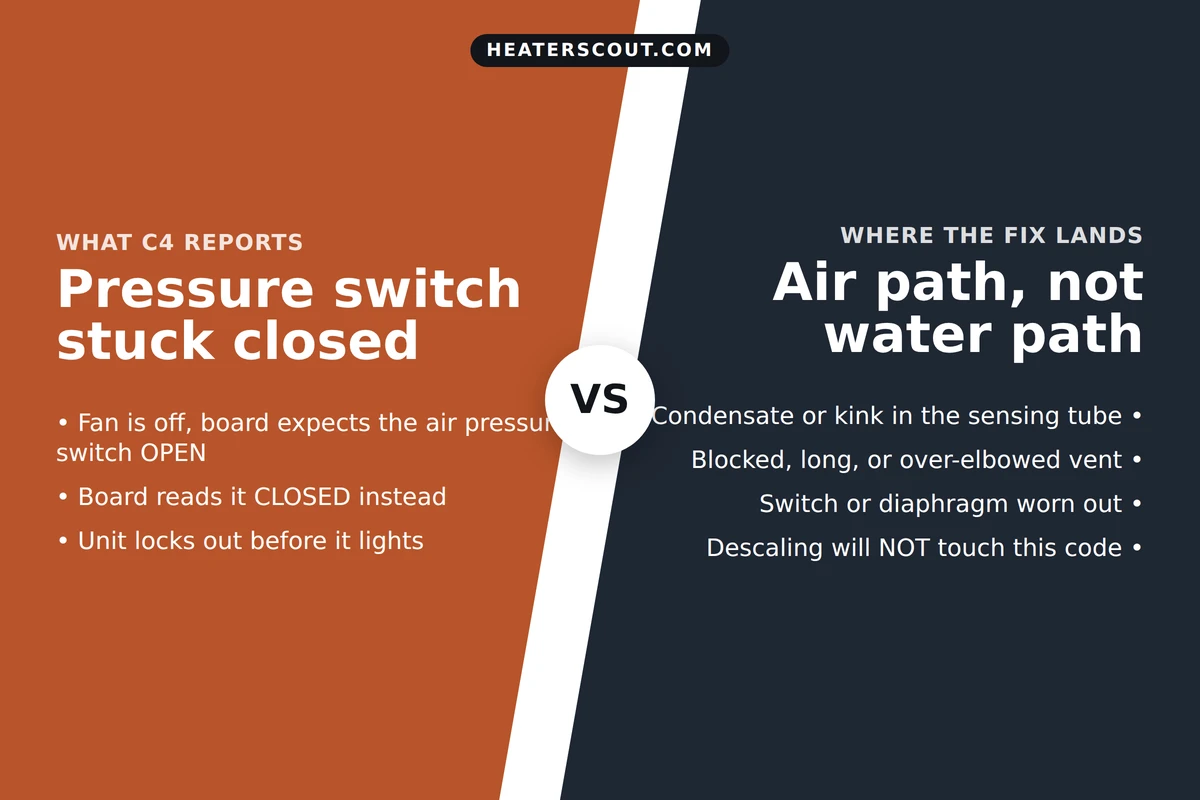
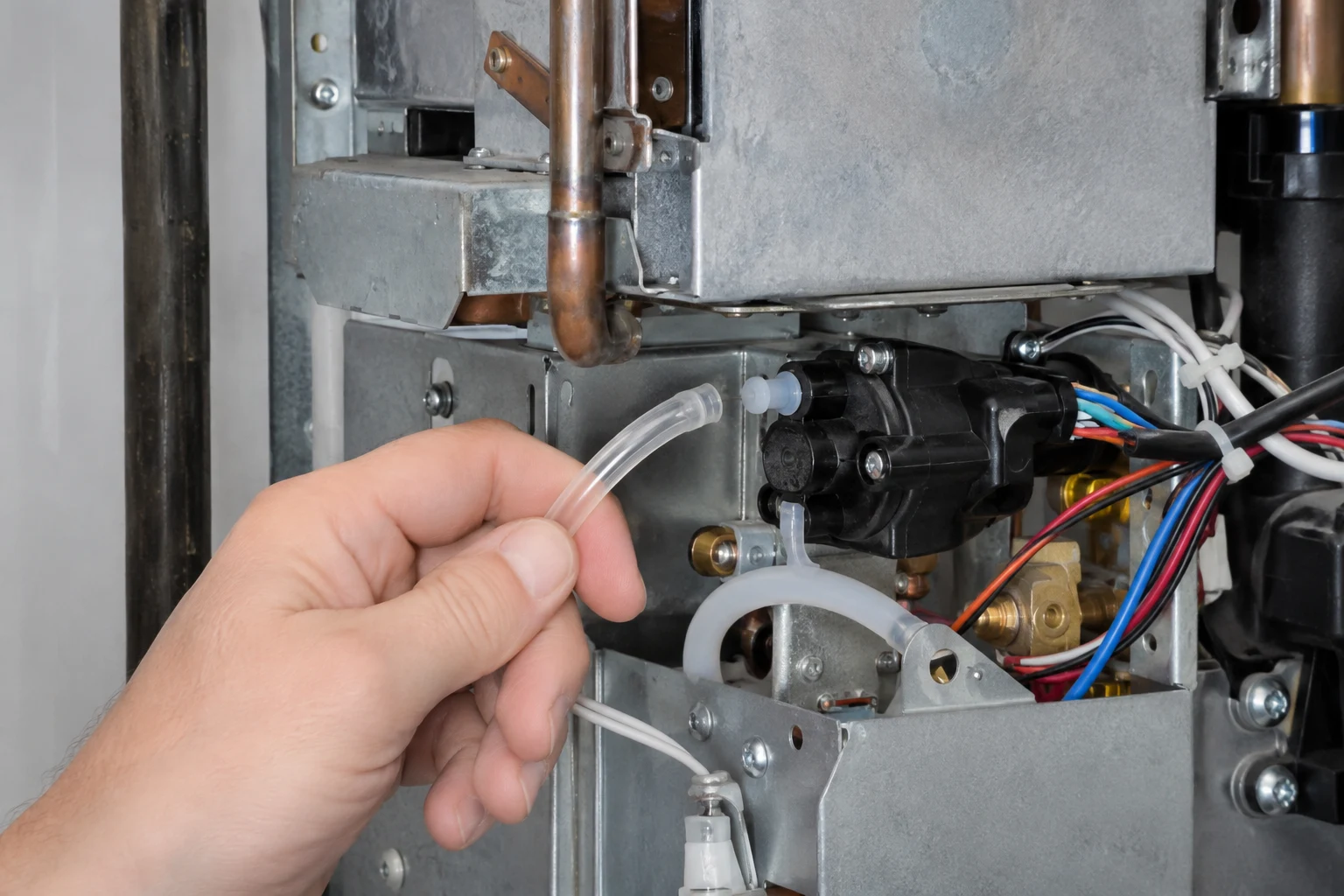
A Bosch tankless flashing C4 is not telling you the water is too cold or the burner failed. It is telling you a safety switch that watches your venting is stuck in the wrong position. Before the burner lights, with the fan off, the board expects the air pressure switch to be open. On a C4 it reads closed instead, so the heater refuses to fire. Nine times out of ten the culprit is not the electronics. It is a slug of condensate sitting in a clear plastic tube the size of a drinking straw, or a vent terminal packed with debris.
Where C4 sits in the Bosch code family
C4 is one of a small cluster of venting and fan codes on Bosch condensing tankless units. Reading them side by side makes the diagnosis obvious, because each one points at a different state of the same air pressure switch and fan.
| Code | What the board sees | Points at |
|---|---|---|
| C1 | Pressure switch opens during a run | Vent blockage or fan losing pressure mid-cycle |
| C4 | Switch closed when fan is off (won't open) | Condensate in tube, blocked vent, stuck switch |
| C6 | Switch will not close when fan runs | Fan not building pressure, disconnected tube |
| C7 | Fan fault | Fan motor, wiring, or speed signal |
The pattern is worth holding onto. C4 and C6 are opposite failures of the same switch: C4 is stuck closed when it should be open, C6 is stuck open when it should be closed. That is why a single fouled sensing tube can throw either code depending on where the water sits, and why the first move for both is the same, clear the tube and the vent.
| Code meaning | Air (differential) pressure switch fault |
| Exact condition | Switch reads closed when the fan is off |
| Family | C1, C4, C6, C7 venting and fan codes |
| Most likely cause | Condensate in the pressure-switch sensing tube |
| Next likely cause | Blocked, over-long, or over-elbowed vent |
| Reset method | Hold Reset on panel, or 30-sec breaker cycle |
| Sensing tube | Small clear silicone line, switch to venting |
| OEM pressure switch | About $30 to $80 depending on model |
| Pro repair range | About $150 to $350 diagnose and switch swap |
| Affected models | Bosch Therm and Greentherm condensing tankless |
| Difficulty | DIY-friendly checks, gas tech for vent or switch |
First-pass checks before you open anything
Start outside and stay simple. Most C4 faults resolve at the vent terminal or in the sensing tube, and you can rule those in or out without tools.
- Look at the vent terminal outside: clear it of leaves, snow, insects, nests, or lint.
- Confirm intake and exhaust are not blocked by anything you or a contractor set nearby.
- Listen for the fan spinning up when you call for hot water. Silence points more at C7.
- Check for water gurgling or trapped in the clear sensing tube on the pressure switch.
- Recall any recent work: a new vent run, added elbows, or a longer flue can cause C4.
- Verify the condensate drain is flowing, not backed up into the venting or switch tube.
The fix, in order
Work cheap to expensive. Do not order a control board because a venting code rattled you. Start where the water is, in the sensing tube, because that is the number one cause on these condensing units.
Who should do which part
The outdoor checks and the tube drain are fair game for a careful homeowner. The vent geometry and the switch test are where a licensed tech earns the visit.
Terminal and tube
Clearing the vent terminal, blowing out the sensing tube, reseating the switch connectors, and running one reset. Screwdriver and a few minutes, no gas work.
Switch swap
Replacing the air pressure switch is mechanically simple, but you are inside a sealed gas appliance. If you are not comfortable shutting gas and reading the manual's diagram, hand it to a pro.
Vent re-run and pressure test
Measuring switch pressure with a manometer, re-running an over-long or over-elbowed vent, or diagnosing a spillage concern. That is licensed gas and venting work.
Why condensing units are prone to this
A Bosch Greentherm or Therm condensing heater pulls so much heat out of the exhaust that the flue gas cools below its dew point and water condenses inside the venting. That is by design, it is where the efficiency comes from, and the unit has a condensate drain to carry that water away. The catch is that the same moist, cool exhaust path is where the air pressure switch takes its reading. If the condensate drain slows or the sensing tube sags, water works its way into that little clear tube and parks against the diaphragm. The switch reads closed, the board wants it open with the fan off, and you get C4. An atmospheric heater without a fan and a condensate path does not have this exact failure, which is why the C-codes belong to the condensing line.
Keeping C4 from coming back
The switch fouls because the air path is dirty, wet, or poorly routed, not because the part is weak. Put a vent and condensate check on your annual service. Have the tech confirm the condensate drain runs freely, the sensing tube has no low spot that traps water, and the vent terminal is clear and screened against nests. Keep landscaping, snow, and stored items away from the intake and exhaust outside. If your unit sits at the far end of a long vent run with several elbows, ask whether the run is actually within spec for the model, because a marginal vent is a C4 waiting for the first cold, wet morning. Descaling keeps the water side healthy, but it is the air side that decides whether you see this code.
Frequently asked
Can I reset Bosch code C4 myself?
You can clear the lock-out, but clearing is not fixing. On a Bosch tankless the reset is the button on the control panel: press and hold Reset for a few seconds, or turn the unit off and back on at the on/off switch. If you have no panel access, flip the breaker feeding the water heater off for about 30 seconds, then back on. That power cycle drops the latched fault and keeps your temperature setting. The problem is that C4 is a hardware condition, the air pressure switch reading closed when it should read open. If the sensing tube still has condensate in it, or the vent is still blocked, the code comes right back the next time the board checks the switch before firing. The reset buys you one clean firing attempt to watch what happens, not a permanent cure.
What does C4 mean on a Bosch tankless water heater?
C4 is an air pressure switch fault, sometimes called the differential pressure switch. Before the burner lights, the fan is off and the board expects the pressure switch contacts to be open. On a C4 the board sees those contacts closed instead, so it will not proceed. In plain terms the safety that confirms your venting is clear is stuck in the wrong position, and the unit refuses to fire rather than run with a vent problem it cannot verify. It is part of the Bosch C-series of venting and fan codes: C1 is the switch opening during a run, C6 is the switch failing to close, and C7 is a fan fault. C4 specifically is the switch not opening when the fan is off.
What causes the Bosch C4 code most often?
Condensate or water sitting in the small clear sensing tube between the venting and the pressure switch is the classic cause on condensing Bosch units. A trapped slug of water holds the diaphragm in the closed position, so the switch never opens and the board flags C4. After that come vent problems: a blocked intake or exhaust terminal, a vent run that is too long, or one that uses more elbows than the manual allows. A pinched or disconnected tube, a torn diaphragm, or a worn-out switch round out the list. The theme is the air side of the heater, not the water side, which is why a descale does nothing for this code.
How much does it cost to fix Bosch C4?
If it is condensate in the sensing tube or a blocked vent screen, the fix costs nothing but your time to drain the tube and clear the terminal. A replacement air pressure switch is an inexpensive part, commonly in the $30 to $80 range for the OEM switch depending on model, and a length of the correct silicone sensing tube is a few dollars. A pro visit to diagnose and replace the switch typically runs $150 to $350 once you count the trip and labor, more in high-cost metros. Vent work that has to be re-run because the original install used too many elbows or an over-long run costs more, since that is materials plus labor on the flue. The board itself is rarely the culprit here and is the last, most expensive thing to suspect.
Will descaling clear a Bosch C4 code?
No. Descaling flushes vinegar or a descaling solution through the heat exchanger to strip scale off the waterways. C4 lives on the combustion and venting side of the heater, at the air pressure switch and its sensing tube, which never touch the water. A flush cannot reach the switch, the diaphragm, or the vent. Descaling is still worth doing on schedule for the health of the unit, and a neglected heater often has both a scaled exchanger and a condensate-fouled sensing line, but do not expect a flush to move this code. Draining the tube, clearing the vent, and checking the switch are the moves that clear C4.
Why does the Bosch C4 code keep coming back?
A code that returns after a reset is telling you the real cause is still there. The usual repeat offenders: the sensing tube was blown out but it is routed so condensate keeps pooling in the same low spot, or the tube has a slow kink that traps water again. Or the vent terminal keeps getting blocked by debris, snow, insects, or a nest, so the pressure the switch sees is never right. Or the original vent run is simply too long or has too many elbows for the model, which loads the switch on every cycle. Or the switch itself is worn and hovers near its trip point, tripping on cold mornings and passing on warm ones. Fix the routing or the vent, not just the symptom, and the code stays gone.
Is Bosch code C4 dangerous?
The code itself is a safety feature doing its job. The air pressure switch is how the heater confirms its venting is behaving before it lights the burner. By shutting down on C4 rather than firing, the unit is refusing to burn gas when it cannot verify the vent path, which is exactly the behavior you want. The danger is not the code, it is defeating it. Never jumper, tape, or bypass the pressure switch to force the heater to run. A blocked vent on a gas appliance can spill combustion products, and this switch is one of the guards against that. If the tube drains clear and the vent checks out but C4 keeps returning, or if you ever smell exhaust or gas near the unit, shut it down and get a licensed gas tech on it.
Which Bosch models show the C4 code?
The C-series venting codes appear on Bosch gas condensing tankless heaters, the Therm and Greentherm lines, including the Greentherm 9000, 9800, and 9900 SE and SEO models and the Therm C-series. These units are power-vented and condensing, so they carry a fan and an air pressure switch, which is what makes a C4 possible. Older atmospheric Bosch Aquastar models that vent without a fan do not use this exact switch logic, so their fault list reads differently. Always check the error table in the installation and operating manual for your specific model, because the exact wording and the companion C-codes vary a little across the condensing line.