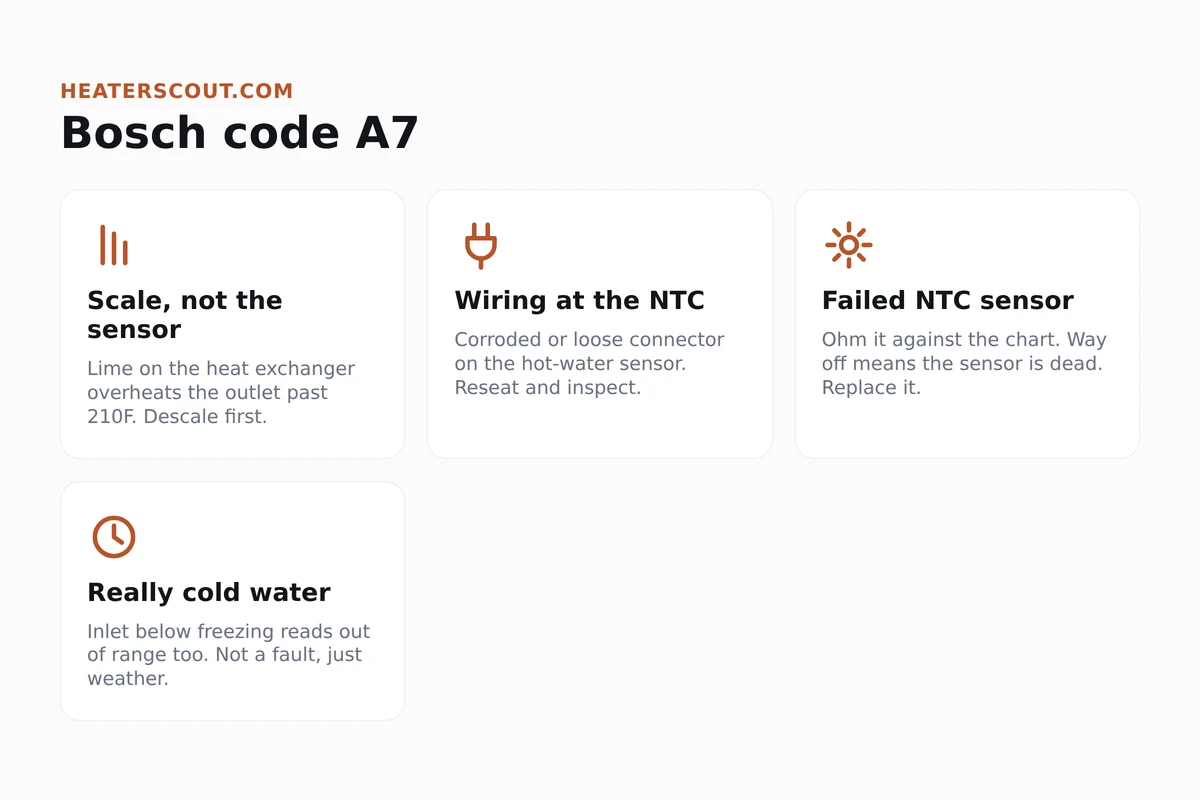
A Bosch tankless flashing A7 is not necessarily telling you a sensor died. It is telling you the hot-water temperature sensor is reporting a number the control board refuses to trust, either below freezing or above roughly 210F. Sometimes that number is a lie from a corroded wire or a worn thermistor. Just as often it is the honest truth: scale on the heat exchanger is genuinely cooking the outlet water past 210F, and the sensor is the only thing standing between you and scalding water at the tap. Reading A7 as automatically a bad sensor is the mistake that gets people to buy the wrong part.
Diagnose in order, cheapest first
Do not order a sensor because a code that mentions the sensor scared you. Walk the reading back to its cause. Most A7 faults never reach the parts counter.
Reset once and watch the outlet
Hold the on/off button three seconds, or pull power for two to three minutes, then restore it. Run a hot tap and watch. A one-time A7 that never returns was a spike. An A7 that returns the moment the burner heats the outlet is a real, repeatable fault to chase.
Check for scale and a clogged inlet screen
In hard-water areas this is the number one cause. Scale insulates the heat exchanger, the fireside overheats, and the outlet spikes past 210F. Pull and clean the cold-inlet filter screen, then plan a descale flush. If the unit has never been descaled, this alone often clears A7.
Inspect the sensor connector and wiring
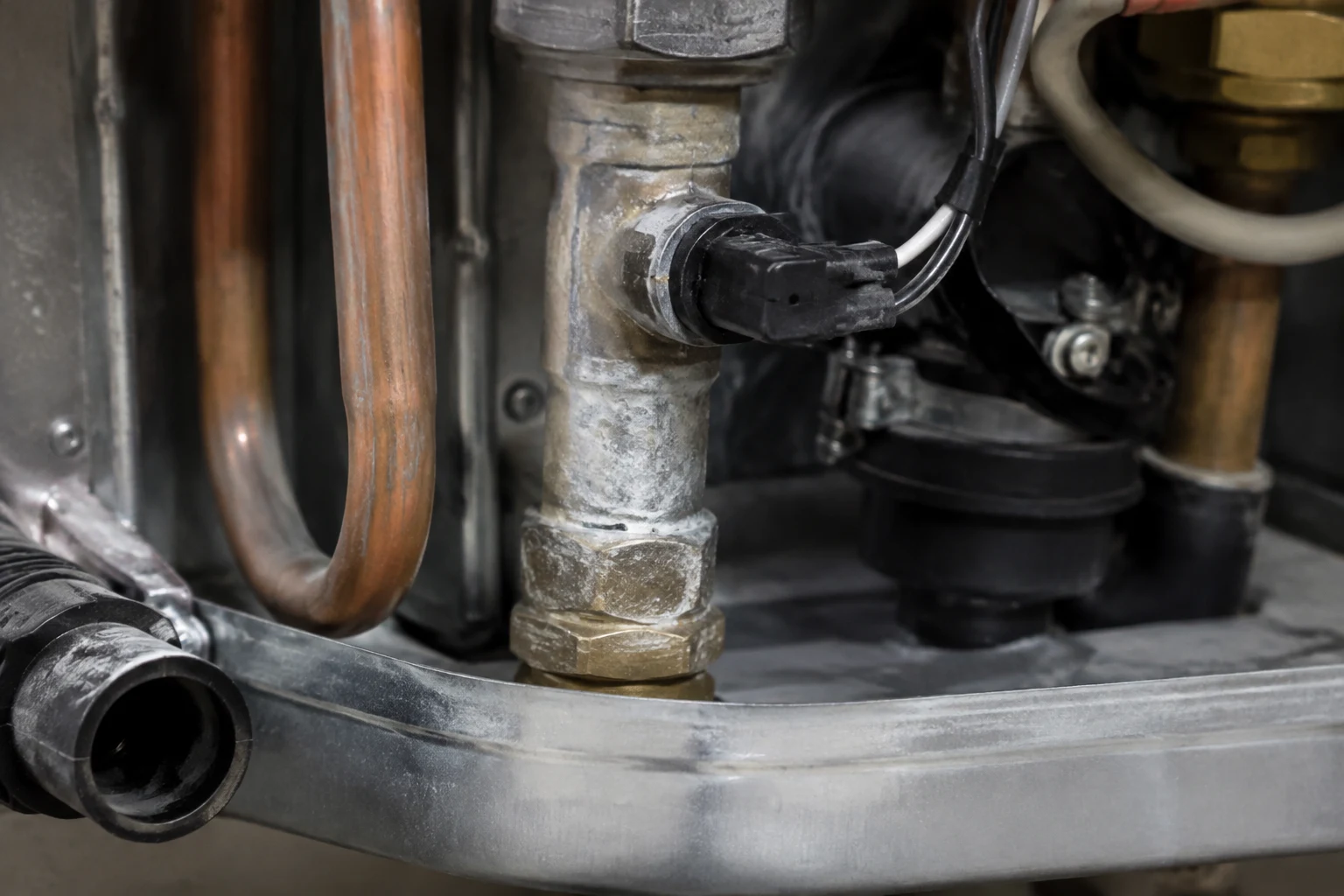
With power off, unclip the two-wire connector at the outlet NTC sensor. Look for green corrosion, a loose fit, melted insulation, or a burnt terminal. Reseat it firmly. A flaky connection reads to the board as an out-of-range value and mimics a dead sensor.
Ohm the NTC against the chart
Put a meter on the sensor terminals in the ohm range and compare the resistance to the temperature-versus-resistance chart in your model's manual, noting the real water temperature. Zero means shorted, infinite means open, and a reading far off the curve means the element has drifted. Any of those condemns the sensor.
Escalate to harness or board
Only after a descale, a clean connector, and a sensor that ohms correctly do you suspect the wiring harness back to the board or the board itself. That is the expensive, least likely end of the list, and it is a technician's call, not a parts-swap guess.
The fix, step by step
This assumes you have narrowed A7 to scale, wiring, or the sensor with the diagnosis above. Work in this order and stop as soon as the code stays gone.
Do not defeat the sensor
Never jumper or bypass the temperature sensor to silence A7. That sensor is what stops the unit from delivering scalding water when scale overheats the outlet. If A7 returns after a descale and a clean sensor test, or if hot taps ever feel scalding at a normal setpoint, stop using the unit for hot water and call a licensed tech to check the heat exchanger and sensor together.
Which path fits your situation
A7 splits cleanly by what your water and your unit have been through. Find yourself in one of these before you spend a dime.
Descale first, then reassess
If you have hard water and have never flushed the unit, scale is overheating your outlet. A descale and an inlet-screen clean clears most A7 in this camp. Do it before you look at the sensor at all.
Go straight to wiring and sensor
If the unit is descaled yearly and your water is soft, scale is unlikely. Skip ahead to the NTC connector and the ohm test. A drifted sensor or a corroded connector is your probable A7.
Likely just cold inlet water
A single A7 during a hard freeze can be genuinely cold inlet water reading below range, not a fault. Reset once and watch. If it does not return as the water warms, there is nothing to fix.
Call a pro for harness or board
If you have descaled, reseated the connector, and the sensor ohms correctly, yet A7 keeps coming back, the fault is in the harness or the control board. That is a technician's diagnosis, not a parts guess.
What the board is actually reporting
The unit carries an NTC sensor, a thermistor, on the hot-water outlet. Negative temperature coefficient means its resistance falls as it heats up and rises as it cools, along a smooth, predictable curve. The control board reads that resistance, converts it to a temperature, and uses it to hold your setpoint by throttling the burner. A7 fires when the converted temperature lands outside the window the board considers physically sane for a running water heater: too cold to be real hot water, or too hot to be safe, somewhere north of 210F near boiling. The board cannot tell whether the sensor is wrong or the water really is that temperature. It just knows the reading is out of bounds, so it stops the burner and shows A7. That distinction is why you never treat A7 as an automatic sensor swap, and why the diagnosis walks the reading back to its cause.
Where the homeowner line sits
Descaling, cleaning the inlet screen, reseating a connector, and ohming the sensor are all fair game for a careful homeowner with a multimeter and the patience to shut off gas and water first. Swapping a clip-on outlet NTC sensor is usually a plumbing-simple job once the unit is cool and depressurized. The line you do not cross is the combustion and control side. If A7 traces back to a heat exchanger that is scaled beyond recovery, or to a wiring harness fault or a suspect control board, that is a Bosch-authorized or licensed tech's job. It is also the moment to stop guessing, because a board is the most expensive part in the unit and almost never the real cause of A7.
Keeping A7 from coming back
The single best defense against A7 in a hard-water home is descaling on schedule, once a year or more if your water is very hard. Scale is what quietly turns a healthy unit into one that overheats its own outlet. Clean the inlet filter screen at the same time so flow stays up, because low flow lets the burner cook the water. When a tech services the unit, have them read the outlet sensor's resistance against the chart while the unit runs, so a slowly drifting NTC gets caught before it strands you without hot water on a cold morning. A7 is one of the more preventable Bosch codes, because most of the time it starts as scale you could have flushed.
Frequently asked
Can I reset Bosch code A7 myself?
Yes, and it is worth trying once so you can watch what happens next. On Bosch tankless units with a touch or digital front panel, hold the on/off button for more than three seconds to clear the latched code. On any model you can pull the plug or flip the breaker, wait two to three minutes, then restore power. That power cycle clears A7 and keeps your temperature setting. The important part is what the reset does not do. A7 is the board reporting an out-of-range reading from the hot-water temperature sensor, so if scale is cooking the water, a connector is corroded, or the sensor itself has drifted, the code comes right back the next time the unit fires and reads the outlet. The reset buys you one clean firing cycle to see whether the problem is real or was a one-off spike.
What does A7 actually mean on a Bosch tankless?
A7 is a water temperature sensor fault. The unit has an NTC sensor, a thermistor whose resistance changes with temperature, sitting on the hot-water outlet. The control board watches its reading to hold your set temperature. When that reading lands outside the range the board trusts, roughly below freezing or above about 210F, the board throws A7 and shuts the burner down. The key thing owners miss is that A7 is a reading, not a verdict. The sensor can be perfect and still report a true over-temperature because scale on the heat exchanger is genuinely overheating the water. So A7 means the outlet reading is out of bounds, and your job is to find out whether the water is actually that hot or cold, or whether the sensor and its wiring are lying.
Will descaling clear code A7?
Often, yes, and this is the one error code on a Bosch tankless where a descale is a real fix rather than just good hygiene. Lime scale coats the inside of the heat exchanger and acts like insulation. The burner keeps heating, the water on the fireside gets hotter than it should, and the outlet temperature can spike past 210F even though your setpoint is 120F. The sensor reads that spike honestly and the board throws A7. Flush the exchanger with a descaling solution or white vinegar for 45 to 60 minutes, clean the cold-water inlet filter screen, and the outlet temperature settles back into range. If you have hard water and have never descaled, start here before you touch a wire. If your water is soft and the unit is descaled on schedule, scale is not your A7 and you look at wiring and the sensor instead.
How do I test the Bosch outlet temperature sensor?
Kill power to the unit first. Find the hot-water NTC sensor on the outlet plumbing, unclip its two-wire connector, and set a multimeter to ohms or the kilo-ohm range. Put the probes on the sensor's two terminals and read the resistance, then compare it to the temperature-versus-resistance chart in your model's service manual while noting the actual water temperature. A working NTC drops in resistance as it warms and rises as it cools, along a smooth curve. If the reading is wildly off the chart for the current temperature, reads zero (shorted), or reads infinite / open, the sensor is bad and gets replaced. Also wiggle the wire while you watch the meter. A reading that jumps around points at a broken conductor or a bad crimp rather than the sensor element itself.
How much does it cost to fix Bosch A7?
If a descale clears it, your cost is a jug of descaling solution or vinegar and an hour of your time, call it $20 or less. Cleaning or reseating a corroded connector costs nothing. A replacement Bosch outlet NTC temperature sensor is an inexpensive part, commonly $25 to $60 for the sensor depending on model and where you buy it. A plumber or Bosch-authorized tech to diagnose and swap the sensor generally runs $150 to $350 once you add the trip charge and labor, more in expensive metros. The worst case is not the sensor at all but a heat exchanger so scaled it cannot be recovered, which is a major repair, but A7 rarely gets there if you descale on schedule. The order matters: the cheap descale-and-reseat path clears most A7 faults, so do that before anyone quotes you a part.
Why does Bosch A7 keep coming back?
A code that returns after a reset is telling you the underlying condition is still live. The usual repeat offenders in order: the heat exchanger is still scaled and keeps overheating the outlet, so a quick reset without a descale just delays the next A7. Or the sensor connector is corroded or loose and the signal drops intermittently, which reads as an out-of-range value. Or the sensor is worn and its curve has drifted so it reports the wrong temperature. Or, less often, the water genuinely is very cold at the inlet in deep winter and trips the low end. Chase it in that order. If a descale, a clean connector, and a sensor that ohms correctly against the chart still leave you with a returning A7, the fault is upstream in the wiring harness or the control board, and that is a technician's call.
Is Bosch A7 dangerous?
The code itself is a protection doing its job. By shutting the burner down when the outlet reads above roughly 210F, the unit is stopping itself from delivering scalding or near-boiling water to your taps, which is exactly what you want. The danger is not the shutdown, it is ignoring a repeated A7 or trying to defeat the sensor to keep hot water flowing. A unit that truly overheats the outlet because of heavy scale can produce dangerously hot water, and the sensor cutting it off is the safety net. Never jumper or bypass the temperature sensor to silence the code. If A7 keeps returning after a descale and a good sensor test, or if you ever get water that feels scalding at a normal setpoint, stop using the unit for hot water and get a licensed tech to look at the heat exchanger and the sensor together.
Which Bosch models show the A7 code?
A7 shows up across the Bosch gas tankless line that uses a digital error display, including the older AquaStar 2400ES, the Therm 940 and 940ES non-condensing models, and the condensing Greentherm 9000 series. The exact letter-number scheme is shared across these platforms, so the A7 meaning, an outlet temperature sensor reading out of range, is consistent even though the physical sensor location and the resistance chart differ a little between condensing and non-condensing units. Always match the temperature-versus-resistance values to your specific model's manual before you condemn a sensor, because the numbers are not identical across the range.