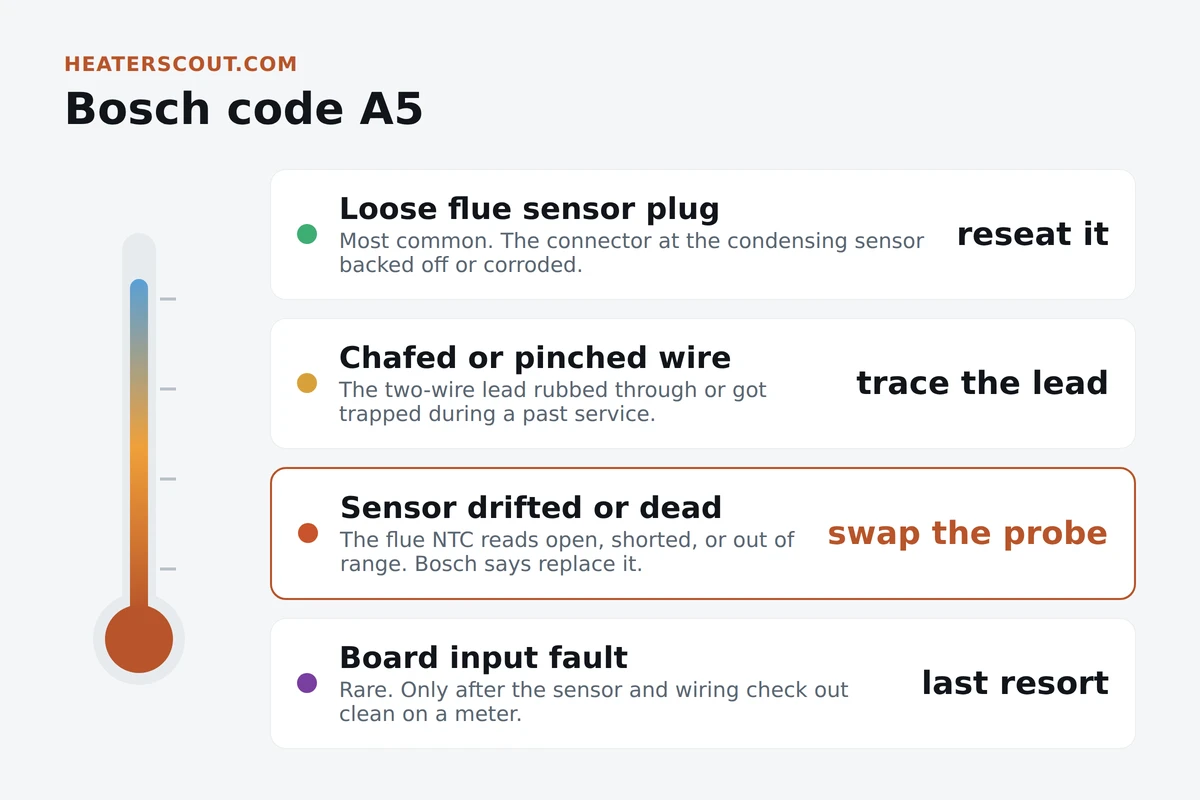
A Bosch tankless that shows A5 has not overheated and it has not lost its flame. It has lost track of one small temperature sensor sitting in the exhaust. On the condensing Greentherm and Therm units the control board watches how hot the flue gas is as it leaves the secondary heat exchanger, and when that sensor stops answering, or answers with a reading that makes no sense, the board posts A5 and shuts the burner down on purpose. Most of the time the culprit is a connector that backed off, not a dead part.
Rule out the free fixes first
Before you buy anything, walk this list. A5 is a signal problem, and the cheapest causes are also the most common. Kill power at the breaker before you open the cover, because you will be reaching near live spark voltage and a hot exchanger.
- Power the unit off at the breaker and let the heat exchanger cool for a few minutes before you open the cover.
- Find the flue gas sensor on the exhaust side, at or near the top of the secondary (condensing) heat exchanger.
- Unplug and reseat its connector. Look for a plug that backed off, green corrosion, or a burnt terminal.
- Trace the two-wire lead end to end for chafe, a pinch point, or a spot melted against hot metal.
- Check for condensate or moisture at the connector, since the flue side of a condensing unit sees water.
- Reset the code (front-panel RESET, or a 2 to 3 minute breaker cycle) and fire the unit to see if A5 returns.
What A5 is, and what it is not
The quickest way to stop chasing the wrong part is to be clear on what the board is actually reporting. A5 is a flue gas sensor fault, nothing more. It is easy to confuse with a water-side overheat trip or a descaling problem, and both of those send you in the wrong direction.
What A5 is
- A condensing flue gas temperature sensor fault.
- A lost, open, shorted, or out-of-range signal from that probe.
- A protective shutdown that guards the plastic vent.
- Specific to condensing units: Greentherm 9000, condensing Therm C.
What A5 is not
- Not the domestic hot water outlet temperature sensor.
- Not a scald or overheat safety trip on the water side.
- Not a scale or flow problem that descaling would fix.
- Not a code you will ever see on a non-condensing Bosch unit.
A5 at a glance
Keep the spec next to you while you work. The resistance numbers are the ones that tell you whether the sensor is the fault or the wiring is.
| Code meaning | Condensing flue gas temperature sensor fault |
| Sensor type | NTC thermistor on the exhaust side of the secondary heat exchanger |
| Affected models | Greentherm 9000 series, condensing Therm C-series |
| Not affected | Non-condensing Bosch tankless (no flue sensor) |
| Most likely cause | Loose or corroded sensor connector |
| Next cause | Chafed, pinched, or open two-wire lead |
| Reset method | Front-panel RESET, or a 2 to 3 minute breaker cycle |
| How to verify sensor | Meter its resistance, compare to Bosch curve at known temperature |
| Bad reading | Open (infinite ohms), shorted (near zero), or far off the curve |
| OEM flue sensor | Roughly $40 to $90 for the part, by model and supplier |
| Pro repair range | About $150 to $350 to diagnose and replace |
| Difficulty | DIY reseat and inspect; sensor swap is a careful DIY or a tech job |
The fix, in order
Work cheap to expensive. Do not order a control board because a code scared you, and do not order a sensor before you have reseated the plug and traced the wire. Most A5 faults never get past the first two steps.
Do not bypass the flue sensor
Never jumper or defeat the flue sensor input to force the unit to run. That sensor guards the plastic vent, which is rated only to a limited temperature. Bypassing it removes the protection that keeps the exhaust inside safe limits. If the sensor and wiring keep failing, stop and get a licensed tech, do not work around the fault.
What the sensor is doing, in detail
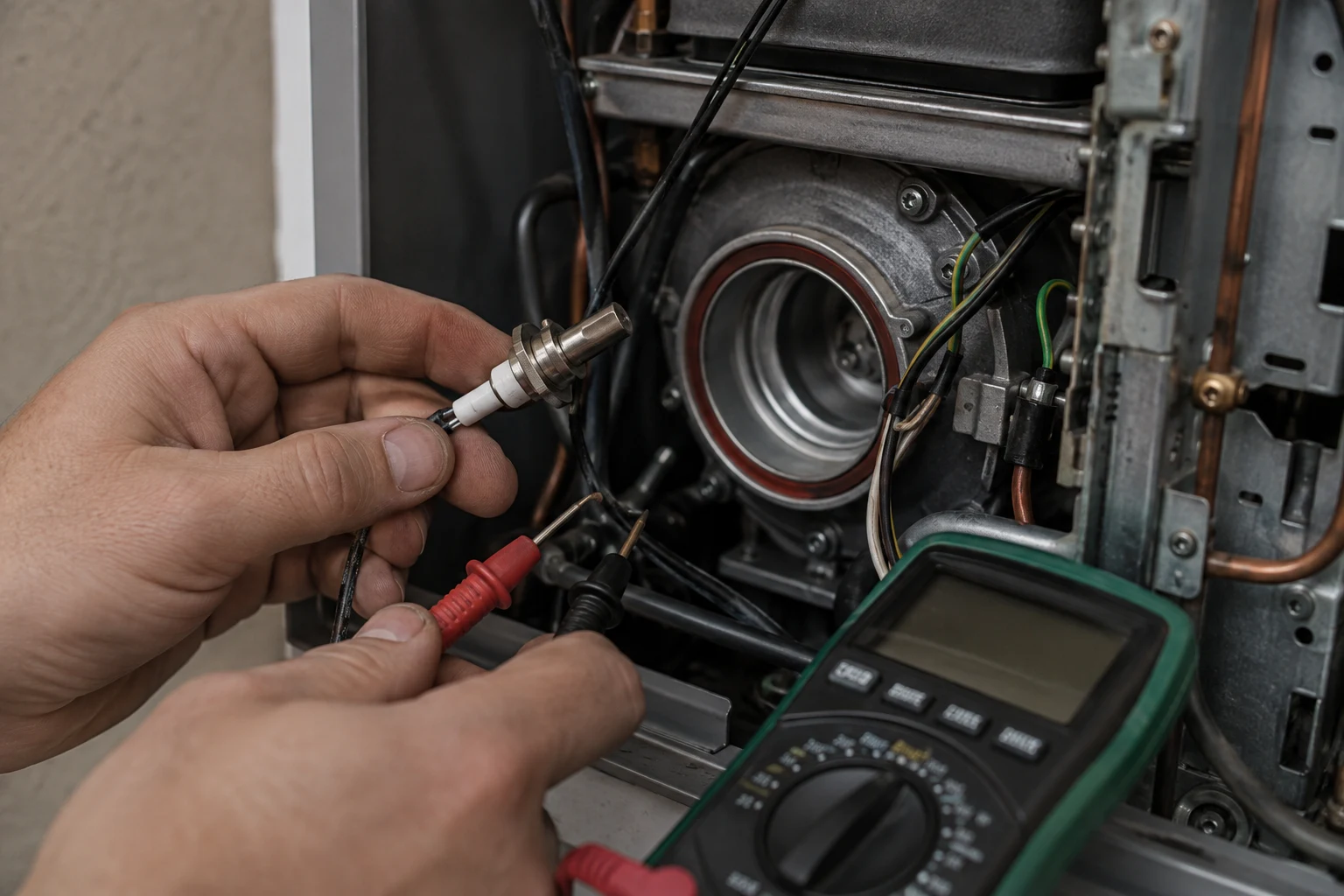
Understanding what the board watches makes the whole repair obvious. The flue gas sensor is a thermistor, an NTC type, whose resistance changes with temperature. The board reads that resistance and converts it to a flue temperature. On a condensing heater that number matters twice over. It confirms the secondary heat exchanger is pulling heat out of the exhaust the way condensing units are supposed to, and it guards the plastic vent pipe, which is only rated to a limited temperature. If the sensor reads open, the board sees infinite resistance and calls it a fault. If it reads shorted, near zero resistance, same story. If the number is simply implausible for a running burner, the board flags A5 rather than trust it. So A5 is the board saying it cannot rely on the one reading that keeps the exhaust and the vent inside their limits.
That is also why the resistance check in step four is the real test. A connector can look perfect and still open under heat, and a sensor can read fine cold and drift once the flue warms up. Metering the probe against the Bosch curve at a known temperature is the only way to separate a wiring fault from a sensor fault. If the cold reading already sits open or shorted, you have your answer without even firing the unit. If it reads plausible cold but A5 returns hot, you are chasing an intermittent, and the connector and the lead are where you look, not a fresh sensor.
Where the homeowner line sits
Resetting the code, reseating the connector, and tracing the wire are fair game for a careful homeowner who is comfortable shutting off power and opening a sealed unit. It is a screwdriver and a flashlight. Metering the sensor and swapping it is a step up, still doable for a confident DIYer with a multimeter and the Bosch resistance spec, but it puts you inside the combustion cabinet of a condensing unit. The line you do not cross is bypassing the sensor to force the heater to run, or ignoring an A5 that keeps returning. If the plug reseats and the wire looks clean and the code still comes back, the sensor or the board is the fault, and at that point a Bosch-savvy tech with the model manual is cheaper than guessing at parts.
Keeping A5 from coming back
The flue side of a condensing unit lives with moisture, so corrosion at the sensor connector is the slow killer. When your unit gets its annual service, have the tech pull and inspect the flue sensor connector, clean any condensate residue, and confirm the lead is routed clear of hot metal. Keep the condensate drain flowing and the trap clean, because a backed-up drain raises humidity right where that connector sits. Keep the intake and exhaust clear so the burner runs clean and the flue temperature stays in its normal band. None of this is exotic. It is the same annual visit that descales the heat exchanger, just with one extra look at a small connector on the exhaust side that most people never think about until the shower runs cold.
Frequently asked
What does A5 mean on a Bosch tankless water heater?
A5 is the condensing flue sensor fault. Bosch condensing tankless units, the Greentherm 9000 series and the condensing Therm C models, carry a temperature sensor that watches the flue gas leaving the secondary heat exchanger. The control board uses that reading to confirm the condensing exchanger is doing its job and to protect the plastic vent from overheating. When the board loses the signal from that sensor, or the signal reads open, shorted, or wildly out of range, it posts A5 and shuts the burner off. It is not the domestic hot water outlet sensor, and it is not a scald or overheat lockout. It is specifically the flue gas probe on the exhaust side. Non-condensing Bosch models do not have this sensor, so you will not see A5 on those units.
Can I reset Bosch code A5 myself?
You can clear it, and on many Therm and Greentherm units the front panel has a RESET button you press to drop the code. If your controller has no reset button, cut power at the breaker for two to three minutes, then restore it. Either way the unit reboots and A5 clears so the heater can try to fire again. The honest catch is that clearing is not fixing. A5 is a hardware fault, a lost or bad sensor signal, so if the plug is loose or the sensor has drifted, the code returns the moment the board polls that input again. Use the reset to confirm your repair worked, not as the repair itself. If A5 comes back within a firing cycle or two, the sensor circuit still has a real problem.
Is Bosch code A5 dangerous?
The code itself is a protection, not a hazard. The flue sensor exists to keep exhaust temperature in a safe band and to protect the condensing vent, which on these units is plastic and rated only to a certain temperature. When the board cannot trust that reading, shutting the burner down is the safe move. So a unit sitting on A5 is a cold shower, not a fire risk. The real risk is defeating the sensor or forcing the unit to run without it. Never jumper the flue sensor input to make the code go away, because you would be removing the very protection that keeps the exhaust and the vent inside their limits. If the sensor and wiring keep failing, get a Bosch-savvy tech on it rather than working around the fault.
How much does it cost to fix Bosch A5?
If the cause is a loose or corroded connector, the fix costs nothing but your time. Reseat the plug and the code clears. If the flue sensor itself has failed, a genuine Bosch flue gas temperature sensor for the Greentherm and condensing Therm lines typically runs in the rough range of 40 to 90 dollars for the part, depending on model and supplier. A service call to diagnose and replace it usually lands somewhere around 150 to 350 dollars once you add the trip charge and labor, more in high-cost metros. There is no expensive board swap hiding behind A5 in most cases, which is exactly why you rule out the plug and the wire before you spend on parts. The board is the last and least likely suspect.
Will descaling clear Bosch code A5?
No. Descaling flushes vinegar or a descaling solution through the heat exchanger waterways to strip mineral scale. A5 lives on the exhaust side, at a dry flue sensor reading gas temperature, so a water-side flush does nothing for it. People reach for descaling because it is the fix for a lot of tankless complaints, but this is not one of them. Regular descaling is still worth doing on schedule for the health of the unit, and a heater that is starved of flow by scale can push other codes, but A5 will not budge from a flush. The moves that clear A5 are reseating the sensor connector, tracing the wire, and, if needed, replacing the flue sensor.
Why does Bosch A5 keep coming back?
A code that returns after a reset is telling you the underlying fault is still there. The usual repeat offenders on A5: the connector was pushed back on but not fully seated, so vibration or heat cycling breaks the contact again. Or the two-wire lead is chafed or pinched somewhere along its run, so it opens intermittently as the unit heats and cools. Or the sensor has genuinely drifted out of range and needs replacing, not reseating. Corrosion at the terminal from condensate is another common one, since these are condensing units and the flue side sees moisture. Measure the sensor resistance with a meter and compare it against the Bosch spec for that model at a known temperature. If it reads open, shorted, or far off the curve, the sensor is the fault, and reseating will never hold.
Which Bosch models show code A5?
A5 is a condensing-unit code, so you see it on the models that actually have a flue gas sensor. That means the Greentherm 9000 series condensing tankless heaters and the condensing Therm C-series units. Non-condensing Bosch tankless models, the older Therm and AquaStar style heaters without a secondary heat exchanger, do not carry that sensor and use a different fault-code scheme, so A5 does not appear on them. If your unit is condensing, it vents through plastic pipe and drains condensate, and it is the kind of heater that can throw A5. Always match the code against the manual for your exact model number, because Bosch has revised code tables across generations.