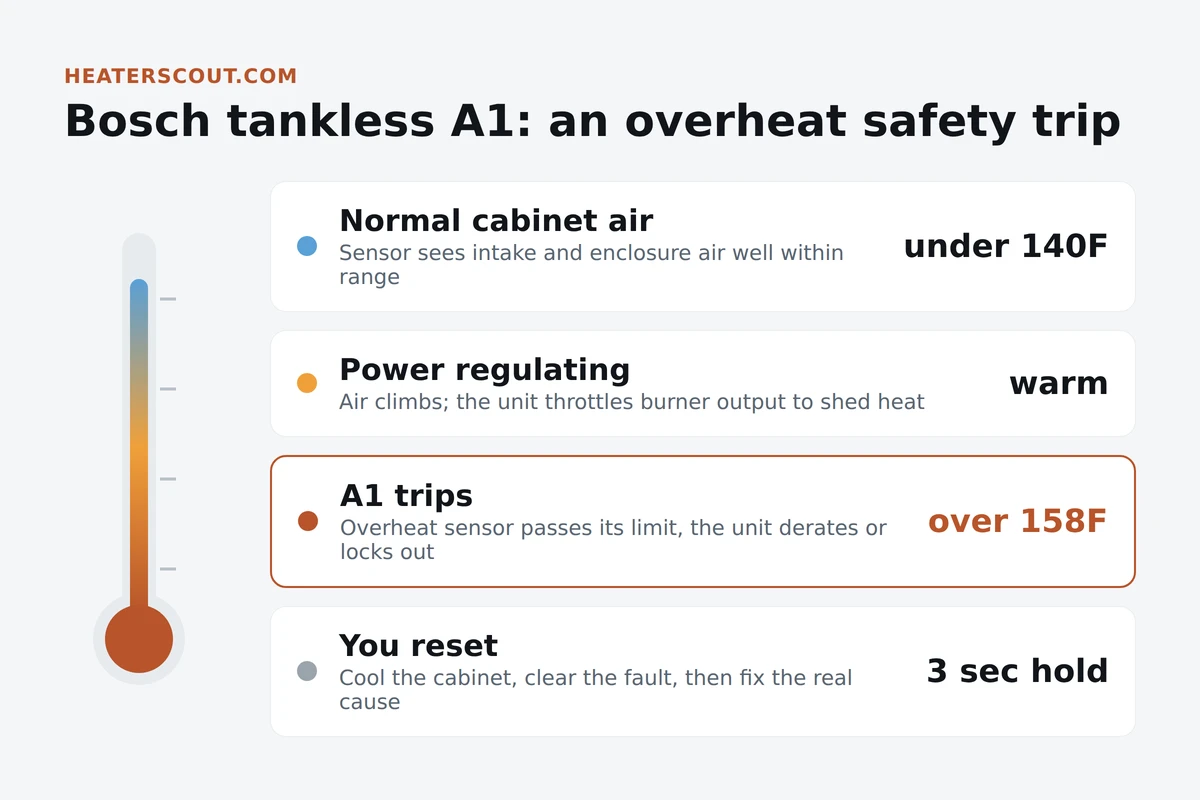
Your Bosch tankless flashes A1, the hot water sputters or quits, and the natural assumption is a broken part. It usually is not. A1 is Bosch's overheat protection code, and it means the sensor on the heat exchanger saw the air or flue-gas temperature inside the cabinet climb past its safe limit, around 158 F. The unit throttled the burner or shut down on purpose to keep the heat exchanger from cracking. So A1 is not itself a failure. It is the safety system reacting to something that made the inside of the unit too hot, and your job is to find that something. The same code carries the same meaning on the non-condensing Therm line and the condensing Greentherm line.
Read the code before you chase parts
The mistake with A1 is ordering an overheat sensor on day one. The sensor is usually fine. It is reporting a real temperature, and that temperature is coming from somewhere: a hot enclosure, combustion heat leaking inside the cabinet, restricted venting, or a scaled heat exchanger running hotter than it should. Work the causes in order of how often they turn out to be the culprit and how cheap they are to rule out. The diagnostic path below is roughly that order, from the free checks to the ones that need a meter and a manual.
Check the air around the unit
The overheat sensor watches cabinet air. If external air near the unit is above about 140 F, A1 is almost guaranteed. A heat wave, an unvented closet, a nearby dryer or furnace, or airflow blocked by storage against the cabinet all cook the intake air. Clear the space, improve ventilation, and let it cool. This alone resolves a surprising share of A1 codes, and it costs nothing.
Confirm strong, clean water flow
Weak flow means the burner dumps heat into very little water, and the heat exchanger and its air run hotter. Check the inlet water filter screen for scale and debris, make sure the cold supply is fully open, and clean any aerators. Restoring proper flow lowers the temperature the sensor sees.
Inspect the venting for leaks and restriction
This is the big one on A1. A leaking flue joint or a cracked concentric vent spills combustion heat straight into the cabinet. A blocked or bird-nested termination traps it. So does a vent run that is too long or uses more than three elbows, or an improper combination-vent setup. Look for scorching, loose clamps, gaps, and anything obstructing the intake or exhaust outside.
Descale if the unit has hours on it
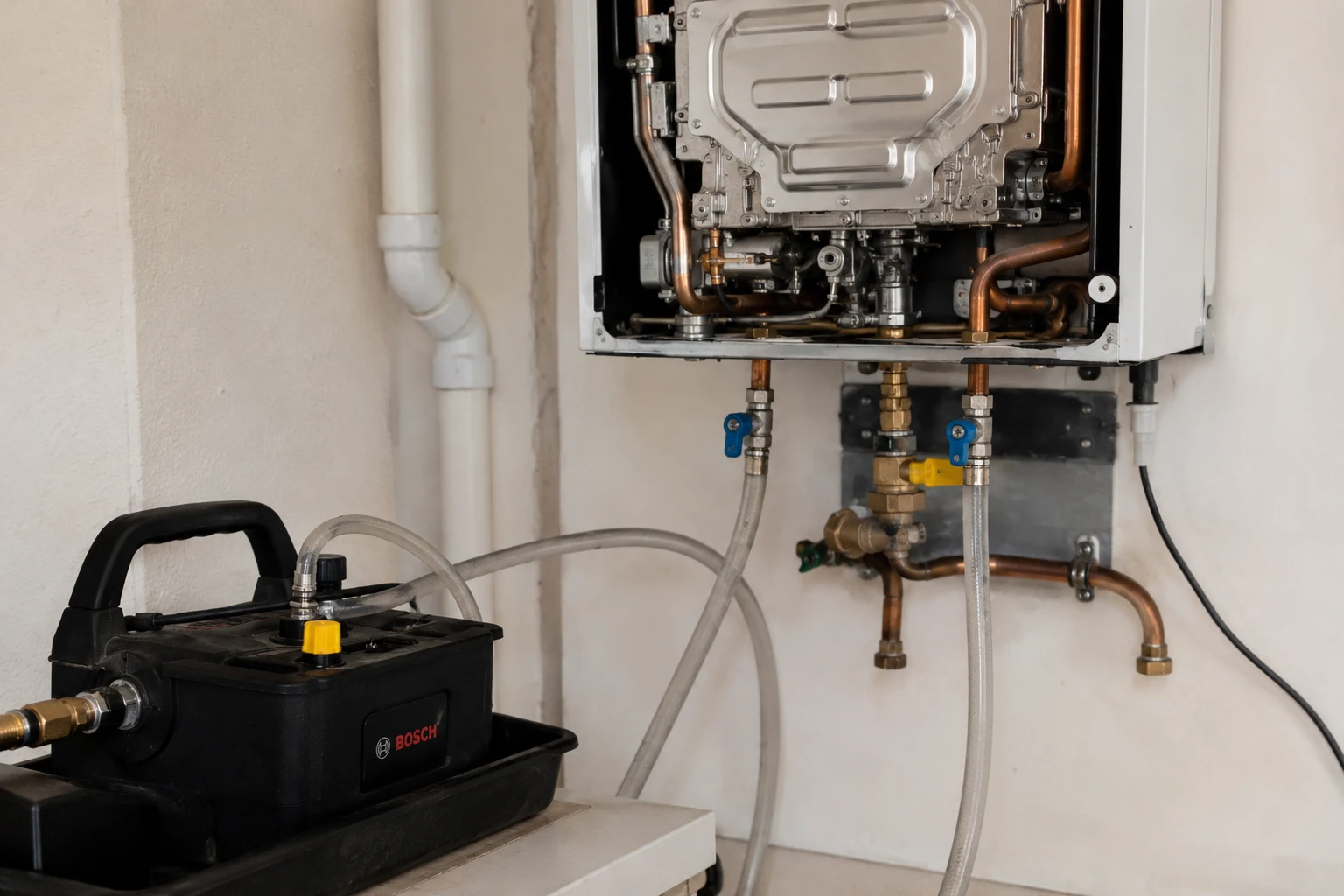
Mineral scale on the heat exchanger insulates the metal and raises flue-gas temperature, which can drift the sensor over its limit. On a unit a few years into hard water with no maintenance, a descale through the isolation valves often clears a scale-driven A1. On a clean or new unit, skip this and look at venting and airflow.
Check the overheat sensor and wiring (tech)
Only after the above: inspect the white wire connections at the overheat sensor. Clean corroded terminals with an eraser. Badly corroded terminals or a failed sensor throw a false or premature A1, and the sensor plus harness get replaced. Measuring sensor resistance against the manual's table is a licensed-tech step, done with the unit safely powered down.
Suspect the control board last
If air, flow, venting, scale, and the sensor all check clean and A1 persists, the control board can misread the sensor circuit. This is the rare, expensive end of the list, and it is a diagnosis of exclusion. Do not start here.
Should I just replace the overheat sensor to make A1 go away?
Not first. The sensor is reporting a real temperature far more often than it is lying. Swapping it without finding why the cabinet is hot usually leaves you with a new sensor and the same A1. Rule out the air around the unit, water flow, the venting, and scale before you touch the sensor. Replace it only when it or its wiring tests bad, or when everything else is verified clean and the code still trips.
Safety first
Do not defeat or jumper the overheat sensor to silence A1. It is the last guard against a heat exchanger running away. If A1 shows up with a burning or exhaust smell, soot at the vent, or a CO alarm, shut the unit off and get a licensed technician on it before you run it again. A vent leak that throws A1 is also a path for combustion products.
Homeowner fixes versus the pro's territory
A1 splits cleanly into work you can do yourself and work that needs a licensed gas technician. The dividing line is whether you are touching the sensor circuit, the gas train, or the vent system's integrity. Anything electrical inside the unit or anything that affects combustion safety belongs to a pro.
| Cause | Fix | Who |
|---|---|---|
| Hot cabinet air / poor airflow | Clear the space, add ventilation, cool the unit, then clear the code | Homeowner |
| Clogged inlet water filter | Shut supply, pull and rinse the inlet screen, restore flow | Homeowner |
| Blocked vent termination | Clear a bird nest, snow, or debris from the outside terminal | Homeowner (if reachable) |
| Scale on the heat exchanger | Descale through the isolation valves for 45 to 60 minutes | Homeowner or pro |
| Flue or vent leak inside cabinet | Reseal joints, replace cracked concentric vent, verify vent spec | Licensed tech |
| Corroded / failed overheat sensor | Clean terminals, test resistance, replace sensor and harness | Licensed tech |
| Control board misreading sensor | Confirm by exclusion, then replace the PCB | Licensed tech |
The reset, and why it is not the fix
Clearing A1 is simple. On units with the front touch control, hold the on/off button for more than three seconds. On any unit, killing power at the outlet or breaker for a minute and restoring it clears the fault and lets the unit re-check the sensor. If the cause was a one-off, a heat wave or a temporarily blocked airflow, the code may stay gone. But a reset does nothing about a vent leak, a scaled exchanger, or a corroded connection. If A1 returns, treat the reset as a test result, not a repair: it confirms the driver is still there. Some models also log an error history you can page through to see how often A1 has fired, which helps separate a one-time trip from a chronic problem.
| Code | A1 |
| Meaning | Overheat / high-limit protection: cabinet air or flue-gas temperature exceeded the safe limit |
| Sensor threshold | Roughly 158 F at the overheat sensor; the unit regulates power near this point |
| Applies to | Bosch Therm (non-condensing) and Greentherm (condensing) gas tankless lines |
| Top causes | Hot enclosure air, vent leak, restricted / over-long venting, heat-exchanger scale |
| Then | Overheat-sensor wiring corrosion or failed sensor; control board (rare) |
| Clear it | Hold on/off 3+ seconds, or cycle power for a minute |
| DIY fixes | Airflow, inlet filter, water flow, descale, clear an outdoor vent blockage |
| Pro fixes | Vent resealing, sensor / harness, control board |
| Rough cost | $0 airflow, $30-$60 DIY descale, $150-$300 pro flush, $40-$120 sensor part, $300-$600+ board |
Keeping A1 from coming back
Most repeat A1 codes trace to two neglected things: scale and venting. Descale the unit once a year in hard water, twice if your water is very hard, and clean the inlet filter screen at the same time. Keep the space around the unit open so intake air stays cool, and do not store anything against the cabinet. Once a year, walk outside and look at the vent termination for nests, screens clogged with lint, snow, or debris. If your unit was recently installed and throws A1 early, have the installer verify the vent length and elbow count against Bosch's spec, because an over-long or over-elbowed vent is a design problem, not a wear problem, and no amount of resetting will fix it.
When to stop and call a pro
If you have cleared the air around the unit, cleaned the filter, confirmed good flow, descaled, and A1 still returns, the problem is inside the combustion or sensor circuit, and that is where DIY stops. A vent leak, a sensor resistance test, or a board diagnosis all need a licensed gas technician with the manual for your exact model. That model point matters: Bosch revises its code tables between the Therm and Greentherm generations, so confirm the A1 definition and sensor spec against the manual that shipped with your unit rather than a generic list. A code that keeps firing after the cheap fixes is not nagging you, it is telling you the cause is still in there.
Frequently asked
What does error code A1 mean on a Bosch tankless water heater?
A1 is Bosch's overheat protection code. The overheat sensor on the heat exchanger reads the air or flue-gas temperature inside the cabinet, and when that climbs past its safe limit, roughly 158 F, the control board flags A1 and regulates burner power or shuts the unit down to keep the heat exchanger from cooking. It is a safety trip, not a wiring diagnosis by itself. The board is telling you the inside of the unit got too hot, and now you have to find why. The most common real reasons are a hot install location, a flue or vent leak spilling combustion heat inside the cabinet, restricted or over-long venting, scale on the heat exchanger, or a corroded overheat-sensor connection. The meaning is the same on both the non-condensing Therm line and the condensing Greentherm line.
Can I reset a Bosch A1 code myself?
Yes, clearing the code is a homeowner job, but clearing it and fixing it are two different things. On units with the touch control panel, hold the on/off button for more than three seconds to clear the fault, or cut power at the outlet or breaker for a minute and restore it. If the cabinet was simply hot, from a heat wave, a nearby appliance, or poor airflow around the unit, the A1 may not return once things cool down. If it comes right back or keeps returning, the reset is not the fix. Something is still driving the internal temperature up, and that has to be corrected before the code will stay clear.
Why does the A1 code keep coming back after I reset it?
A recurring A1 means the cabinet is still getting too hot, so the sensor keeps tripping. Walk it in order. First the easy stuff: is the unit in a hot, tight space, is anything blocking airflow around it, is the intake filter clean, and is water flow strong. Then the venting: a leaking flue joint, a cracked concentric vent, a blocked or bird-nested termination, or a vent run that is too long or has more than three elbows all trap combustion heat inside the cabinet. Then scale: mineral buildup on the heat exchanger raises flue-gas temperature and can nudge the sensor over its limit, which a descale clears. Last, the overheat sensor itself, its wiring, or the control board. Fix the driver, not the symptom, or the code just returns.
Is a Bosch A1 error dangerous?
The code itself is the safety system doing its job, so in that sense A1 is protecting you. It stops the heat exchanger from running away and cracking. What it can point to, though, deserves attention: a flue or vent leak that throws A1 is also a path for combustion products, and a blocked vent is a carbon monoxide concern. Do not defeat the overheat sensor or jumper it to make the code go away. If A1 appears alongside a burning or exhaust smell, soot around the vent, or a CO alarm, shut the unit down and get a licensed technician on it before you run it again.
Will descaling clear a Bosch A1 code?
It can, when scale is the cause. On a unit that is a few years into hard water with no maintenance, mineral buildup on the heat exchanger insulates the metal and pushes flue-gas temperature up, which can drift the overheat sensor over its limit and set A1. A proper descale, circulating a descaling solution or white vinegar through the isolation valves for 45 to 60 minutes, restores heat transfer and often clears a scale-driven A1. But descaling does nothing for a vent leak, a blocked termination, a hot install location, or a corroded sensor connection. If the unit is clean or newly installed, look at venting and airflow first.
How much does it cost to fix a Bosch A1 error?
It depends entirely on the cause. Homeowner fixes are cheap: clearing an intake filter or improving airflow around the unit costs nothing, and a DIY descale kit runs about $30 to $60. A professional descale and flush is roughly $150 to $300. Venting repairs vary: resealing a joint or clearing a blocked termination might be $150 to $400, while re-running an over-long or badly elbowed vent can run higher. An overheat sensor is a modest part, often $40 to $120, plus one to two hours of labor. A control board is the expensive end, commonly $300 to $600 or more installed. Chase the free and cheap causes first before anyone quotes you a board.
Does A1 mean something different on a Greentherm versus a Therm model?
No. Across Bosch's US gas tankless lineup, A1 is the overheat protection code on both the non-condensing Therm units and the condensing Greentherm units. The sensor and its threshold are essentially the same job on both. The one practical difference is what tends to trip it: on a condensing Greentherm the venting and condensate side is more involved, so vent restriction and flue-gas temperature show up more; on a non-condensing Therm, install location and airflow around the cabinet are common drivers. The code meaning does not change, only the likeliest cause by how the unit is built. Always confirm against the manual for your exact model, since Bosch does revise code tables between generations.