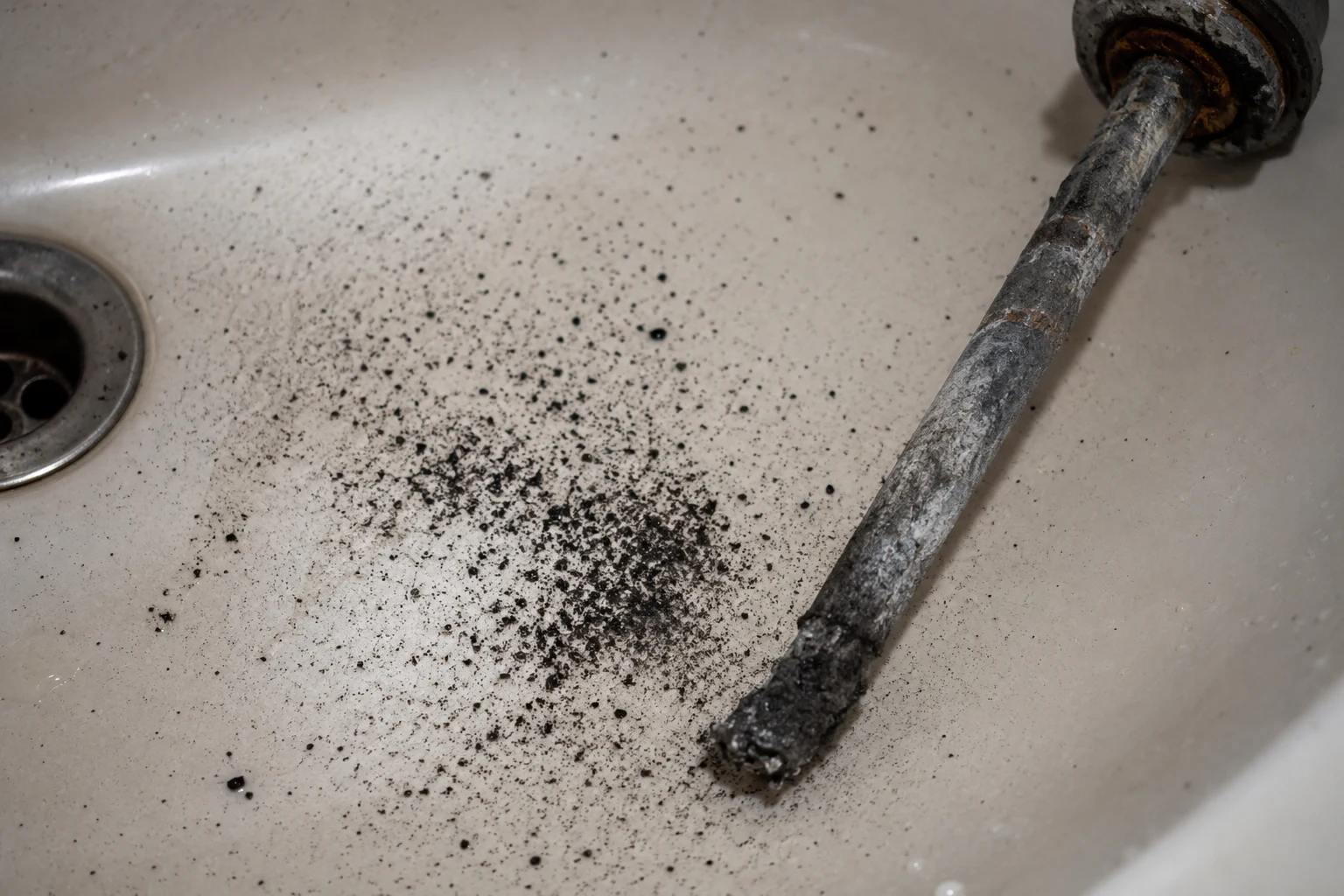
Dark, sandy grit settling in the bottom of a hot glass of water almost always traces to one part: the anode rod hanging inside your water heater. It is a length of magnesium or aluminum built to corrode on purpose so the steel tank does not, and as it dissolves it sheds a fine dark sediment that rides out on the hot line. But there are two other suspects that look similar at a glance and get misdiagnosed constantly, so before you order a part, the first job is telling anode grit apart from crumbling dip-tube plastic and smeary black rubber. The tap the particles come from and how they feel between your fingers settle it.
The three things black water actually is
People throw the word black around loosely, so pin down what you are seeing before you spend a dime. There are three distinct sources and they look and feel different. Get a clean sample by holding a white coffee filter or a paper towel under a running hot tap, catch the grit, let it dry, and look at it in good light. The color and whether it smears will route you straight to the right part.
Gritty dark sediment = anode rod
Dark grey to nearly black grit that feels like fine sand or coffee grounds. This is a magnesium or aluminum anode rod corroding the way it was designed to. It shows only on the hot side and it will keep coming until the rod is replaced.
White or tan curls = dip tube
Pale plastic flakes that look like little shavings, not black grit. Classic on heaters built roughly 1993 to 1996 with a defective dip tube. Note the color: this debris is never black, so dark grit rules it out.
Black smear = rubber
Black flecks that smudge between your fingers rather than feeling like sand. That is a deteriorating rubber washer, gasket, or the lining of a braided flex connector, not anything inside the tank. Often a leak is not far behind.

Trace it before you fix it
The single most useful test costs nothing and takes two minutes: compare the hot and the cold. The water heater only touches the hot side, so which taps carry the grit tells you whether you are even looking at the right appliance. Work this path in order and you will land on the actual culprit instead of guessing.
Hot tap only, cold runs clean
The contamination is inside the water heater, because cold water never routes through the tank. This is the anode-rod or dip-tube case. Move on to texture and color to split those two.
Both hot and cold are dirty
The heater is off the hook. Grit on both lines means the trouble is upstream in the incoming supply: well sediment or manganese, disturbed city-main scale, a failing whole-house filter, or corroding galvanized house pipe. Check the outside hose bib, which is usually plumbed before the heater, to see the raw water.
Grit feels gritty and sandy
Dark, sandy sediment that does not smear is a corroding magnesium or aluminum anode rod shedding its material. This is the most common answer by a wide margin. Plan on a flush and an anode inspection.
Flecks are white or tan curls
Curled pale plastic, not black grit, is a disintegrating dip tube. Suspect it on heaters built around 1993 to 1996. The color difference is the whole tell: anode grit is dark, dip-tube debris is light.
Flecks smear black on your fingers
Rub a fleck. If it smudges into a black streak instead of feeling like sand, it is rubber from a gasket, washer, or a flex-connector lining. Track down the deteriorating connector and replace it rather than opening the tank.
The fix, in the order that works
Once the sample and the two-glass test have named the source, the repair is straightforward and mostly homeowner work. The one rule: do not skip the flush and jump straight to replacing a part, and do not remove the anode without replacing it. Run the sequence below and you clear the loose grit and stop the source in one visit.
A note on brand quirks that comes up a lot. A.O. Smith, Rheem, and Bradford White all ship with a magnesium anode as standard, and magnesium is the most reactive, which means it protects well but also sheds the most sediment and is the most likely to cause a rotten-egg smell in certain water. If a fresh magnesium rod keeps making black grit or odor, that is your cue to go aluminum-zinc or powered rather than to keep replacing like for like. And if you have run the two-glass test and the grit shows on both hot and cold, stop opening the heater. That water is coming in from the street or the well, and the answer is a whole-house filter or a supply-side fix, not another anode.
If only the hot tap runs black and the cold stays clean, the water is not your problem. The grit is coming from inside the tank, and that points straight at the water heater, not the supply.
Frequently asked
Why is there black stuff coming out of my hot water only?
Because the black stuff is coming from inside the water heater, and the hot side is the only path that runs through the tank. Cold water bypasses the heater entirely, so if the flecks show up only at the hot tap and never at the cold, the source is the tank hardware, not your city or well supply. The usual culprit is the sacrificial anode rod. It is a metal rod hung inside the tank that is designed to corrode in place of the steel walls, and as a magnesium or aluminum rod eats away it drops a fine, dark, gritty sediment that gets stirred up and carried out on the hot line. Less often it is a crumbling dip tube or a rubber part. Fill a clear glass from a hot tap and a second glass from a cold tap and compare them side by side. If only the hot one is dirty, you have confirmed the heater as the source before you touch a tool.
Are the black particles in my hot water dangerous to drink?
The most common source, a corroding magnesium or aluminum anode rod, is not toxic. Those are the same metals sold as dietary supplements, and the grit they shed is not a poison. That said, water carrying visible sediment is not water you want to drink or cook with, and grit clogs aerators, fills the bottoms of glasses, and jams the little screens inside faucets and appliance valves. If the flecks smear black between your fingers rather than feeling like sand, you are looking at deteriorating rubber, and while a little rubber will not hurt you either, a failing gasket or flex-line usually means a leak is not far behind. Either way the fix is the same direction: flush the tank, find the failing part, and replace it. Treat black water as a maintenance signal, not an emergency, but do not just live with it because a heavily spent anode leaves the steel tank unprotected and shortens its life.
How do I know if it is the anode rod or the dip tube?
Color and texture. Anode grit is dark, from grey to nearly black, and it feels gritty and sandy between your fingers, like fine sand or coffee grounds. Dip tube debris is different: it is white or tan curled plastic flakes, almost like little wood shavings or bits of eggshell, and it is clearly plastic, not grit. So black sand points at the anode, and pale plastic curls point at the dip tube. There is a third possibility. If the flecks are black and smear or smudge when you rub them, that is rubber from a washer, a gasket, or the lining of a braided flex connector, not anything inside the tank. Catch a sample in a white coffee filter held under a running hot tap, let it dry, and look at it in good light. The color and whether it smears will tell you which of the three you are chasing.
Can a bad anode rod cause black water, and should I just remove it?
Yes, a spent anode rod is the number one cause of dark gritty hot water, but no, do not just pull it and leave the port empty. The anode exists to corrode instead of your tank, so a rod that is shedding grit is a rod nearing the end of its service life and doing exactly what it was built to do. If you remove it and run without one, the tank steel becomes the sacrificial metal and the tank starts to rust from the inside, which is how you turn a black-water annoyance into a leaking tank and a full replacement. The right move is to pull the old rod, look at how much is left, and put a fresh one in. If a standard magnesium rod makes too much sediment or a rotten-egg smell, switch to an aluminum-zinc rod or a powered anode, which sheds far less.
How do I get the black particles out of my water heater?
Flush the tank. Shut off the power at the breaker on an electric unit or set a gas unit to pilot, close the cold water inlet valve, and hook a garden hose to the drain valve at the bottom of the tank. Open a nearby hot tap to break the vacuum, then open the drain and let the water run out, carrying the loose sediment with it, until it runs clear. On a badly loaded tank you may need to open and close the cold inlet in bursts to stir the grit up off the bottom. A full flush clears the loose sediment, but if the anode is the source it will keep making more, so a flush alone is a temporary fix. Pair the flush with pulling the anode rod and inspecting it, and replace the rod if it is heavily eaten away. That combination, flush plus a fresh anode, is what actually stops the black water rather than just clearing it for a month.
My water heater is from the 1990s, could the dip tube be the problem?
It is a real possibility worth checking. A wave of defective dip tubes went into heaters built roughly between 1993 and 1996, and those tubes crumble with age and shed plastic into the hot water. The catch is that dip tube debris is white or tan curled plastic, not black grit, so if your particles are dark and sandy the dip tube is probably not your issue and you should look at the anode instead. If you are seeing pale plastic flakes clogging your aerators, though, the dip tube is a strong suspect on a heater of that age. The dip tube is the plastic pipe that carries incoming cold water to the bottom of the tank, and it usually sits under the cold inlet fitting on top. On a heater that old, keep in mind the whole unit may be past its expected fifteen-year life, so weigh a dip tube replacement against the cost of a new heater.
Why does black stuff come out of both my hot and cold taps?
If both the hot and the cold are dirty, the water heater is off the hook. The heater only touches the hot side, so contamination on both lines means the problem is upstream, in the water coming into the house. On a well that can be sediment, manganese, or a failing filter. On city water it can be disturbed pipe scale after a main break or hydrant flushing nearby, or corrosion in old galvanized house piping. Black staining from both taps specifically can point to manganese in the supply, which is common on wells and leaves dark specks and stains. Start by checking any whole-house filter or softener and running the outside hose bib, which is usually plumbed before the heater, to see if that raw water is also dirty. If the raw supply is clean and only the hot is black, you are back to the heater and its anode.