An A. O. Smith tank does most of its talking through one small light and one red button. On a gas model, a single status light on the gas control valve blinks a code every three seconds. On an electric model, a red reset button on the upper thermostat is the safety cutoff that has almost certainly tripped when you get no hot water at all. Learn to read those two things and you have solved most of what goes wrong with these heaters. This page walks the top symptoms owners actually hit, gas and electric, and points each one at its likely cause and the right next move, without guessing at parts you do not need yet.
Start here: the two things A. O. Smith heaters tell you
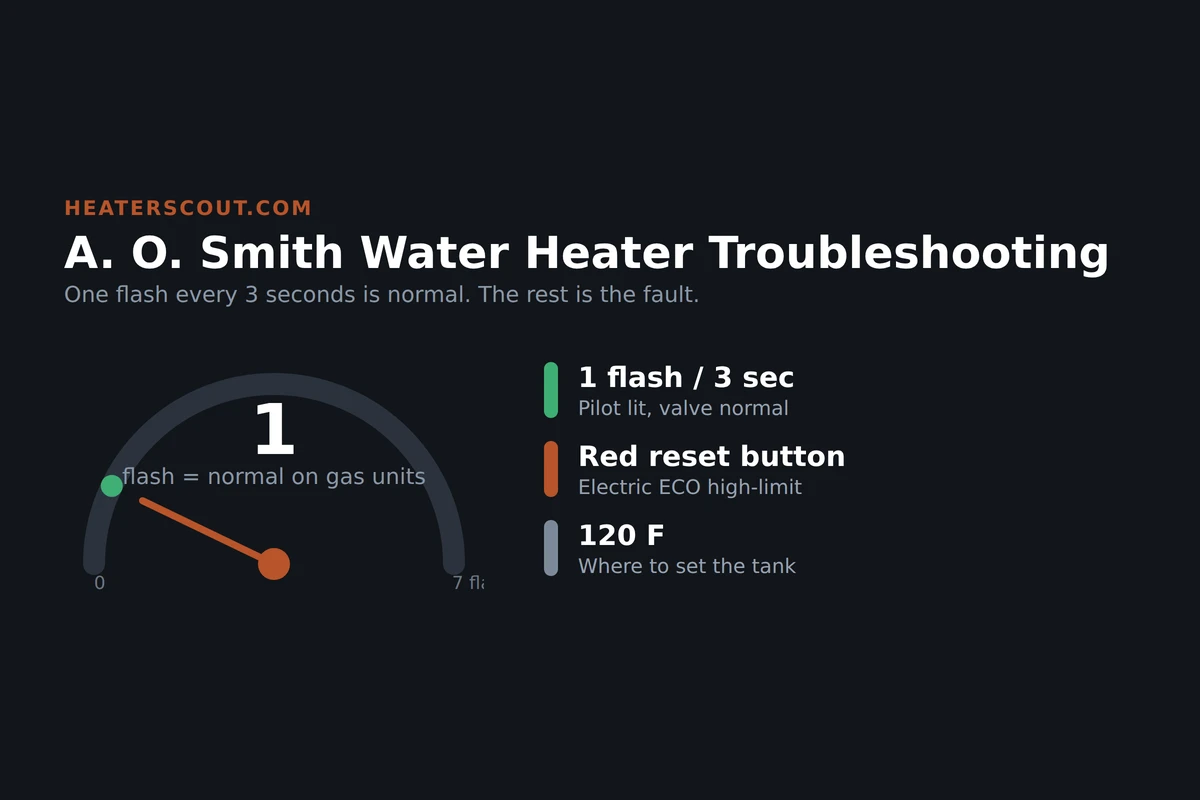
Before you open anything, figure out which fuel you have, because the diagnosis forks hard. A gas A. O. Smith unit has a gas control valve near the bottom with a single status light on it. That light blinks a pattern that repeats about every three seconds, and the pattern is the diagnosis. One flash every three seconds is the normal, everything-is-fine code. Anything else is a fault, and the number of flashes in each group before the long pause is the code. Count them cleanly. A group of two, a pause, then another two is a two-flash code, not a four.
An electric A. O. Smith unit has no pilot and no status light. Its equivalent tell is the red reset button, the ECO or emergency cut-off, sitting on the upper thermostat behind the top access panel. It is a one-shot high-limit switch that cuts all power to both elements when the tank water gets dangerously hot, around 170 to 180 degrees. If an electric unit goes stone cold with the breaker on, a tripped ECO is the first thing to check. The catch is that it does not trip for no reason, so a repeat trip is a real fault to chase, not a button to keep pushing.
- Confirm fuel type: gas (status light + pilot) or electric (red ECO button, 240 V breaker).
- Gas: read the status-light flashes against the chart on the unit. One flash per 3 seconds is normal.
- Electric: kill the 240 V breaker, pull the top panel, and check the red ECO reset button.
- Check the temperature dial or thermostat setting before condemning parts. Aim for 120 F.
- Confirm the pilot is actually burning (gas) through the sight window before touching the thermopile.
- For any leak, find the exact source: top fittings and T&P are fixable, a bottom tank leak is not.
- Have the model and serial from the rating label ready. Flash charts and parts vary by model.
No hot water at all
This is the call that comes most often, and the fix depends on fuel. On a gas unit, look through the sight window. If the pilot is out, the thermopile stopped holding the valve open, and you relight following the printed instructions on the jacket. If the pilot will not light or will not stay lit once you release the knob, you are into thermopile territory, covered below. If the status light shows a fault code, read it: two flashes is a weak pilot or thermopile, four flashes is a high-limit trip that needs a technician to find why the water overheated.
On an electric unit, no hot water with the breaker on almost always means the red ECO tripped. Turn off the 240-volt breaker, pull the upper access panel and the insulation, and press the red button. If it clicks and resets, restore power and give it an hour. If it trips again, the fault is a stuck thermostat driving the elements nonstop, a shorted element, or bad wiring, and each of those needs a meter, not another press. Never keep resetting a tripping ECO, that switch is what keeps the tank from cooking the water to scalding.
The pilot lights, then dies: it is the thermopile
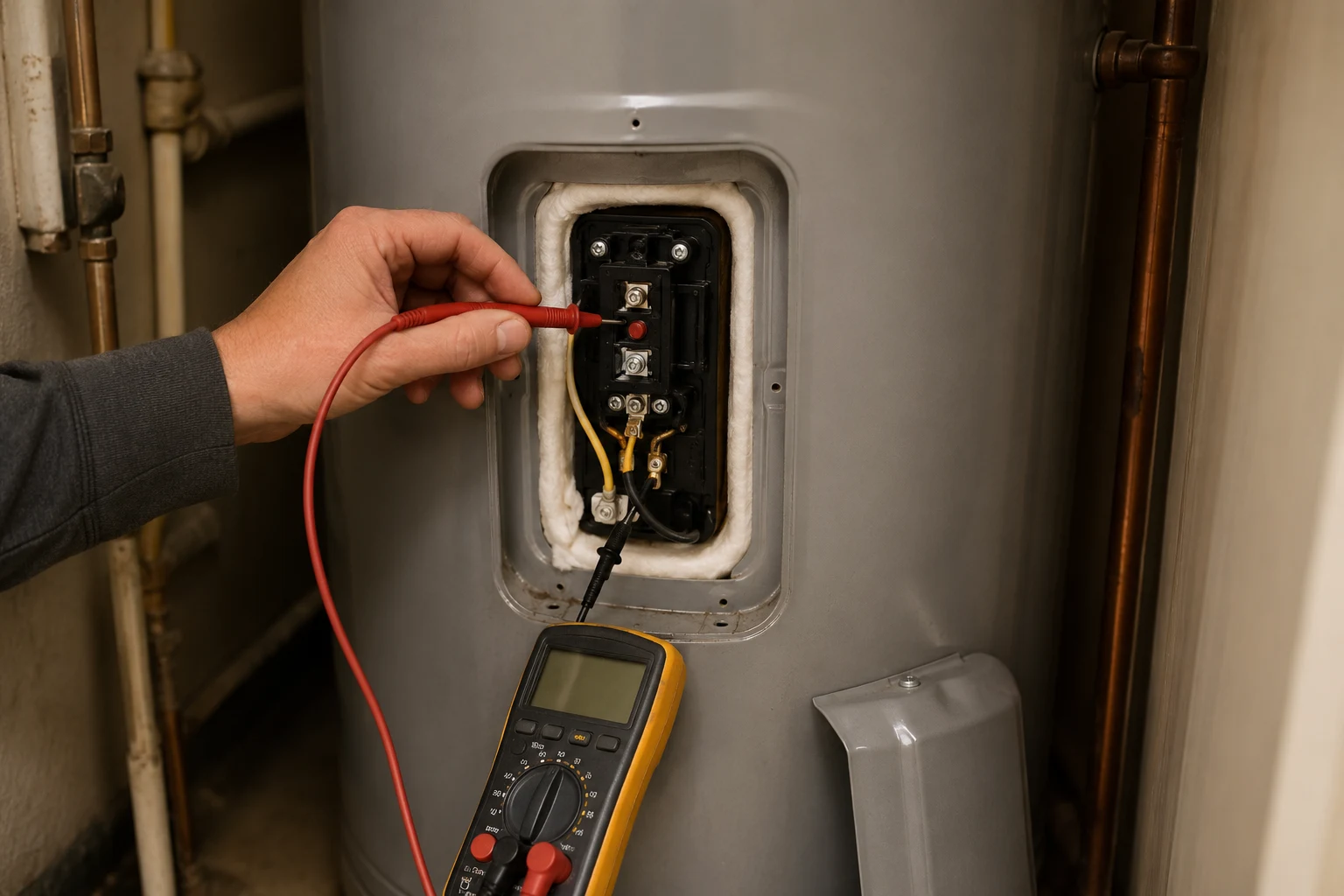
A gas pilot that lights while you hold the knob and drops the instant you let go is the classic thermopile symptom, and the status light usually confirms it with two flashes for low thermopile voltage. The thermopile sits in the pilot flame and converts that heat into a small voltage that holds the main gas valve open. A healthy one produces somewhere in the range of 400 to 800 millivolts. When it is dirty, worn out, or the pilot flame is weak and not wrapping the top quarter of the probe, the voltage falls too low to keep the valve open, and the pilot goes dark.
Do not throw parts at it blind. First make sure the pilot flame itself is strong, blue, and actually enveloping the tip of the thermopile. A lazy yellow or undersized pilot has its own causes, often a partially clogged pilot orifice. If the flame looks right and the pilot still will not hold, the pilot assembly is the fix, and on these units the thermopile is replaced as part of that whole assembly rather than on its own. If a fresh assembly still will not hold the valve open, the gas control valve itself is the next suspect.
| 1 flash / 3 sec | Normal. Pilot is lit and the gas valve is operating properly. No action. |
| 2 flashes | Low thermopile voltage: weak pilot flame, or a dirty or worn thermopile. |
| 3 flashes | Pilot outage. Relight the pilot; replace the pilot assembly if it will not hold. |
| 4 flashes | High-limit (ECO) temperature trip. Water overheated. Have a technician find the cause. |
| 5 flashes | Temperature sensor fault. Technician diagnosis. |
| 6 flashes | Flammable-vapor sensor lockout. Clear the vapors and area; relight; call a tech if it recurs. |
| 7 flashes | Gas valve or electronics failure. Technician; usually a control-valve replacement. |
| No light | No thermopile power: pilot out, failed thermopile, or a loose/corroded valve connection. |
Confirm against your model, and know when to stop
Read the chart on your own unit before buying a part. Flash-code meanings differ between A. O. Smith models and between control valves, and a code is a starting point, not a guarantee. Anything involving gas, a tripping ECO that will not stay reset, or 240-volt wiring is where a licensed pro earns the call. The status light and reset button tell you where to look; they do not license guessing on live gas or high-limit safety devices.
Water too hot, leaks, noise, and bad water
Scalding water with the dial set low is a stuck thermostat calling for heat it should not. On an electric unit that same fault is what drives the tank past 170 degrees and trips the ECO, so a too-hot complaint and a tripping reset button are often the same underlying problem. Set both electric thermostats to match at 120, and if the water still runs scalding, the thermostat that is not shutting off gets replaced.
Leaks sort themselves by location. Water at the top means fittings, nipples, or the temperature and pressure relief valve. A dripping T&P is opening because pressure reached 150 psi or the water reached 210 degrees, commonly from thermal expansion on a closed system with no expansion tank, or the valve is simply worn. It is a safety device, so replace it, never cap it. Water pooling under the center of the tank with nothing dripping above is the steel shell corroded through, and that ends in replacement. Popping and rumbling is trapped steam under a layer of sediment, cured by a flush and kept away with a yearly one. Rusty or brown water and a rotten-egg smell point at the tank and the anode rod, where a magnesium rod reacting with bacteria makes the sulfur odor and an aluminum-zinc or powered anode clears it.
Thermopile (self-powered gas valve)
A bundle of thermocouples sitting in the pilot flame that converts heat into a small electrical voltage, roughly 400 to 800 millivolts when healthy. That voltage both powers the control's status light and holds the main gas valve open, which is why these units need no batteries or outlet. When the thermopile weakens or the pilot flame stops enveloping it, the voltage drops, the valve closes, and the pilot dies. On A. O. Smith units the thermopile is replaced as part of the complete pilot assembly, not by itself.
Frequently asked
My A. O. Smith gas water heater has no hot water and the status light is flashing. What do the flashes mean?
On a standard A. O. Smith gas tank unit there is a single status light on the gas control valve, and it speaks in a pattern that repeats about every three seconds. One flash every three seconds is the good news code: the pilot is lit and the valve is working normally, so if you have no hot water with a single steady flash the problem is elsewhere, usually the temperature setting or demand. More flashes are faults. Two flashes points at low thermopile voltage, which is a weak pilot flame or a dirty, worn thermopile. Three flashes is a pilot outage. Four flashes is a high-limit or ECO temperature trip. Five is a temperature sensor fault, six is the flammable vapor sensor locking the unit out, and seven is a gas valve or electronics failure. The exact chart varies by model, so read the label and the manual for your specific unit before you buy a part, and count the flashes carefully: a one-two-three group with a pause is three, not a hundred and twenty-three.
What is the red button on my A. O. Smith electric water heater and can I just press it?
That red button is the ECO, the emergency cut-off, also called the high-limit reset. It sits on the upper thermostat behind the top access panel, and it is a one-shot safety device that kills all power to both heating elements the moment the water in the tank climbs past a safe threshold, somewhere around 170 to 180 degrees. You can press it once to reset it, but do it with the breaker off, and understand that it tripped for a reason. If it resets and holds, you may have had a one-time fluke. If it trips again within minutes or hours, stop pressing it. A repeat trip means a stuck thermostat calling for heat it should not, a shorted element, or bad wiring, and each of those needs to be found and fixed, not reset around. Pressing a tripping ECO over and over defeats the one device standing between you and a tank of scalding water.
Why is my A. O. Smith water heater running out of hot water so fast?
Short hot water on a tank that used to be fine almost always comes down to one of three things. The most common is sediment. Minerals settle on the bottom of the tank, and on an electric unit they bury the lower element so it cannot heat the water around it, which drops your usable capacity even though the tank is technically full. The second is a broken or shortened dip tube, the pipe that carries incoming cold water to the bottom of the tank. When it cracks or crumbles, cold water dumps in at the top and mixes straight into the hot water leaving for your taps, so you get lukewarm that quits early. The third is a failed lower heating element on an electric unit, which leaves only the upper element working and roughly halves your hot water. Flush the tank first, then check the elements and the dip tube.
My A. O. Smith gas pilot will not stay lit. Is it the thermocouple or thermopile?
On these units it is a thermopile, not a plain thermocouple, and it is the most common reason a pilot lights then dies the moment you release the control knob. The thermopile sits in the pilot flame and turns that heat into a small voltage that holds the main gas valve open. A healthy one puts out roughly 400 to 800 millivolts. When it is dirty, worn, or the pilot flame is weak and not wrapping the top quarter of the probe, the voltage sags and the valve closes, dropping the pilot. A two-flash status code is the unit telling you exactly this. Before you condemn parts, make sure the pilot flame is strong and blue and actually enveloping the thermopile tip. If it is and the pilot still drops, the pilot assembly, which includes the thermopile, is the usual fix. If a new one does not hold, the gas valve is next.
Water is leaking from my A. O. Smith water heater. Do I need a new one?
It depends entirely on where the water is coming from, so find the source before you panic. Water at the top of the tank usually traces to the cold and hot connections, the nipples, or the temperature and pressure relief valve, and those are repairable. A T&P valve that drips is opening because pressure hit 150 psi or the water hit 210 degrees, often from thermal expansion on a closed plumbing system with no expansion tank, or it is simply a worn valve that needs replacing. Never plug or cap a weeping T&P valve, it is a safety device. Water pooling under the center of the tank with no fitting above it dripping is the bad one. That is usually the steel tank corroded through from the inside, and a tank that leaks from the shell cannot be repaired. On a unit past ten or twelve years, a bottom leak means replacement.
Why does my A. O. Smith water heater make a popping or rumbling noise?
Sediment, almost every time. Minerals in the water settle into a crusty layer on the bottom of the tank, and when the burner or the lower element heats the tank floor, water gets trapped under that layer and flashes to steam. The bubbles fight their way out through the sediment and you hear popping, rumbling, or a sound like a kettle. It is not dangerous on its own, but it is a sign the tank is losing efficiency and the lower element on an electric unit is at risk of overheating and burning out. The fix is to drain and flush the tank, and then do it once a year to keep it from coming back. A different noise, an irregular rattle or clicking, can be a degraded dip tube shedding plastic fragments that knock around inside, which was common on units built in the mid-1990s.
What temperature should I set my A. O. Smith water heater to?
One hundred and twenty degrees. That setting balances scald safety against having enough hot water, and it is the number the Department of Energy and most plumbing guidance land on. Water at 140 degrees can give a serious burn in seconds, which matters in a house with kids or older adults, and running hotter than you need also speeds up sediment and burns more energy. Keep it at or below 125 degrees. On a gas unit you set it at the dial on the gas control valve. On an electric unit both thermostats should be set to the same temperature, upper and lower, so they share the work evenly. If your water is scalding and the dial is low, the thermostat is likely stuck closed and calling for constant heat, which is also what trips the ECO.
The status light on my A. O. Smith gas heater is not lit at all. What does no light mean?
No light usually means the thermopile is producing no usable voltage, which on these self-powered gas units also means no power to run the status light or hold the valve. In plain terms the pilot is out, or the thermopile has failed completely, or its connection to the gas valve is loose or corroded. Start simple: check whether the pilot is actually burning through the sight window. If the pilot is out, follow the lighting instructions printed on the unit to relight it. If it will not light or will not stay lit, you are back to the thermopile and pilot assembly. If the pilot burns fine but you still get no status light and no hot water, the gas control valve itself is suspect. These are self-powered systems with no batteries, so a dead light with a lit pilot is a real fault, not a drained battery.