Eight flashes on an A.O. Smith gas water heater trips up a lot of people, because the obvious guess is wrong. It looks like a low-thermopile complaint, and low thermopile is exactly the kind of cheap, common fault that fits a heater gone cold. But on the mainstream A.O. Smith and State chart, the one with the Honeywell or Resideo electronic gas valve, eight flashes means something else entirely: you turned the gas control knob OFF, yet the thermopile is still feeding the control millivolts. That mismatch is what the light is reporting, and how you fix it depends on one look through the sight glass.
Quick answer
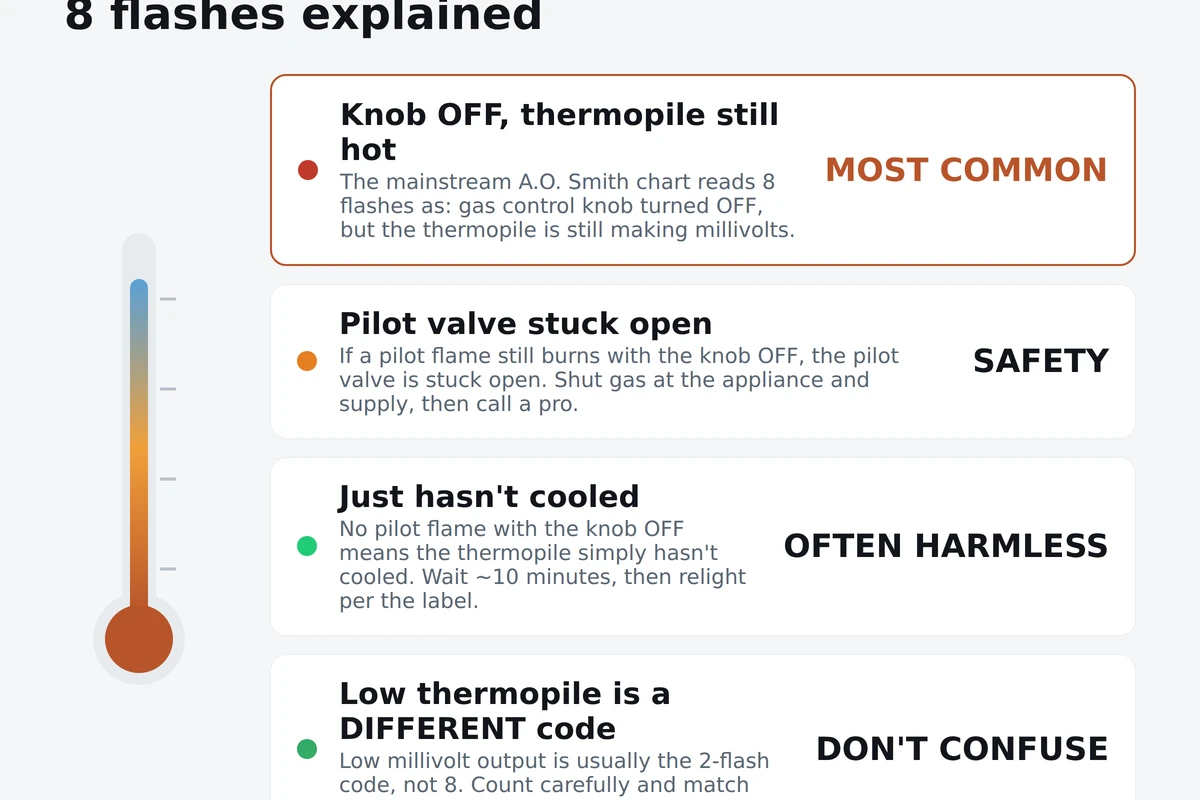
On the standard A.O. Smith / State chart, eight flashes means the gas control knob is OFF but the thermopile is still producing millivolts. Confirm the knob is OFF, wait a minute, and look through the sight glass. No pilot flame? The thermopile just needs about ten minutes to cool, then relight per the label. A pilot flame still burning with the knob OFF means the pilot valve is stuck open: shut the gas at the appliance and supply and call a pro. Low thermopile voltage is a different code (usually 2 flashes), and the exact numbers vary by valve brand, so read your burner-door chart.
Eight flashes is not the thermopile crying weak. It is the control saying: you told me OFF, so why do I still see voltage?
What the control is actually complaining about
The gas valve on these heaters is self-powered. There is no wall plug. The pilot flame heats a thermopile, a stack of thermocouples, which generates a small DC voltage that runs the control electronics and holds the main gas valve open. That design is elegant until you shut the unit down. When you turn the knob to OFF, the control expects the thermopile signal to disappear as the pilot goes out and the metal cools. If the voltage lingers, the control has a genuine reason to worry, because there are only two explanations, and one of them is a gas problem.
The harmless explanation is timing. A thermopile that has been running hot does not cool the instant you kill the pilot. For a minute or two it keeps making millivolts on residual heat, and if the control reads that residual voltage right after a shutdown it can flash eight until the metal cools. Wait it out and the code clears on its own. The other explanation is mechanical: the pilot valve inside the control did not fully close, so the pilot is still lit even though you commanded OFF. Now the thermopile is being actively heated, the voltage is not going anywhere, and the eight-flash code stands because gas is flowing when it should not be. That is the version that gets a pro.
Why people expect this to be low thermopile, and why it usually isn't
Search the code and half the results will steer you toward thermopile voltage, so it is worth being precise. On the Honeywell and Resideo electronic valves A.O. Smith fits to most residential FVIR gas heaters, LOW thermopile output is the TWO-flash code, not eight. Eight is the knob-off-but-still-powered condition. They feel similar because both involve the thermopile and both leave you without hot water, but they are opposite complaints. Two flashes says the thermopile is too weak to hold the valve open. Eight flashes says the thermopile is too strong for a unit you told to shut off.
Here is the wrinkle that makes the topic messy: the flash-count assignments are not universal. They vary by valve brand and generation. On some Robertshaw gas valves an eight-flash pattern is a reset condition rather than either of the above, and a few older A.O. Smith charts number the faults differently again. So a code you read on a forum is a starting point, not an answer. The authority for your heater is the diagnostic chart printed on the label behind the burner door. If your chart ties eight flashes to low thermopile voltage, the millivolt test below is your fix path, not the stuck-valve path.
Set the knob to OFF and wait a minute
Turn the gas control knob fully to OFF. Give it about a minute. This lets the control see a clean shut command and gives the pilot valve a chance to seat. Do not keep flipping it back and forth.
Look through the sight glass for a pilot flame
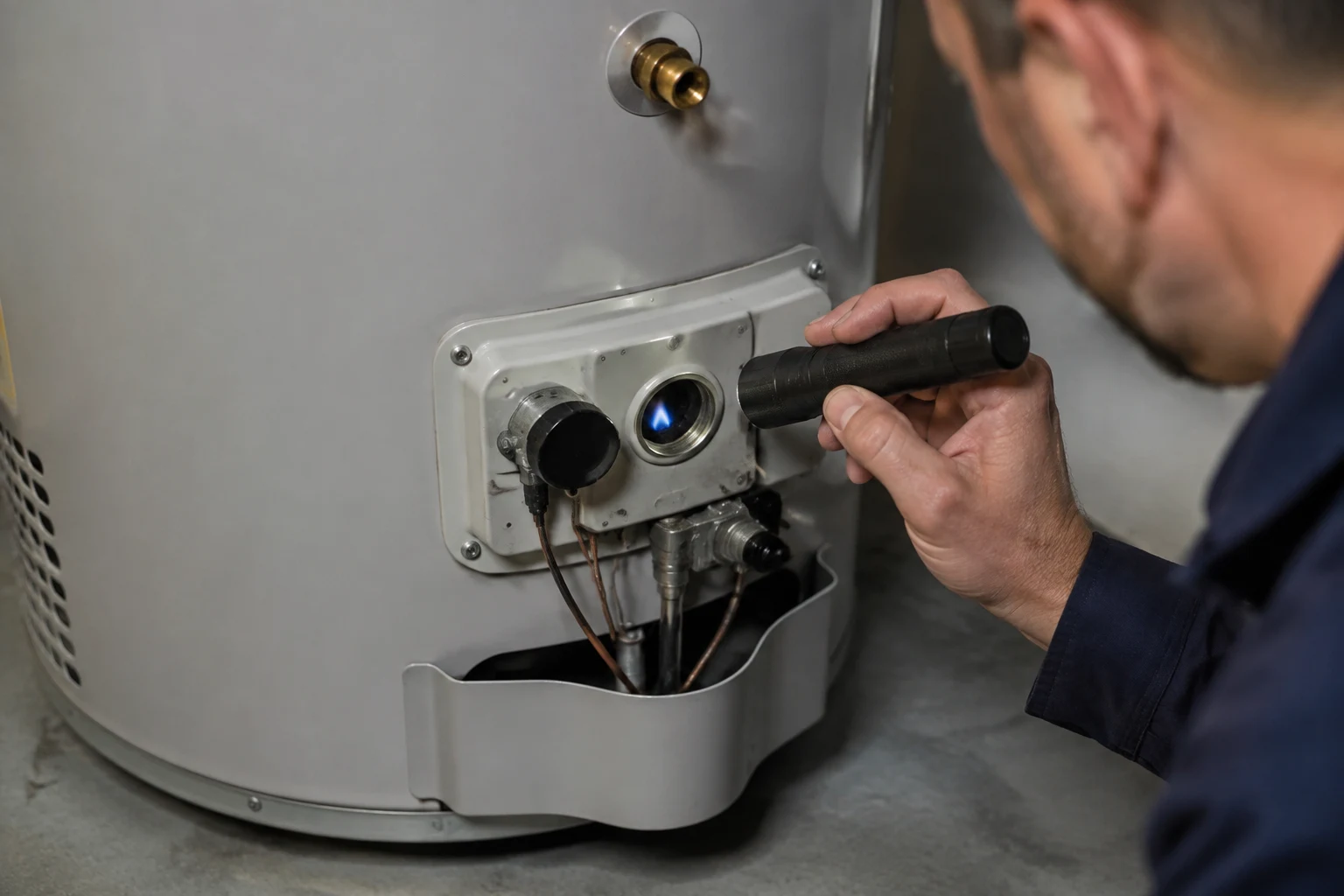
Pull the outer door and look through the sight glass, ideally with the room lights off so a small flame is easy to spot. What you see here decides everything that follows, so take your time and be sure.
No pilot flame: let it cool, then relight
If there is no flame, the thermopile just hasn't cooled. Wait about ten minutes for the metal to drop temperature, then relight the pilot following the lighting instructions printed on the burner door. The eight-flash code should clear once the control sees the signal behave normally.
Pilot flame with the knob OFF: stop and get help
A pilot still burning with the knob at OFF means the pilot valve is stuck open. Shut the gas control knob OFF, shut the gas supply valve to the heater OFF, and contact A.O. Smith support or a licensed plumber. This is a gas-tight failure inside the valve, not a reset.
If your chart says 8 = low thermopile, meter it
Only if your own burner-door chart ties eight flashes to low voltage: put a meter on the thermopile. At least about 350 mV loaded and roughly 650 to 850 mV open circuit is healthy. Below 350 mV loaded means replace the thermopile, the cheap part.
The thermopile millivolt test, step by step
Whether you are ruling low thermopile in or out, the measurement is the same and it is quick. You need a multimeter that reads DC millivolts, which almost any cheap meter does. There are two readings that matter, and the difference between them tells the story.
For the LOADED reading, leave the thermopile connected to the gas valve, light the pilot, and probe the thermopile terminals at the valve. This is the real-world number, the voltage available while the control is actually drawing on it. A healthy system holds at least around 350 mV under load. For the OPEN-CIRCUIT reading, disconnect the thermopile leads and measure the thermopile alone with the pilot heating it. A good thermopile makes roughly 650 to 850 mV open circuit, and a strong blue pilot flame wrapping the tip can push it toward 900 mV. The diagnostic gold is the gap: a thermopile that reads strong open circuit but sags below 350 mV the moment the valve loads it is worn out and should be replaced. Before you condemn it, though, check the pilot flame itself. A weak, yellow, or lazy pilot that barely licks the thermopile will starve a perfectly good part, and cleaning the pilot orifice or clearing a partial obstruction can bring the voltage back without spending anything.
A.O. Smith 8-flash by the numbers
When it is DIY and when it is a pro call
Draw the line at the sight glass. If you looked and there was no pilot flame with the knob OFF, this is a homeowner job: cool, relight, done. If your chart pins eight flashes to low thermopile and the meter confirms a sagging voltage, replacing a thermopile is also within reach for most people, since it lives in the burner assembly and swaps out with hand tools. Those are the cheap, safe paths.
The pro call is the stuck-open pilot valve. A pilot that keeps burning after you commanded OFF is gas flowing past a control that should have shut it. You cannot clean or reset that condition back to safe, and forcing the heater to keep cycling only runs a gas appliance on a valve that has flagged itself. Shut the gas at the appliance and the supply and bring in A.O. Smith support or a licensed plumber, who will inspect the valve and, in most stuck-valve cases, replace it. On many models that valve is still under warranty, so pull the model and serial number off the rating label before anyone quotes you a part. If you ever smell gas near the heater, do not troubleshoot at all: shut the supply and call for service first.
Keeping the code from coming back
Most repeat eight-flash codes trace to one of two things. The first is a pilot valve that is starting to hang up, which shows as a code that returns every time you relight because the pilot never truly goes out. That is a valve inspection, not a maintenance item you can outrun, so do not keep resetting it. The second is a miscount, where a two-flash or four-flash burst gets read as eight in a bright room. Beyond that, the ordinary care that keeps any gas heater honest applies here too: keep the area around the base clear so the flame arrestor breathes, keep the pilot flame strong and blue, and give the unit an annual look so a lazy pilot or a weakening thermopile gets caught before it turns into a cold shower.
Frequently asked
What does 8 flashes mean on an A.O. Smith water heater?
On the mainstream A.O. Smith and State residential gas heaters with the Honeywell or Resideo electronic gas control valve, eight flashes of the green status light means the gas control knob has been turned OFF but the thermopile is still producing millivolts. In plain terms the control is saying: you told me to shut down, yet I still see voltage coming in. Two things cause that. Either the pilot valve is stuck open so the pilot keeps burning and heating the thermopile even with the knob OFF, or the thermopile simply has not cooled off yet after a recent shutdown. A.O. Smith's own 8-flash instruction is to confirm the knob is OFF, wait a minute, then look through the sight glass for a pilot flame. A visible pilot with the knob OFF is the serious version and needs a pro. Important: the count for a given fault varies by valve brand, so match eight flashes to the chart inside your own burner door before acting.
Is 8 flashes the same as low thermopile voltage?
Not on the mainstream Honeywell and Resideo charts A.O. Smith uses. There, low thermopile voltage is the TWO-flash code, and eight flashes is the knob-off-but-still-powered condition. People mix them up because both involve the thermopile and both leave you without hot water. The flash-count assignment varies by valve brand, though. On some Robertshaw valves an 8-flash pattern is a reset condition, and a few older charts number things differently, so you cannot trust a code you read online. Open the burner door, find the diagnostic chart on the label, and read what eight flashes means for your valve. If your chart does tie eight flashes to low thermopile, the millivolt test in this article is your fix path.
Can I fix 8 flashes myself?
Sometimes, and it depends on what you find at the sight glass. If you set the knob to OFF, wait, look through the glass, and see NO pilot flame, then the thermopile just needs time to cool. Wait about ten minutes, relight the pilot using the instructions on the burner door, and the code should clear on its own. That is a homeowner job. But if you see a pilot flame still burning with the knob OFF, stop. That means the pilot valve is stuck open, which is a gas-tight failure inside the valve. Shut the gas off at the control and at the supply line and call A.O. Smith support or a licensed plumber. Do not keep cycling it. A stuck-open pilot valve is not something you clean or reset your way out of, and it is not a place to improvise on a gas appliance.
How do I test the thermopile on an A.O. Smith heater?
Set a multimeter to millivolts DC. For the loaded reading, leave the thermopile connected to the valve, light the pilot, and probe the terminals: a healthy system holds at least about 350 mV. For the open-circuit reading, disconnect the leads and measure with the pilot heating it alone, where a good one makes roughly 650 to 850 mV. A number that reads strong open circuit but collapses below 350 mV under load is a worn thermopile. This matters for an 8-flash symptom two ways: it confirms the pilot and thermopile actually work while you chase the knob-off fault, and if your valve chart ties eight flashes to low voltage, it decides whether you replace a cheap thermopile or something bigger.
How much does a thermopile cost?
The thermopile itself is one of the cheapest parts on the heater, commonly about $20 to $40 for the part, and A.O. Smith sells model-specific ones. Swapping it is a modest DIY job on most units: shut the gas, pull the burner assembly, replace the thermopile, reseat everything, and relight. If you bring in a plumber to diagnose and replace it, the visit usually lands somewhere around $150 to $300 once you count the trip and labor. Compare that to the gas control valve, which runs roughly $130 to $250 for the part and is the expensive component. That price gap is the whole reason you test the thermopile before you condemn a valve. Also check your warranty first: on most A.O. Smith heaters the thermopile and valve are covered for a period that varies by model, so pull the serial number off the rating label before buying.
Why does 8 flashes keep coming back?
If it returns every time after you relight, the thermopile is still being heated when it should be cold, and that points back at the pilot valve. A pilot valve that will not fully close keeps a small flame alive with the knob OFF, the thermopile keeps making millivolts, and the control keeps flashing eight. Cooling and relighting does not repair a mechanical valve fault, so the code comes right back. The other reason it repeats is simpler: you are miscounting. In a bright room a fast eight-flash burst can blur, and a two-flash thermopile code gets read as eight. Watch several full cycles in a dim room, count one burst between the long pauses, and match your burner-door chart. If it is truly eight and repeating, plan on a valve inspection by a pro.
Is a low thermopile or 8-flash code dangerous?
The code itself is the safety system doing its job, not a live hazard. Eight flashes is the control refusing to trust a mismatch between what you commanded and what it senses, and a low-thermopile code is the control declining to hold gas open on weak power. Both fail safe: the heater goes cold rather than run in a state it cannot verify. The one situation that deserves real caution is the stuck-open pilot valve behind some 8-flash cases, since a pilot that stays lit with the knob OFF is gas flowing when it should not. Shut the gas at the appliance and the supply and get a pro. And if you ever smell gas near the heater, shut the supply off and call for service before touching anything else.