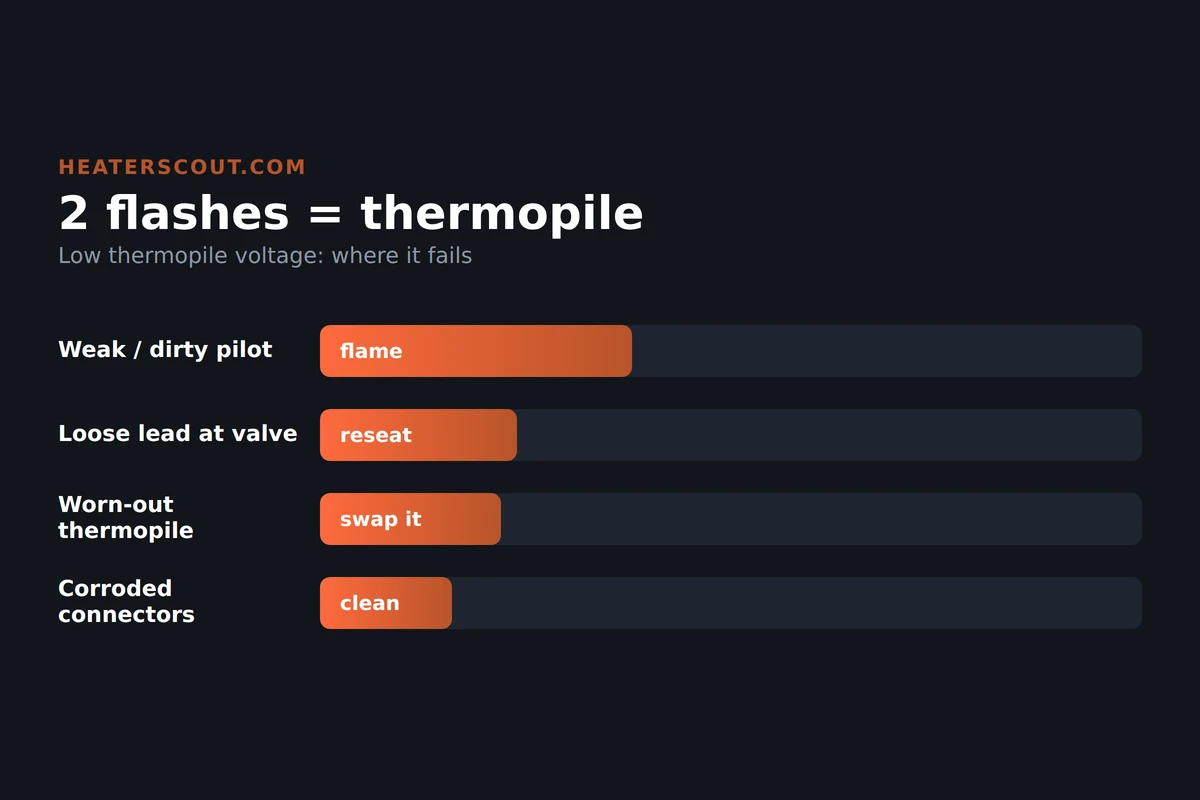
The green status light low on the front of an A.O. Smith gas water heater is a diagnostic readout, not a decoration, and two flashes every three seconds is one of the more common non-normal codes it throws. It is not an over-temperature warning and it is not a temperature-sensor fault. Two flashes means the pilot is lit but the gas control valve is not sensing enough voltage from the thermopile to trust that the pilot is really burning. Nine times out of ten that traces back to a weak pilot flame, a loose connection, or a thermopile that has quietly worn out, and the whole repair is often a $30 part.
The short version
Two flashes is low thermopile voltage. The pilot is lit but the gas valve is not seeing enough millivolts to hold open, so the burner will not fire. Confirm a strong blue pilot flame that wraps the thermopile tip, clean and reseat the thermopile lead and the valve connectors, then meter the thermopile in DC millivolts with the knob in PILOT. Healthy is roughly 650 to 850 mV open circuit; the valve needs about 350 to 400 mV under load. If it reads low, replace the thermopile, a cheap part. This is not the gas-valve or temperature-sensor code, those are four and five flashes.
Quick answer
Two flashes every three seconds on an A.O. Smith gas water heater means low thermopile voltage: the pilot is lit, but the gas control valve is not detecting enough millivolts from the thermopile to keep the main burner enabled. Fix it in order: verify a strong blue pilot flame on the thermopile tip, clean and reseat the thermopile lead and the connectors at the valve, then measure the thermopile output in DC millivolts. If it reads below the valve's roughly 350 to 400 mV holding threshold, replace the thermopile. It is a DIY-friendly, inexpensive repair.
What the thermopile actually does
An A.O. Smith standing-pilot gas heater has no battery and no plug. The tiny bit of electricity it needs to open the gas valve comes from the pilot flame itself, converted to voltage by the thermopile. A thermopile is a stack of thermocouples wired in series, so where a single thermocouple makes maybe 25 to 30 millivolts, the thermopile stacks up to several hundred. The pilot flame heats one end, the cool end sits away from the heat, and the temperature difference generates DC voltage. The gas control valve watches that voltage constantly. As long as it stays above the valve's holding threshold, the valve knows the pilot is burning and it is safe to let gas to the main burner. Let that voltage sag and the valve does the safe thing: it flags two flashes and refuses to fire the burner, because a dropped pilot with gas still flowing is exactly the situation the whole safety system exists to prevent.
Two flashes is the valve saying the pilot voltage is too low to prove the pilot is lit. It is a supply problem, not a valve failure.A.O. Smith gas control diagnostics
The numbers that decide it
The reason two flashes is so diagnosable is that it comes down to a voltage you can measure. These are the figures that separate a healthy thermopile from a dying one on an A.O. Smith gas heater.
Work it in order
Do the free checks before you spend a dime. Most two-flash faults are the flame or the connection, not the part. Turn the gas control knob to OFF before you open the burner door, and give the unit time to cool.
Where the DIY line sits, and warranty
Testing and swapping the thermopile is fair game for a careful homeowner. It is a screwdriver, a wrench, a multimeter, and an inexpensive part, and nothing here touches gas tuning as long as you shut the gas off and check for leaks with soapy water afterward. The place to stop is the gas control valve. If a strong pilot and a good thermopile still leave you at two flashes, that is a wiring or valve question for a pro. On the money side, the thermopile is cheap enough that warranty rarely matters, so most people just replace it. Where warranty is worth checking is if the trail eventually leads to the gas control valve itself, which is a covered part on many A.O. Smith heaters for several years. Have the model and serial number from the rating label ready before you call. For the full map of every blink pattern, from the normal one-flash heartbeat to the four, five, and seven flash faults, see the A.O. Smith status light guide that this page links back to; two flashes is just the thermopile chapter of it.
Frequently asked
Why is my A.O. Smith water heater flashing 2 times?
Two flashes every three seconds on the status light means the pilot is lit but the gas control valve is not sensing enough millivolts coming from the thermopile. The thermopile is a bundle of thermocouples that the pilot flame heats to generate the small DC voltage that powers the valve. When that voltage drops below the valve's threshold, the control cannot trust that the pilot is burning, so it flags the two-flash code and the burner will not fire for the main call. It is almost always a pilot-flame problem or a worn thermopile, not a mysterious board failure. On A.O. Smith gas storage heaters this specific code is the thermopile, not a temperature sensor; the temperature sensor and over-temperature faults show up as four and five flashes instead.
Can I reset the 2-flash code myself?
Yes. Turn the gas control knob to OFF, wait a few minutes for the status light to go dark, then relight the pilot following the lighting instructions printed on the burner door and turn the knob back to your setting. That clears a momentary fault. But clearing is not fixing. Two flashes is a live measurement of how much voltage the thermopile is making right now, so if the pilot is weak or the thermopile is tired the code returns as soon as the valve rechecks the voltage. Use the reset to confirm your repair worked, not as the repair. If the code comes back immediately after a clean relight, the thermopile circuit is genuinely low and you need to chase the flame, the connections, and then the part itself.
How do I test the thermopile with a multimeter?
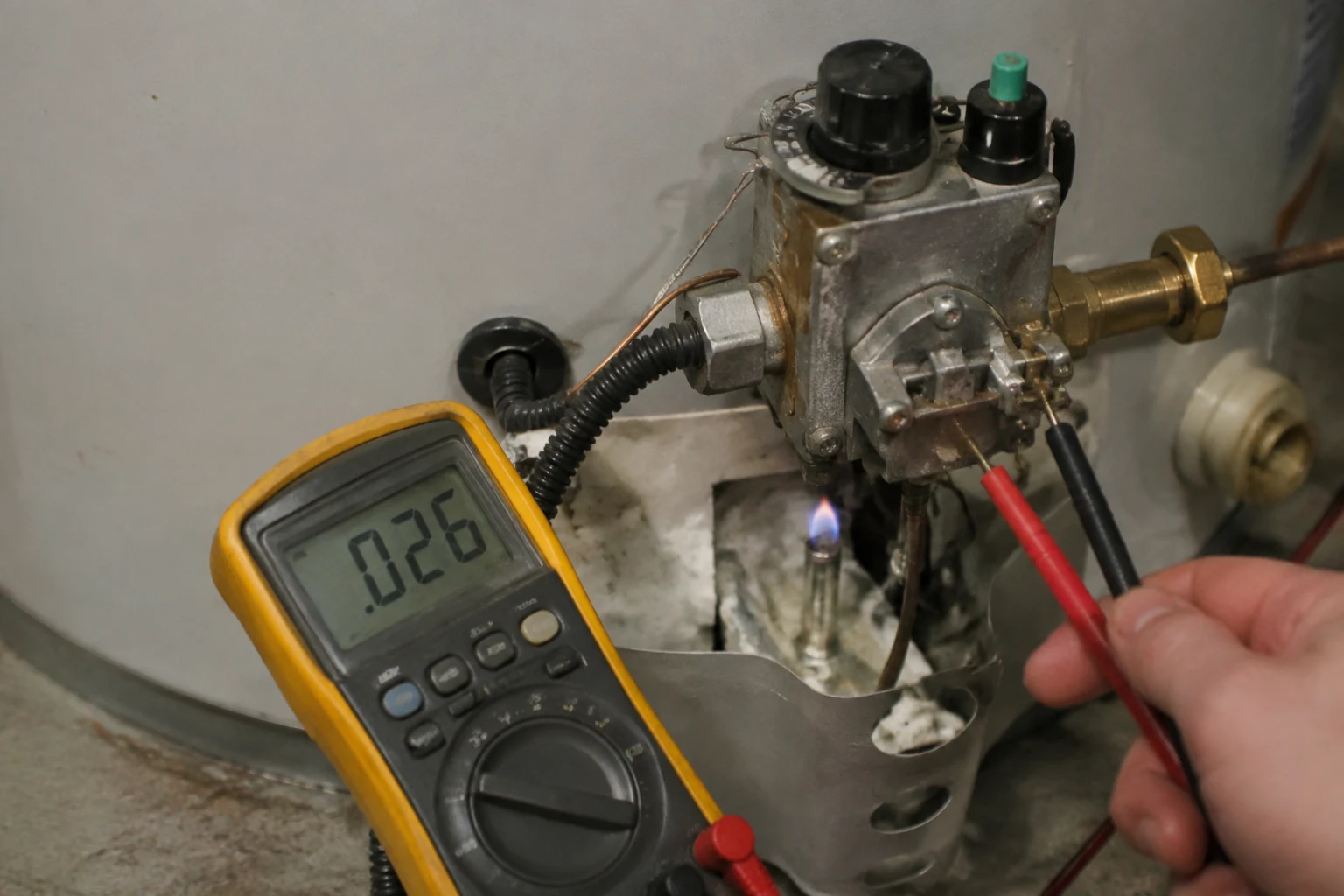
Set a multimeter to DC millivolts. Find the two thermopile leads at the gas control valve, usually the connector separate from the single thermocouple wire, and back-probe or connect across them. Light the pilot, hold the knob in the PILOT position so only the pilot burns, and read the voltage while it is lit. A healthy A.O. Smith thermopile puts out roughly 650 to 850 millivolts open circuit. The gas valve needs to keep seeing about 350 to 400 millivolts once it is loaded to hold open. If your reading is well under that loaded threshold, or it climbs then sags as the valve draws current, the thermopile is worn out or the pilot flame is not heating it fully. A reading near zero with a lit pilot points to a broken thermopile or a bad connection at the valve.
How much does it cost to fix the 2-flash code?
If it is a dirty pilot orifice, a loose lead, or corroded connectors, the fix costs nothing beyond your time. The part itself is cheap: a replacement A.O. Smith thermopile assembly typically runs about $20 to $45, and many are sold as a combined pilot-and-thermopile assembly so you renew the pilot at the same time. Doing the swap yourself keeps the whole job in that range. If you bring in a plumber to diagnose and replace the thermopile, expect somewhere around $150 to $350 once you count the trip and labor, more in high-cost metros. That gap is exactly why it pays to meter the thermopile and clean the pilot before anyone quotes you a new gas control valve, which is a far more expensive part that two flashes does not point to.
Does 2 flashes mean I need a new gas control valve?
Usually not. Two flashes is the valve reporting that it is not getting enough voltage from the thermopile, which is a signal-supply problem, not a valve failure. The cure is almost always a stronger pilot flame, a clean tight connection, or a fresh thermopile. The gas control valve itself shows up in the higher codes: four flashes is over-temperature and five flashes is a failed temperature sensor, and those are the ones that tend to end in a valve replacement. So if you are seeing exactly two flashes, resist the urge to buy a valve first. Confirm the pilot burns strong and steady, reseat and clean the leads, meter the thermopile in millivolts, and only look past the thermopile if a good part still reads low at the valve, which usually means a wiring or connector fault rather than the valve.
Why does the 2-flash code keep coming back?
A code that returns after a clean relight means the thermopile voltage is still sagging under load. The usual repeat offenders: a pilot flame that is small, yellow, or lifting off the thermopile tip because the pilot orifice or tube is partly clogged, so the thermopile never gets fully heated. A connection that looks tight but has a corroded pin or a backed-out terminal, dropping voltage only when the valve draws current. Or a thermopile that has simply aged and now reads fine for a second, then falls below the dropout as the valve loads it. Meter it lit and watch the number under load, not just at rest. Clean or reset the pilot to a strong blue flame that wraps the tip, redo the connections, and if the voltage still collapses under load, replace the thermopile.
Can a bad pilot flame cause the 2-flash thermopile code?
Yes, and it is the single most common cause. The thermopile only makes voltage from the heat the pilot puts on it. A weak, dirty, yellow, or unstable pilot flame does not fully bathe the thermopile tip, so its output drops and the valve reports two flashes even when the thermopile itself is fine. Before you replace anything, clean the pilot orifice and tube, make sure the flame is a strong steady blue cone that wraps the top of the thermopile, and check for drafts or a dirty burner starving the pilot. A restored flame will often bring the voltage back and clear the code on its own. Swapping a good thermopile onto a starved pilot just wears the new part out the same way, so fix the flame first.