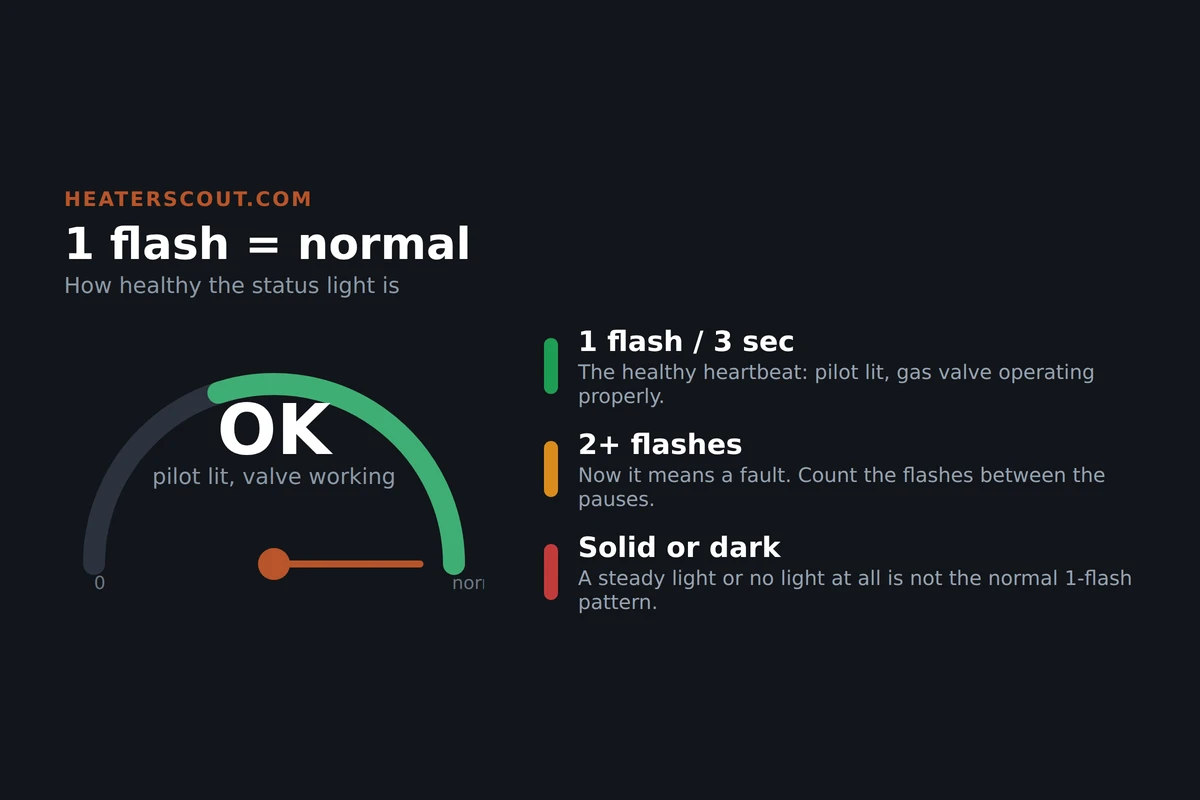
A single green flash every three seconds low on the front of an A.O. Smith or State gas water heater sends a surprising number of people reaching for a plumber. It looks like a warning. It is not. On these standing-pilot gas heaters, one flash every three seconds is the normal, healthy state: the pilot is lit and the gas control valve is working properly. The unit is telling you it has power and it is fine. The flashes you actually care about come in groups of two or more, and once you know how to count them, that little light turns from a source of dread into the most useful gauge on the heater.
Quick answer
One flash every three seconds on an A.O. Smith or State gas water heater status light means normal operation: the pilot is lit and the gas control valve is working properly. It is not a fault code and needs no action. If you have no hot water while seeing one flash, set the gas control knob to HOT and wait for the tank to reheat. Only worry when the light flashes in groups of two or more, stays solid, or goes dark with the gas on.
Confirm you are actually reading one flash, not two
Before anything else, make sure the pattern really is a single even blink and not the first flash of a larger group. Watch two or three full cycles and check it against this list.
- The light blinks once, then goes dark for about three seconds, then blinks once again, evenly, forever.
- The flashes are spaced the same distance apart every time, with no grouping into pairs or triplets.
- The pilot has been lit for at least 90 seconds, so the thermopile is warm enough to run the light.
- The light is not on steady, and it is not completely dark with the gas turned on.
- You counted through the pause, not across it, so you did not merge two separate bursts into one.
What the light is and where it lives
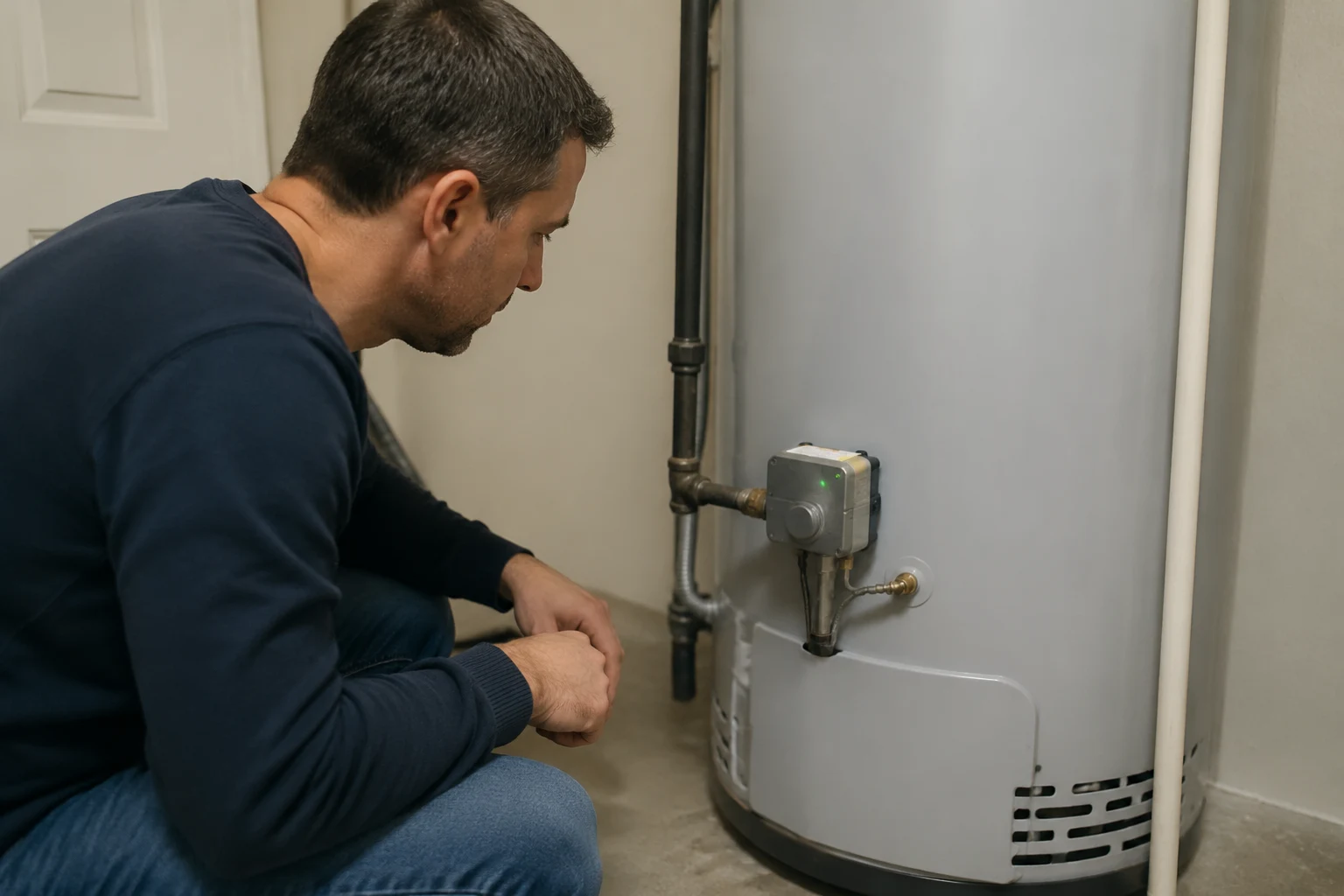
The status light is a small LED built into the electronic gas control valve, the box mounted low on the front of the tank where the gas line and the thermostat knob meet. A.O. Smith and its State-branded heaters use gas controls from suppliers like Honeywell and Robertshaw, and while the housings differ, the blink logic is the same across the residential FVIR gas line. The valve has no external power. The pilot flame heats a thermopile, the thermopile makes a few hundred millivolts of DC, and that trickle runs the valve's control circuit and the light. That is why the light only starts blinking a minute or so after you light the pilot: the thermopile has to warm up first. Once it is running, the valve blinks the light once every three seconds to report that it is powered, the pilot is proven lit, and none of its safety checks are tripped.
Reading the blink: normal versus the fault codes
Every diagnostic on these heaters is a flash count. The valve blinks a number, pauses, and repeats. One is the healthy number. Everything from two up is a fault. Here is how to work through it in order.
When one flash still comes with a problem
One flash is a clean bill of health for the ignition and safety chain, but it does not promise hot water on its own. The valve can be perfectly healthy while the water stays cold for a mundane reason. The classic case is a knob bumped down to a low or vacation setting, so the thermostat is satisfied and never calls the burner. Another is a long recovery after heavy use: a big tank pulled down to cold can take an hour to come back, and during that hour the light still shows its calm one-flash beat. A failing dip tube can also mix cold water into the hot outlet so the tap runs lukewarm even though the burner and valve are doing their job. None of those change the flash count. So when someone reports one flash and no hot water, the light has already told you the useful thing: look downstream at the knob setting, the recovery time, and the plumbing, not at the ignition system.
Should I ever reset the heater when I see one flash?
No. A reset, meaning turning the gas control knob to OFF, waiting for the light to go dark, and relighting the pilot, is for clearing a real fault code after you have fixed its cause. Resetting a unit that is showing normal one-flash operation does nothing useful and just leaves you relighting a pilot that was already lit. Save the reset for when you see two or more flashes and have addressed the flame, connection, or part behind them.
Why the reassurance matters
People replace parts they do not need because a blinking light feels like an alarm. A homeowner sees the pilot lit, the light flashing, and no obvious problem, panics, and buys a gas control valve or calls for a service visit that finds nothing wrong. The one-flash pattern is specifically there to prevent that. Learn to count the flashes and you get a free, built-in diagnostic that tells you exactly when to act and when to leave the heater alone. If you want the full breakdown of every fault count, the two-flash thermopile code and the four, five, and seven flash faults each have their own walkthrough on this site. For the healthy heater in front of you right now, though, one even flash every three seconds is the answer you were hoping for: nothing is wrong.
Frequently asked
Is one blink on my water heater normal?
Yes. On an A.O. Smith or State gas storage water heater, a single flash of the status light every three seconds is the normal running pattern. It means the pilot is lit and the gas control valve is working properly. The light sits low on the front of the gas control valve and it is designed to blink like that whenever the unit is healthy, whether the burner is firing or the water is already up to temperature. Owners see the blink, assume a blinking light must be a warning, and start pulling the burner door off. One flash is the opposite of a warning. It is the valve telling you it has power from the thermopile and everything it checks is passing. The codes you actually worry about are two or more flashes, and those come in a tight burst with a clear pause between bursts.
Why does the status light flash once every few seconds?
Because that steady one-flash-per-three-seconds rhythm is how the gas control valve says it is alive and healthy. A standing-pilot A.O. Smith heater has no plug and no battery. The pilot flame heats a thermopile that generates a small DC voltage, and that voltage runs the valve's little control circuit, including the status light. So the blink is proof the pilot is lit and the valve has enough power to operate. If the light were solid, or dark, or flashing two or more times per burst, that would mean something. A single, even, once-every-three-seconds pulse means keep using your hot water and stop worrying. After you first light the pilot it can take up to about 90 seconds before the thermopile is hot enough for the light to start its one-flash pattern, so give it a minute before you judge it.
How do I know if it's 1 flash or 2 flashes?
Watch a full cycle and count the flashes between the pauses, not the total flashes over a minute. One flash looks like: blink, then a roughly three-second gap, then a single blink again, evenly spaced forever. Two flashes looks like: blink-blink, pause, blink-blink, pause, so the flashes come in pairs with a longer gap after each pair. The trick is that a lone one-flash pattern and the first flash of a two-flash pattern look identical for a split second. Wait through two or three complete cycles and the grouping becomes obvious. If you are ever unsure, take a slow-motion video on your phone and count frames. Getting the count right matters because one flash is normal and two flashes is low thermopile voltage, which are completely different situations.
When should a blinking light worry me?
When the blink comes in bursts of two or more, or when the light is solid, or when there is no light at all with the gas turned on. A single flash every three seconds is normal and needs nothing from you. Two flashes means low thermopile voltage. Four flashes means the unit hit an over-temperature limit and the safety cutout tripped. Five flashes points to a failed temperature sensor. Seven and higher point to an internal control fault. A light that stays on steady, or a light that will not blink at all once the pilot has been lit for a couple of minutes, is also a problem. So the rule is simple: one even flash is fine, anything grouped, solid, or dead is a code to look up on your specific model.
My status light flashes once but I have no hot water. What now?
One flash confirms the pilot is lit and the valve is working, so if you have no hot water the usual cause is that the gas control knob is not turned up. Set the temperature dial or knob to HOT, or to your target temperature, and wait. A cold 40 or 50 gallon tank can take 30 to 60 minutes to fully recover, and the burner may have been idling because the thermostat was satisfied or set low. Check that anyone in the house did not knock the knob to a vacation or pilot setting. If the knob is up, the light still shows one flash, and the burner never fires and the water stays cold for well over an hour, then the thermostat inside the valve or the dip tube may be the issue, and that is worth a closer look. But with one flash the safety chain is fine.
Does 1 flash mean the burner is actually running?
Not necessarily, and that trips people up. One flash means the pilot is lit and the gas control valve is healthy, not that the main burner is firing right now. Most of the time the burner is off because the water in the tank is already at temperature, so the valve is just holding, waiting for the next call for heat. You will still see the one-flash pattern the whole time. When someone draws a lot of hot water and the tank cools past the setpoint, the valve opens the main burner and you will hear it whoosh on, but the status light keeps its same calm one-flash rhythm through all of it. So one flash is a health signal, not a burner-on signal. If you want to know the burner is firing, listen for it or look for the flame through the sight window, not at the status light.
Is a blinking status light the same as an error code?
The status light is the error-code display, but a single flash is the not-an-error state. On these A.O. Smith and State gas heaters there is no separate screen. The one light does double duty: one even flash every three seconds is the all-clear, and any repeating group of two, four, five, seven or more flashes is the diagnostic code. So yes, the same light that shows codes is blinking, but the specific one-flash pattern is the manufacturer's way of saying no code is active. Think of it like a car that shows a check light only when there is a fault; here the light is always blinking, and the count is what carries the meaning. Learn to read the count and the light stops being scary and becomes useful.