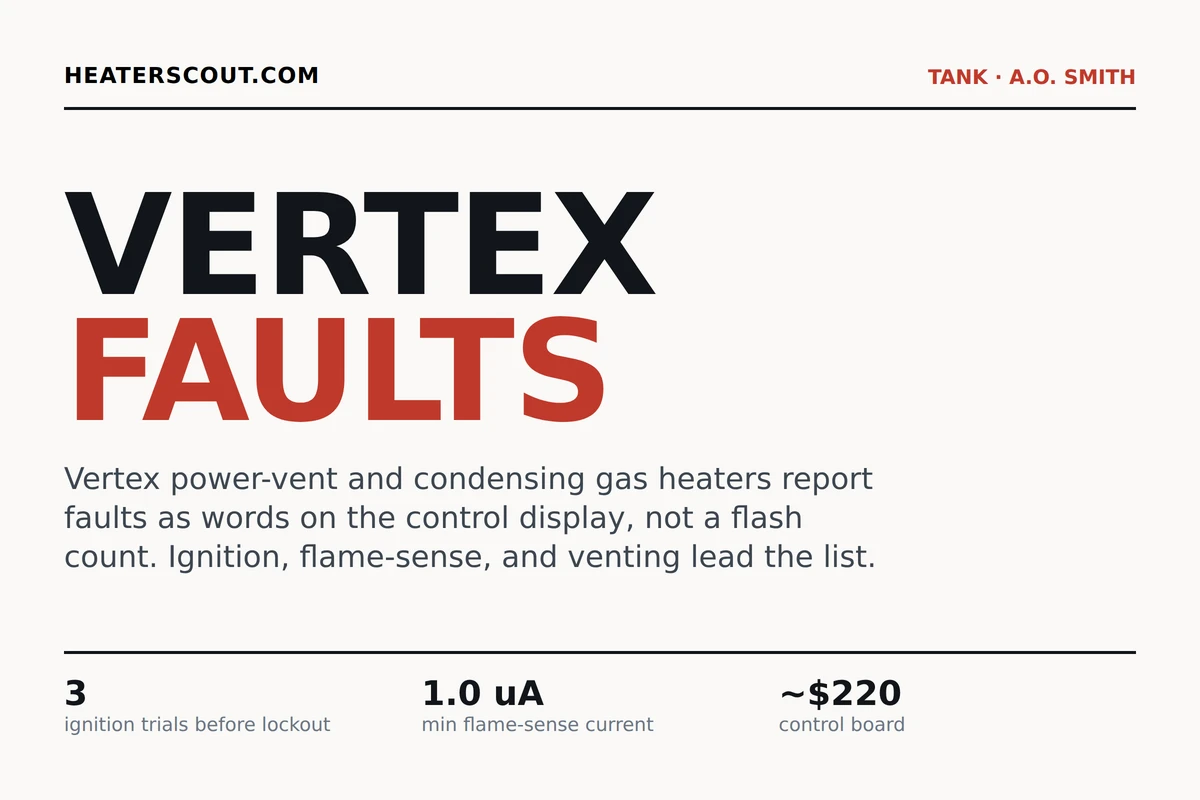
The A.O. Smith Vertex does not blink a code at you. Where a plain tank heater flashes a status light two or four times, the Vertex writes a fault in words on the control display, or on the numbered boards it shows a three-digit code. That difference matters, because the fix for Ignition Failure has nothing to do with the fix for a blower fault or an over-temperature trip. This page maps the real Vertex and Cyclone-family faults, orders the causes by how often they turn out to be the culprit, gives the exact reset, and draws a clear line between what a homeowner can safely do and what belongs to a licensed tech.
Key takeaways
- The Vertex reports faults as text on the control display, not as a flash count. On numbered boards it shows a three-digit code instead.
- Ignition Failure is the most common message: the board ran its trials and never sensed a flame at 1.0 microamp or more.
- Most-likely causes in order: dirty flame probe, gas supply, hot-surface igniter, probe wiring, then the control board.
- Reset is a power cycle at the board. An ECO over-temperature trip is a one-shot cutoff you reset manually after finding the cause.
- Cleaning the flame sensor is DIY. Blower, board, gas-valve, and sealed-combustion work is licensed-pro territory.
Why the Vertex uses messages, not a flash count
The Vertex is a power-vent and condensing gas heater. It has a fan that pushes exhaust through PVC vent pipe, a sealed combustion chamber, a hot-surface igniter, and a flame sensor, all run by a control board with a small display. That extra hardware is why it reports faults as named conditions instead of a flash code. A flash count can only say a number. The board can say Ignition Failure, Low Igniter Current, or a thermistor fault directly. The catch is that A.O. Smith used more than one control platform across the Vertex lifespan. Residential GDHE and GPHE units tend to show text messages. Cyclone-lineage and commercial boards show numbered codes. Read what is actually on your display before you match it to any list.
A.O. Smith Vertex fault code
A condition reported by the Vertex control board when it refuses to run the burner safely. On residential GDHE and GPHE units the fault appears as a text message on the control display, such as Ignition Failure, Flame Probe Short, Low Igniter Current, an ECO over-temperature trip, or a sensor fault. On Cyclone-lineage and commercial boards the same family of faults appears as a three-digit number instead, for example 101 for insufficient combustion air, 121 for loss of flame, 311 or 341 for a thermistor failure, and 611 for a fan-motor fault. Because these are power-vent and condensing units, many faults involve the flame sensor, the blower, the venting, or the condensate path, not just the gas valve. The exact wording, the numbered codes, and the reset steps vary by model line and board revision, so the code on the heater in front of you is the one that governs.
How to read the fault before you touch anything
Get to the control unit and read the display. On a text board, write down the exact message. On a numbered board, write down the three digits. Note whether the unit is in lockout, meaning it stopped trying, or whether it is cycling. Do not power-cycle first, because a reset clears the display and you lose the very message you needed. The fault you record is what you match to the map below.
The Vertex fault map
This is the core of the page. The table pairs the text messages you see on residential GDHE and GPHE boards with the numbered codes on Cyclone-lineage and commercial boards, then routes each to the part most likely behind it and to how hard the fix is. Where a fault spans several causes, the causes are ordered most-likely first.
| Message (GDHE/GPHE) | Numbered code | What the board is reporting | Where it points | Fix difficulty |
|---|---|---|---|---|
| Ignition Failure | 121 (loss of flame) | No flame sensed after the ignition trials | Dirty flame probe, gas supply, igniter | Some DIY, then a pro |
| Flame Probe Short | - | Flame-sense circuit shorted | Fouled or grounded probe, wiring | DIY-friendly to check |
| Low Igniter Current | - | Hot-surface igniter not drawing right | Cracked or worn igniter, wiring | Call a pro |
| Sensor / Thermistor Fault | 311 / 341 | Tank, outlet, or exhaust sensor out of range | Loose lead, debris, failed thermistor | Some DIY, then a pro |
| Over-Temperature (ECO) | - | Energy cutoff tripped, water too hot | High setpoint, sediment, stuck valve | Find the cause, then a pro |
| Blocked Vent / Combustion Air | 101 | Cannot move exhaust or draw air safely | Plugged vent, condensate, dead blower | Ventilation DIY, then a pro |
| Blower / Fan Fault | 611 | Fan motor or its proving signal failed | Loose connector, debris, dead motor | Call a pro |
| DIP Switch Setting | 031 | Control configured wrong for the model | Board DIP switches set incorrectly | Pro / installer |
A caution on the numbered codes: the 0xx and 1xx and 6xx numbers come off A.O. Smith maintenance sheets for the Cyclone-lineage and commercial controls. Not every residential Vertex board uses them, and the exact number-to-fault mapping can shift by board revision. If your Vertex shows a three-digit code, confirm it against the maintenance sheet or chart for that specific model and serial, not against a generic table. If it shows words, use the words.
Ignition Failure, the one you will actually see
Ignition Failure is the message that brings most people to this page. The board opens the gas valve, fires the hot-surface igniter, and watches the flame sensor for a flame. That sensor works by passing a tiny current, at least 1.0 microamp, through the flame to ground. If it never sees enough current after its trials, usually three set by the S1 dipswitch, it shuts the gas and locks out. So Ignition Failure does not always mean no fire. It often means the board could not prove the fire it lit.
Chase the causes in order. The flame sensor comes first because a dirty, corroded, or sooted probe is the single most common reason the current falls below threshold, and it is the cheapest to fix. Gas supply is next: a valve not fully open, air in the line after service, low pressure, or a nearly empty LP tank starves the burner so it never lights or lights weakly. Then the hot-surface igniter, which can crack or weaken with age and show as Low Igniter Current. Then the wiring and connectors to the probe and igniter. The control board is last, because it is the least likely and the most expensive.
The burner lights for a second then shuts off with Ignition Failure. What is that?
That pattern points hard at the flame sensor rather than the igniter or gas supply. If the burner actually lights, the igniter and gas are doing their job. The board lit the flame but the sensor never confirmed enough current, so after the flame stabilization window it dropped out and logged Ignition Failure. Clean the flame probe, check that its wire is seated and not grounding against metal, and verify the probe is positioned in the flame. If it still drops out with a clean, well-seated probe, measure the flame current with a meter, and if it reads below about 1.0 microamp with a good flame, the probe or the board circuit is the suspect.
Which fault is yours, and what to do next
Before the reset and the tools, match your situation to one of these. Each points you at the right first move so you do not chase a flame probe when the real problem is the vent.
Start at the flame probe
If the display reads Ignition Failure and you hear or see the burner attempt to fire, clean the flame sensor, confirm the gas valve is fully open, and check the probe wiring before you suspect the igniter or board. This is the most common and most DIY-friendly path.
Go outside and check the terminations
A 101 combustion-air, a blocked-vent message, or a 611 fan fault means air or exhaust could not move. Clear the intake and exhaust of nests, lint, and snow, and check the condensate drain. If the terminations are clear, the blower or its wiring is likely the culprit and that is a pro job.
Find why the water overheated
An ECO over-temperature lockout is a safety trip, not a nuisance. Lower the setpoint, flush sediment, and if it returns on a clean tank at a sane setting, the gas valve or a drifting sensor is failing to shut the burner off. Do not keep resetting or bypass the cutoff.
Match it to that model's sheet
If your board shows a three-digit code like 031, 311, or 341, the exact meaning can vary by revision. Pull the model and serial off the rating label and confirm the number against the A.O. Smith maintenance sheet for that unit rather than a generic list.
The reset, and where the DIY line sits
The reset is a power cycle, not a secret button. Do it once before you spend money, to rule out a one-time hiccup.
Over-temperature is a safety trip, not a hiccup
An ECO over-temperature trip is not a normal reset. The energy cutoff is a one-shot safety that opens when the water gets too hot, and it has to be manually reset or replaced. Before you reset it, find why the water overheated: a setpoint dialed too high, heavy sediment trapping heat, or a gas valve failing to shut off. Never jumper or bypass the ECO to keep the burner running.
Where you stop depends on the fault. Cleaning the flame sensor, checking that the gas valve is fully open, reseating a connector, and confirming the vent and intake are clear of nests, snow, or lint are reasonable homeowner steps. Beyond that, the Vertex is a sealed-combustion unit. Opening the gasketed burner assembly to replace the igniter or flame probe, swapping the blower or draft inducer, replacing the control board, and any work on the gas valve or the sealed chamber belong to a licensed tech, both for safety and because a botched gasket reseal can leak combustion products.
Venting, condensate, and the faults people miss
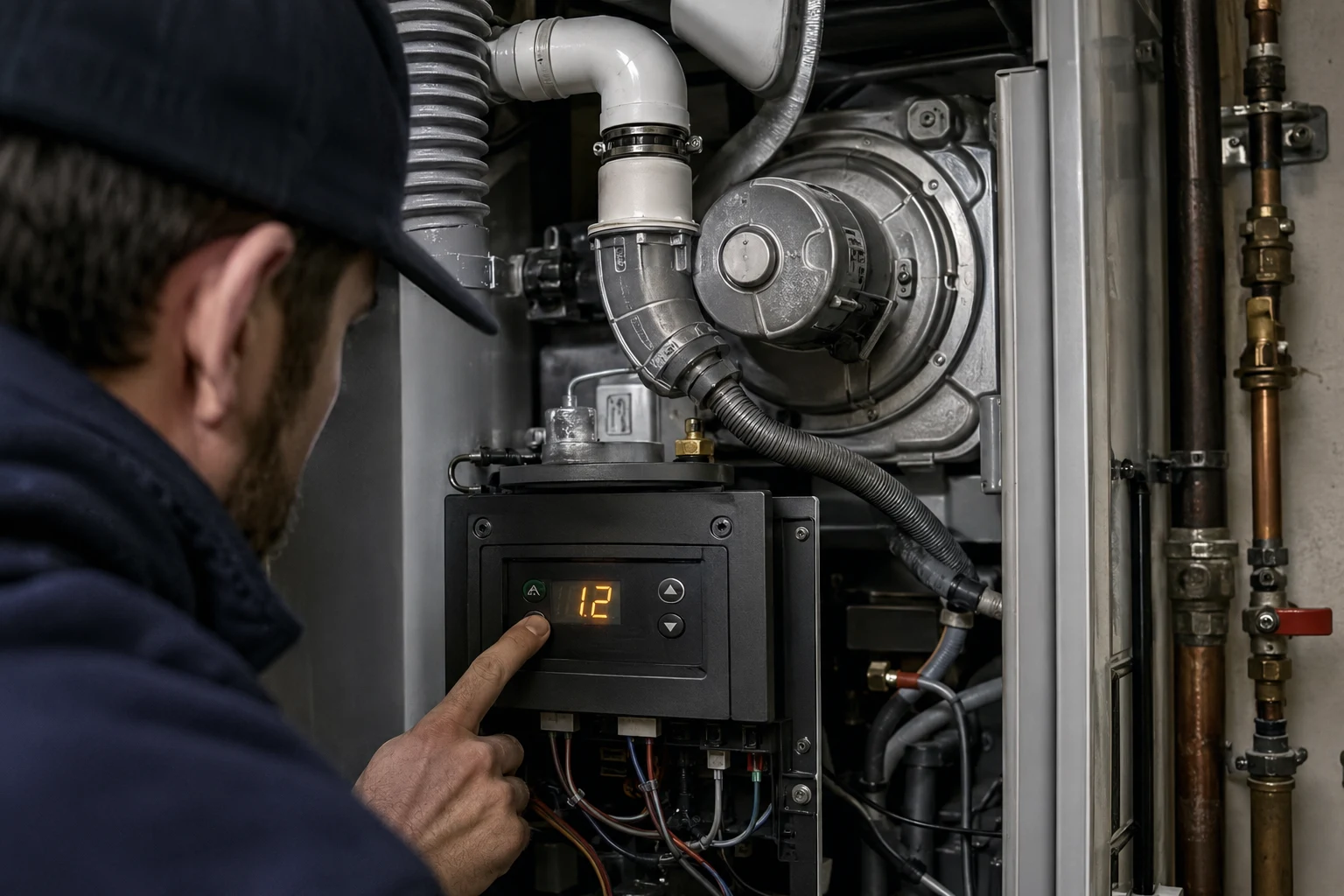
Because the Vertex moves its own exhaust with a fan, a whole class of faults has nothing to do with the burner. A blocked-vent or combustion-air fault, the 101 on numbered boards, means the unit could not draw air or push exhaust safely. Check the intake and exhaust terminations outside for nests, leaves, snow, or a screen packed with lint, and check that the vent pipe has not sagged into a low spot that traps condensate. On a condensing Vertex, the condensate drain and any neutralizer can clog and back water into the unit, which trips faults that look unrelated until you find the standing water. A blower or fan fault, the 611, is the fan motor or its proving signal, and that is usually a tech visit for a motor or a connector.
Vertex, State, and the rest of the A.O. Smith family
State, Reliance, American, and some Kenmore gas heaters are A.O. Smith-built and share control platforms, so a State condensing or power-vent unit can throw the same Ignition Failure and flame-probe messages a Vertex does. The faults line up across the family. What varies is the display type and the exact wording: residential Vertex boards write text, while Cyclone-lineage and commercial boards show the numbered codes. If your display and a generic list disagree, the label and chart on your own heater win. From there, prevention is the cheap insurance. A yearly look at the flame probe, the vent and intake terminations, and the condensate path heads off most of the ignition and venting faults before the board ever has to lock out.
Frequently asked
What do the fault codes on my A.O. Smith Vertex water heater mean?
On a Vertex the control does not blink a flash count the way a standard tank heater does. It writes a fault message on the small display on the control unit, or on the numbered-code boards it shows a three digit number. The most common message is Ignition Failure, which means the board tried to light the burner and the flame sensor never confirmed a flame. After that you see flame-probe faults like Flame Probe Short, Low Igniter Current on the hot-surface igniter, temperature or thermistor sensor faults, an ECO over-temperature trip, and blower or venting faults. On the Cyclone-lineage numbered boards those map to codes like 101 for needs more combustion air, 121 for loss of flame, 311 or 341 for a thermistor, and 611 for the fan motor. Read the exact words or number off your display first, because the fix depends on which one it is.
How do I reset an A.O. Smith Vertex water heater?
The reset is a power cycle at the board, not a hidden button. Turn the gas control or the unit off, cut power to the heater at the switch or breaker, wait a full minute so the control fully powers down, then restore power and let it run its startup and ignition sequence. That clears a one-time lockout such as a single missed light. If the fault was an ECO over-temperature trip, that energy cutoff is a one-shot device that has to be manually reset or replaced, and you have to find why the water overheated first. What a power cycle does not do is repair a cause. If Ignition Failure or a venting fault comes right back after a clean reset, the fault is real and repeating, and resetting it again just delays the diagnosis.
Why does my Vertex keep showing ignition failure?
Ignition Failure means the control ran its ignition trials, usually three, and never sensed a flame at the required current, which is at least 1.0 microamp. Work it in order of likelihood. First the flame sensor: a dirty, corroded, or sooted flame probe cannot pass enough current, and cleaning it gently with fine sandpaper or steel wool fixes a large share of these. Next gas supply: a closed or partly closed valve, a stuck LP tank, air in the line after service, or low pressure starves the burner. Then the igniter itself, the wiring to the probe, and finally the control board. Because the Vertex is a sealed combustion unit where the blower, burner, and flame probe live behind a gasketed cover, cleaning the probe is homeowner-reachable but deeper work usually goes to a tech.
How much does it cost to fix a Vertex fault code?
It spans a wide range. Cleaning the flame sensor or reseating a connector is free beyond your time. A new flame sensor or hot-surface igniter is roughly $30 to $90 in parts, and either is a moderate job because you open the sealed burner assembly to reach it. A temperature sensor or thermistor is a similar parts cost. The blower or draft-inducer motor on a venting or fan fault runs higher, often $150 to $350 for the part. The control board itself is around $200 to $250. Add a service call and labor of roughly $150 to $400 depending on the repair. Before you buy any major part, pull the model and serial off the rating label and check the warranty, because Vertex heaters carry multi-year coverage and the board or gas valve may be a covered part.
Is a Vertex fault code dangerous?
The fault message itself is the safety system doing its job by refusing to run in an unsafe state, which is safer than forcing the burner. Some faults are benign to diagnose, like a dirty flame probe throwing Ignition Failure. Others are genuine safety trips. An ECO over-temperature lockout means the water got too hot, and you address the cause, not just the switch. A blocked-vent or combustion-air fault means the unit could not move exhaust or draw air safely, and that points at a plugged intake or exhaust, a condensate blockage, or a dead blower. The dangerous move is never the fault message. It is defeating a sensor, jumpering a safety, or running a unit that keeps flagging a venting problem. If a venting or over-temperature fault keeps returning, shut the unit down and call a licensed tech.
Will cleaning the flame sensor clear the ignition fault on my Vertex?
Often, yes, if the fault is Ignition Failure or a low flame-current message and the real problem is a fouled probe. The flame sensor works by passing a tiny current, at least 1.0 microamp, through the flame to prove it is lit. A film of soot, corrosion, or scale on the probe drops that current below the threshold and the board reads it as no flame, then locks out after its trials. Power the unit down, reach the probe on the burner assembly, clean it gently with fine sandpaper or steel wool, wipe it, reseat its wire, and restore power. If the message clears and the burner holds, that was it. If Ignition Failure returns with a clean probe, move on to gas supply, the igniter, the wiring, and then the board. Cleaning the probe does nothing for a venting, blower, or thermistor fault, so match the fix to the message.
Are Vertex fault codes the same as other A.O. Smith and State water heaters?
Partly. State, Reliance, American, and some Kenmore gas heaters are built by A.O. Smith and share control platforms, so a State condensing or power-vent unit can show the same Ignition Failure and flame-probe messages a Vertex does. Where it splits is the display type. Residential Vertex GDHE and GPHE controls write text messages, while the Cyclone-lineage and commercial boards show numbered codes like 031 for a DIP-switch setting, 101 for combustion air, 121 for loss of flame, 311 or 341 for a thermistor, and 611 for the fan. So the underlying faults line up across the family, but the exact wording, the numbered codes, and the reset steps vary by model line and board revision. Always read the code off the label and chart on the heater in front of you rather than assuming another model's list applies.