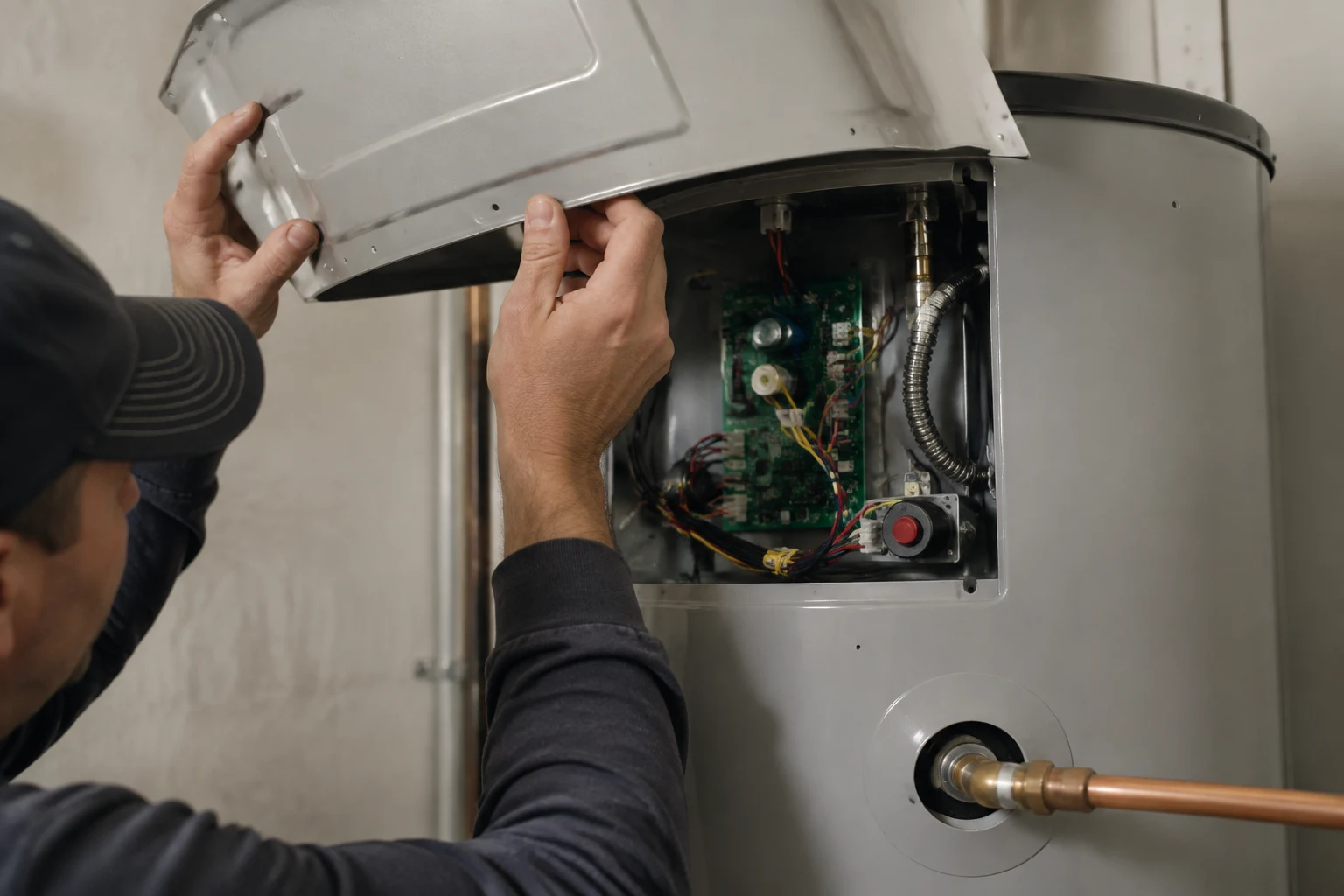
Pull the upper access panel off an A.O. Smith Signature electric water heater and one of two things is true. Either you see a bare metal thermostat with a temperature dial and a red button, which means there is no control board and nothing to read, or you see a boxy plastic module with a small red LED, which means you have the Electronic Thermostat and it can flash you a fault code. Knowing which one you have is the whole game here, because half the advice online assumes a smart board that most of these Lowe's tanks simply do not have. This page splits the two honestly and gives you the reset and the tests that actually apply to yours.
Two very different Signature tanks wear the same name
The Signature line at Lowe's, including Signature 100 and the Signature Select tiers, is mostly conventional electric tanks: two 4500-watt elements, an adjustable upper and lower mechanical thermostat, and a red ECO high-limit switch riding on the upper thermostat. That build has no circuit board, no diagnostic LED, and no error code. When one of these quits, you diagnose it by symptom and by continuity, the same as any basic tank. The only electronics are on the Grid-Capable and Energy Smart versions and any unit fitted with the Electronic Thermostat, and those are the ones that flash a code at you.
So before you go looking for a code, look at the hardware. A metal thermostat block with a slotted temperature adjuster and a red reset button is the mechanical version, and the flash-code section below does not apply to you. A sealed plastic module with an LED window is the electronic version, and the flash counts are your readout.
What the Electronic Thermostat reports
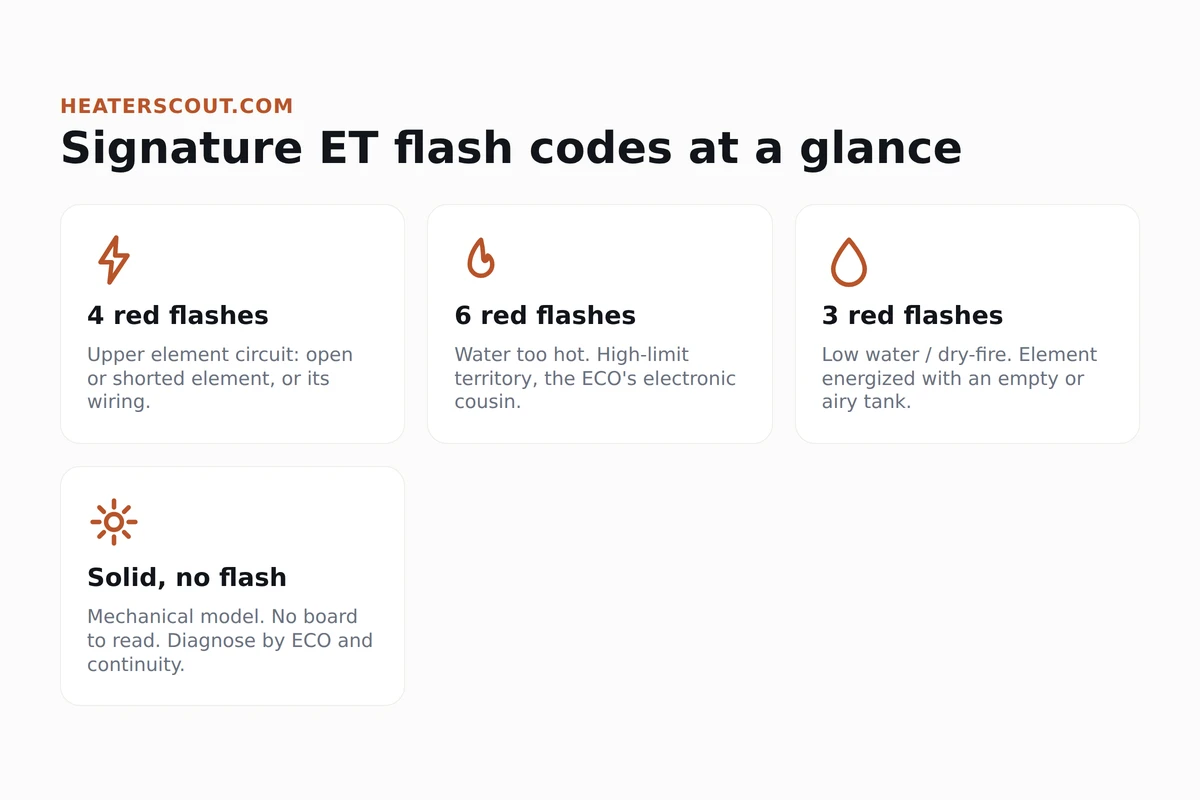
On the electronic models the red diagnostic LED sits on the ET module behind the upper panel. It flashes a burst, pauses, and repeats the same burst, and the count in each burst is the fault. Here is what the counts mean, pulled from A.O. Smith's documentation and confirmed against real repair threads. Where the sources disagree, the table says so.
| 2 red flashes | Sensor or limit fault on some models. The exact 2-flash meaning varies by unit, so read your own ET label. |
| 3 red flashes | Low water / dry-fire protection. The board won't power an element it thinks is sitting in air or an empty tank. |
| 4 red flashes | Upper element circuit fault. Open or shorted element, or a bad connection. If it persists after checking the element, the ET itself is suspect. |
| 6 red flashes | Water temperature too hot. The electronic version of a high-limit trip, an E02/E06-family condition. |
| Leak fault | Moisture pad at the tank base is wet. Often a real leak, sometimes a false trip from condensation dripping on the pad. |
| Solid LED, no flash | Mechanical model, or the board reporting normal. If it's a dial-and-button thermostat, there is no code to read. |
Reading the flash count without getting fooled
The flashes are quick and the pause between bursts is long, so it is easy to miscount and replace the wrong part. Watch one full burst-and-pause first without counting, just to learn the rhythm. Then count only the flashes inside a single burst, stopping at the pause, and confirm you get the same number on the next burst. Real codes repeat identically. If the count changes cycle to cycle, you miscounted, so keep watching until two bursts agree.
Is a steady red LED a fault on the electronic models?
Not by itself. A brief power-on self-check or a steady light can be normal. The fault is a repeating burst of the same count with a pause between, like flash-flash-flash-flash, pause, and again. A single steady glow with no rhythm is usually the module simply powered and watching. If you also have no hot water, check the ECO and the element before you assume the board failed.
The reset that actually applies to your tank
Both versions share the same physical reset, the red ECO button on the upper thermostat or ET module. This is the single most common fix, and it is worth doing once before you spend a dollar on parts.
- Switch off the breaker feeding the water heater. Confirm with a non-contact tester at the top wires.
- Remove the upper access panel and fold the fiberglass insulation out of the way.
- Peel back the plastic safety cover over the thermostat or ET module.
- Find the red ECO button in the center of the upper thermostat and press it firmly.
- Feel or listen for a click. A click means it was tripped and you just reset it.
- Reinstall the cover, insulation, and panel, then restore power.
- Give the tank 60 to 90 minutes and check for hot water at a tap.
Reset the ECO exactly once. If it trips again within a day, the water genuinely overheated and you have a stuck thermostat, a shorted element, or a bad sensor to find. Forcing the button back in repeatedly defeats a safety device and can leave you with scalding water. On the electronic models a repeat trip usually shows back up as the six-flash too-hot code, which is your confirmation that the overheat is real and not a one-time event.
Diagnosing when there is no code to read
On the mechanical Signature, or on any electric tank where you want to confirm the ET's flash count with a meter, the diagnosis follows the same order. Most no-hot-water calls on these tanks trace to the upper element or the upper thermostat, so start at the top of the tank and work down.
Confirm the ECO and power first
Breaker on, ECO reset, 240 volts present at the upper thermostat. No power means a tripped breaker, a bad connection, or a failed thermostat feeding nothing downstream. This clears the cheap causes before you pull elements.
Test the upper element for open and ground
Power off and verified. Ohm across the element terminals: a good 4500-watt element reads roughly 12 to 13 ohms, and anything in the 5 to 25 ohm band is plausible. Infinite means it is burned open. Then check terminal to tank: any continuity to ground means it is shorted and must be replaced. On the ET models this element is what a four-flash code is pointing at.
Check the upper thermostat's switching
A stuck-closed upper thermostat feeds the element until the ECO catches it, which reads as endless reset trips or six flashes. A stuck-open one starves both elements of power. Replace a thermostat that does not switch on a temperature call, and match the replacement to the original exactly.
Test the lower element and thermostat
Lukewarm water that runs out fast usually means the lower element or lower thermostat is dead while the upper still works. Ohm the lower element the same way and check for a short to ground. The lower thermostat only energizes once the upper is satisfied, so test it under a real heat call.
Inspect the leak sensor pad if a leak code shows
On models with a moisture sensor, a leak fault or E55-style code can be a genuine leak or just condensation wetting the pad. Dry the pad, make sure it sits away from a dripping fitting or cold supply line, and reseat it. If it dries and the code clears, it was a false trip. If the tank itself is weeping, that is not a sensor problem and the tank is done.
Parts, prices, and where the pro line sits
The good news on the Signature is that the parts are cheap and standard. A replacement 4500-watt screw-in element runs roughly 15 to 30 dollars at Lowe's or any hardware store, with A.O. Smith's Incoloy low-density elements at the top of that range. A mechanical thermostat is similar money, and an element wrench is the only special tool you need. Budget an hour or two, plus draining time if you are pulling an element.
The Electronic Thermostat module is the pricier part and the one worth pausing on. A four-flash or six-flash code more often traces to the element or a stuck sensor than to the board itself, so confirm the cheaper parts first. If you have verified a good element, tight wiring, and a dry sensor and the fault still repeats, then the ET is the suspect, and A.O. Smith's technical line can confirm the right replacement before you buy. Most Signature tanks carry a 6-year limited warranty, so pull the model and serial off the rating label and check coverage. A covered part turns a repair into a labor-only job.
Call a plumber when the tank is leaking from the shell rather than the sensor being wet, when a code repeats after a clean repair, or when you are not fully confident verifying that 240-volt power is dead before you touch a terminal. That last one is not about skill, it is about not getting hurt. Prevent the whole cycle by holding the setpoint near 120 degrees, flushing sediment once a year so it does not trap heat over the lower element, and keeping the area around the leak sensor dry.
Frequently asked
Does my A.O. Smith Signature water heater have a control board?
It depends on which Signature you bought at Lowe's. The plain Signature 100 electric tank, the one with a temperature dial you turn with a flat screwdriver, has no control board at all. It runs on two mechanical thermostats and a red ECO high-limit switch, and there is nothing to read beyond the ECO button and element continuity. The models that carry electronics are the Electronic Thermostat (ET) and Grid-Capable or Energy Smart versions, which have a red diagnostic LED that flashes a fault count and, on the smarter ones, a beeper and an alphanumeric readout. Pop the upper panel and look: a boxy plastic module with an LED means the electronic version, a bare metal thermostat with a dial means you do not.
What does the red LED flashing on my A.O. Smith water heater mean?
On the Electronic Thermostat models, the red LED behind the upper access panel flashes a code, and the number of flashes in each burst is the fault. Three flashes is low-water or dry-fire protection, the board refusing to power an element it thinks is sitting in air. Four flashes is an upper element circuit fault, an open or shorted element or a bad connection to it. Six flashes is a water-too-hot condition, the electronic equivalent of the high-limit tripping. Two flashes shows up on some units as a sensor or limit fault, and the exact meaning of the two-flash code varies by model, so read it off your own ET label. Count the flashes in one burst, wait for the pause, and confirm you get the same count on the next burst before you chase a part.
Where is the reset button on an A.O. Smith Signature electric water heater?
It is the red button on the upper thermostat, not on the outside of the tank. Turn off the breaker first. Remove the upper access panel, fold back the insulation, and peel off the plastic safety cover. The red button in the center of the upper thermostat is the ECO, the high-limit reset. Press it firmly; a click means it was tripped and you just reset it. On the electronic ET models the same red ECO reset lives on the module. There is no reset button anywhere on the jacket or front of the tank, so if a video shows one on the outside, that is a different brand.
Why does my A.O. Smith water heater keep tripping the reset button?
A high-limit that trips once can be a fluke from shipping or a power blip. A high-limit that trips again within a day is telling you the water genuinely got too hot. The most common cause is a thermostat stuck closed, feeding an element that never shuts off until the ECO catches it around 180 degrees. Next is a grounded or shorted element boiling water at the top of the tank. On the electronic models a failed temperature sensor can read wrong and let the water overheat. Do not keep pressing the ECO to force it back on. That button is a safety device, and resetting past a real overheat is how you end up with scalding water. Replace the stuck thermostat or the shorted element, then reset once.
How do I know if my A.O. Smith heating element is bad?
Kill the breaker, confirm power is off with a meter, then pull the panels and disconnect the two wires from the element you want to test. Ohm across the element's two terminals. A healthy 4500-watt, 240-volt element reads around 12 to 13 ohms, and the general good band runs roughly 5 to 25 ohms. An open reading, infinite or OL, means the element is burned out. Then touch one lead to a terminal and the other to the tank or element base. Any continuity to ground means the element is shorted and needs replacing even if it reads fine across the terminals. On the electronic models a bad element usually shows as the four-flash upper-element code, but always confirm with the meter before you buy a part.
What is error code E04 or E55 on my A.O. Smith electric water heater?
These come from the display-equipped electronic models, and the numbering is where sources disagree, so trust the chart on your own unit over any generic table. In general, an E-code with a leak reference means the moisture pad at the base of the tank got wet, which is often a real leak but is also a common false trip when condensation drips onto the pad. An E-code tied to the upper element means the board sees that circuit open or shorted. A beeping unit with a flashing alert icon is the electronic thermostat calling for attention. Before you replace anything, check the obvious: is the pad actually wet, is the element reading in range, are the wire nuts tight.
Can I fix A.O. Smith Signature codes myself or do I need a plumber?
A lot of it is homeowner work if you respect the breaker. Resetting the ECO, testing and swapping a heating element, replacing a mechanical thermostat, and drying a leak sensor pad are all DIY with a multimeter and an element wrench. Call a pro when the code keeps coming back after a clean repair, when the tank itself is leaking rather than the sensor being wet, or when you are not comfortable verifying power is off before you touch a terminal. Replacing the electronic thermostat is also DIY, but confirm it with A.O. Smith's tech line first, because a four-flash or six-flash code often traces to the element or a stuck thermostat, not the board, and the ET is the pricier swap.