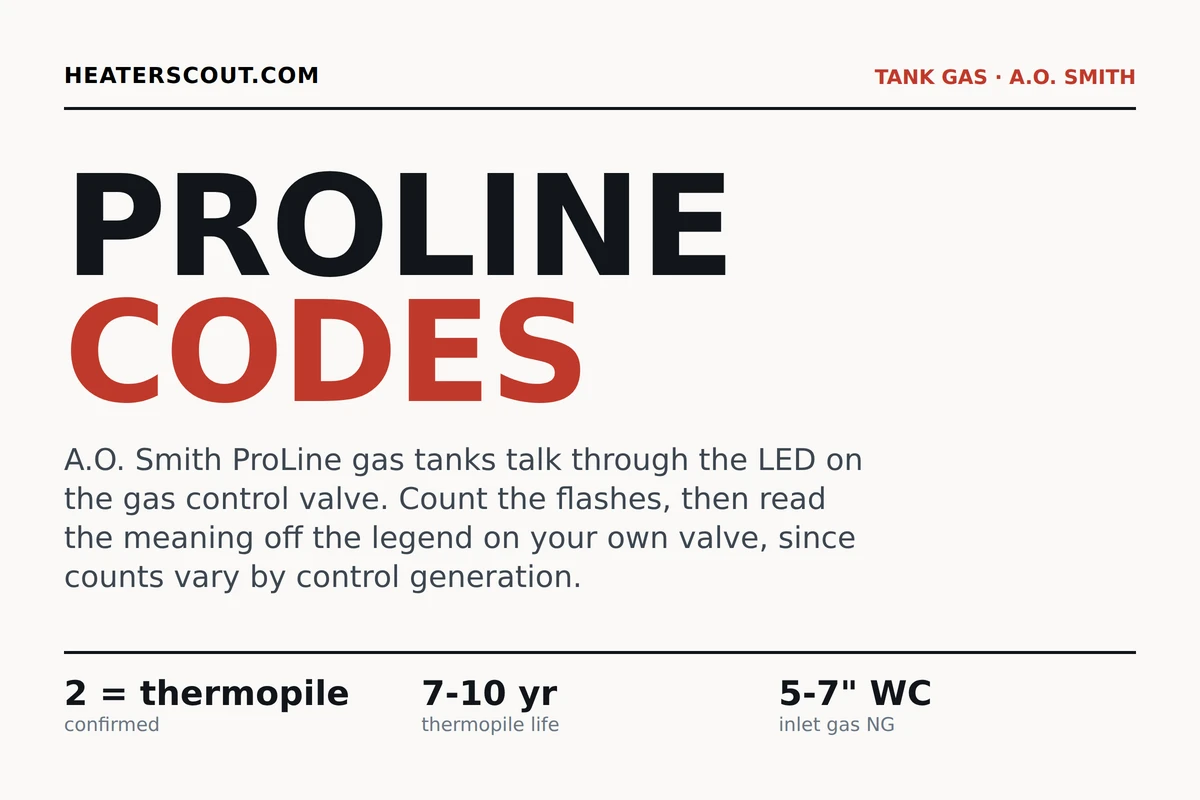
Your A.O. Smith ProLine has been running for eight years. This morning the pilot is out and the small LED on the gas control valve is doing something you do not recognize, a burst of flashes then a long pause, over and over. That LED is not a warning lamp in the old sense. It is a full diagnostic readout, and every count from one to eight points at a specific part of the heater. The A.O. Smith ProLine gas family covers atmospheric GCV models, Power Vent GPVL and GPVH tanks, and Direct Vent GDVT and GDVL units, and they all speak the same LED language because they all run the same family of Honeywell gas control valves. This page decodes it.
Quick answer
Kneel down for a clean line of sight on the small LED at the base of the gas control valve. Watch one full burst and pause go by without counting so you feel the rhythm. Then count only the quick flashes inside a single burst and stop at the long pause. Solid green is normal. Two confirmed counts hold across builds: two flashes is a low or weak thermopile, and seven is a gas valve failure. Every other count varies by control generation, so match it against the legend printed on your own valve or under the front door, not a generic chart. If the code is a high-temperature or over-temp (ECO) lockout, do not keep resetting it, because that is a real overheat. Confirm the same count on the next burst before you reset, because resetting clears the code.
The A.O. Smith ProLine LED decision tree
Count the LED, but read the meaning off the legend on your own valve or under the front door, because the meaning of a given blink count varies by control generation. Identify which ProLine family you have off the model prefix on the rating plate first, since that decides which faults are even possible. A couple of counts are confirmed across builds; the rest you match to your specific valve's legend.
Solid green or one slow flash
Normal. Solid steady green is the valve running with no queued fault, and one slow flash every few seconds is the standby heartbeat with the pilot lit and the thermopile healthy. Neither is a problem.
Two flashes: low or weak thermopile (confirmed)
The pilot is not making enough millivolts to hold the valve open. Cheap, homeowner work. Check the pilot flame is a strong blue that wraps the thermopile tip, clean and reseat the leads at the valve, and if a meter reads low under load, swap the thermopile with the OEM or universal spec for your model.
Seven flashes: gas control valve failure (confirmed)
Internal valve fault. Rarely clears with a reset. Almost always ends in replacing the gas control valve assembly. Check warranty first, because the valve is a covered part on ProLine gas heaters for years.
A pressure-switch code on a Power Vent (GPVL, GPVH)
If your valve's legend identifies the code as a pressure-switch fault, the blower is not proving draft to the switch. Check the exhaust termination outside for a bird nest or blockage, check the intake for slumped insulation or lint, and inspect the small hose between the blower housing and the pressure switch for a kink or a hole. A dead blower motor is the last suspect, not the first.
A high-temperature / over-temp (ECO) code
If the legend identifies the code as a high-temperature or over-temp lockout, do not keep resetting it. The valve sensed the water past its high limit and cut the burner, which is a real overheat. Causes stack from a high setpoint, to heavy sediment insulating the burner and superheating the water above, to a failing temperature sensor. Back the dial to 120 degrees, flush the tank, and call for service if it returns.
Any other count
The meaning varies by control generation, so match it against the legend printed on your own valve or under the front door rather than a generic chart. Do not force a relight through a code you have not identified, since some are safety trips. Call A.O. Smith tech support with the full model and serial if you cannot find the legend.
Before you count the flashes: the pre-diagnostic checklist
Owners lose hours chasing codes on tanks that had a mundane problem the whole time. Walk this list first, because a flash code on a tank that is out of gas or has a wide-open shutoff is telling you a downstream story, not the actual cause. Every item takes under a minute.
- Read the full model and serial off the rating plate, front of the jacket, at eye level. Gas ProLine prefixes start with GCV, GPVL, GPVH, GDVT, or GDVL, and the family sets which faults are even possible.
- Confirm the gas is actually on: shutoff open, meter working, other gas appliances (range, furnace) running. An empty tank or a tripped shutoff reads as no pilot, not a valve fault.
- Look at the pilot flame if it is lit. A strong steady blue that wraps the thermopile tip is healthy; a yellow, weak, or lifting flame is a pilot orifice or a draft issue and will read as a two-flash.
- On a Power Vent (GPVL, GPVH), listen for the blower on a call for heat. Blower runs and a pressure-switch code stays: the vent path, not the motor. Blower silent: check power at the blower first.
- Note the count in one burst, wait for the long pause, confirm the same count on the next burst. Write it down BEFORE you reset the knob, because a reset clears the readout.
- Do a soft reset exactly once before spending money: gas control knob to OFF, wait about five minutes, relight the pilot per the burner-door instructions, and back to your temperature setting.
The fix: relight, then thermopile swap if it does not hold
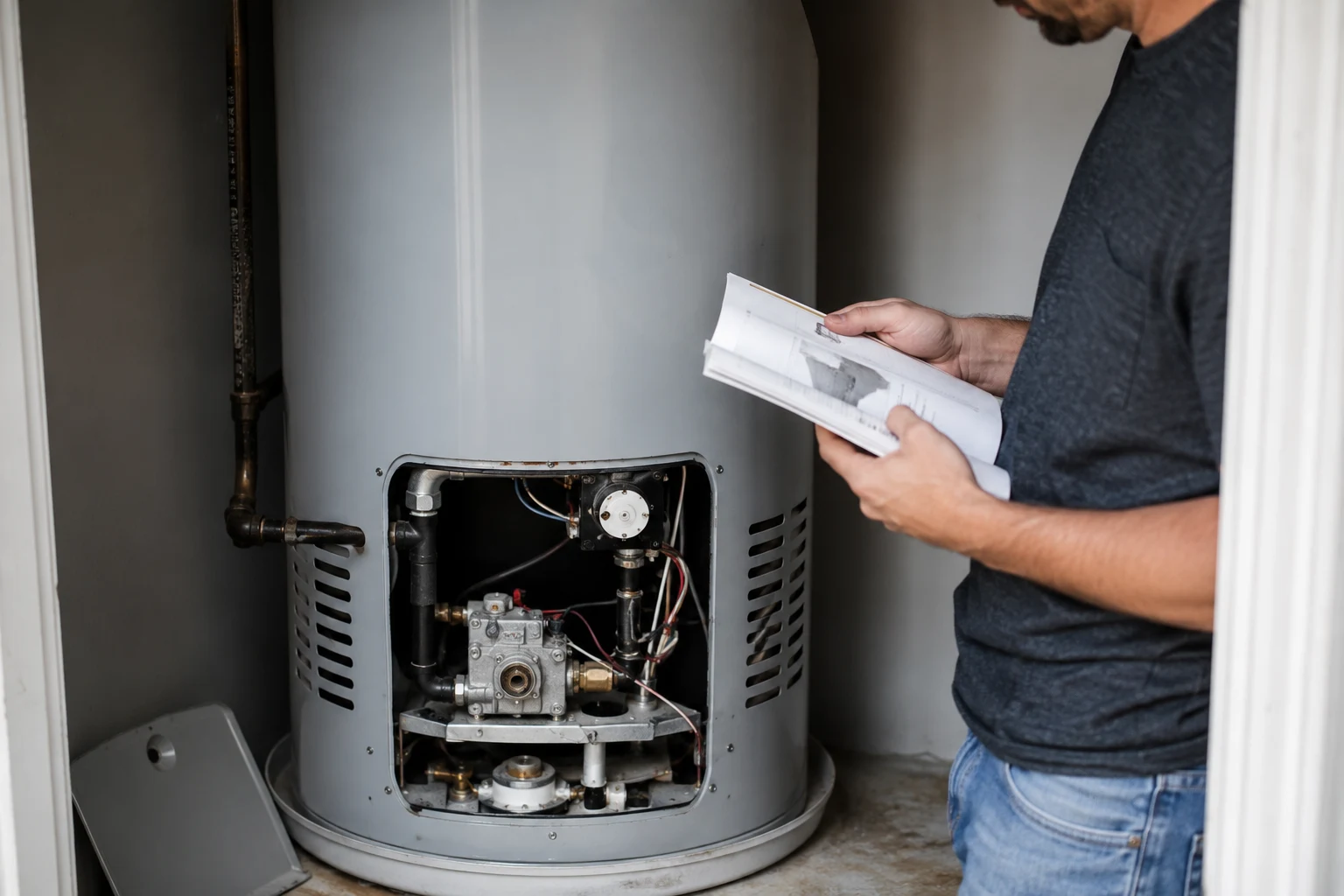
Most ProLine gas complaints resolve on one of two repairs done in order: relight the pilot per the manual, or swap the thermopile if the count is two and the meter confirms low output. If instead your valve's legend points at a high-temperature or over-temp lockout, stop and diagnose the overheat rather than resetting. The sequence below keeps you out of the wrong part.
Three ProLine scenarios owners actually see
These three cases cover most of the calls A.O. Smith service lines and independent plumbers get on ProLine gas tanks. If the LED count and the age of the heater match any of them, start with the described fix rather than pulling the valve.
Thermopile faded at the usual age
A ProLine that ran fine for years is now throwing two flashes and the pilot drops when you release the knob. Thermopiles weaken between year seven and year ten as the junctions oxidize. Clean the pilot orifice first, and if a millivolt meter reads low under load, drop in the OEM thermopile for your model. Under fifty dollars and homeowner work.
A high-temp code that keeps coming back
A GCV or GPVL goes dead and the valve's legend reads the code as a high-temperature or over-temp (ECO) lockout. Clearing it only buys a little time. That is a real overheat, not a nuisance. Back the setpoint to 120 degrees, flush sediment, check the temperature sensing, and stop resetting it if it returns. Call for service rather than overriding the overheat again.
Bird nest in the exhaust cap
A GPVL Power Vent in the utility room throws a pressure-switch code every winter morning. Outside, the sidewall exhaust termination has a bird nest wedged into the cap. Blower is fine, motor is fine, switch is fine; the vent path is what failed. Clear the nest, install a proper termination screen, and the code clears.
Where is the model number on my ProLine and why does it matter?
The full model and full serial live on the rating plate on the front of the jacket, at eye level, and on newer builds are also stamped inside the front access door. The prefix on gas ProLine tanks tells you the family: GCV is atmospheric, GPVL and GPVH are Power Vent, GDVT and GDVL are Direct Vent, and Vertex Power Direct Vent runs the ICON3 electronic control. That prefix decides which faults are even possible on your tank: a three-flash pressure-switch code cannot happen on an atmospheric GCV because there is no blower and no pressure switch, and an ICON3 E-code cannot appear on a heater that does not have an LCD. Match the part to the full model, not the brand name.
Are Whirlpool, Reliance, Signature, and A.O. Smith ProLine really the same heater?
For diagnostic purposes on the gas side, yes. A.O. Smith manufactures ProLine under its own badge, Signature and Whirlpool for Lowe's, and Reliance for Home Depot, and the gas storage tanks in those lines share the same Honeywell or Robertshaw gas control valve, the same LED chart, the same FVIR flame-arrestor base, and the same thermopile spec. That is why a Whirlpool blink-code chart matches an A.O. Smith one flash for flash. What varies between badges is the model prefix, the exact warranty term, and the service phone number, so order parts against the full model on the plate rather than the brand.
Frequently asked
What is the diagnostic mode on an A.O. Smith Vertex water heater?
A.O. Smith Vertex Power Direct Vent tanks and other newer premium ProLine models run an electronic control that swaps the simple flashing LED of the older gas control valve for a small LCD readout on the front. Diagnostic mode is how you make it show what is wrong. Hold the thermostat button on the control for about five seconds until the display switches from the water temperature to an error code, which reads out as an E-code. Those E-codes are model-specific, so look them up in your unit's manual or the label under the front access door rather than trusting a generic chart, because the numbering is not universal across build years. Two you will see are E01 for ignition failure and E02 for an over-temperature or high-limit condition. Read the code off the LCD, note it down before you reset, and match it against your own model's legend.
Do Signature and ProLine share parts?
Yes, on the ways that matter for repair. A.O. Smith builds the ProLine line under its own badge, Signature for Lowe's, Whirlpool for Lowe's, Reliance for Home Depot, and State and American for the plumbing-supply channel, and the gas storage tanks in those lines share the same Honeywell or Robertshaw gas control valve, the same LED chart, the same FVIR flame-arrestor base, and the same thermopile spec. That is why a Whirlpool blink-code chart matches an A.O. Smith one flash for flash, and why a Signature part number and a ProLine part number for a thermopile or a gas valve line up. What differs between the badges is the model prefix on the rating label, the exact warranty term, and the customer service phone number, so order the part against the full model and serial off the appliance in front of you rather than against the brand name, because parts are keyed to the model.
How do I replace the thermopile on an A.O. Smith ProLine?
A ProLine thermopile swap is a screwdriver, an open-end wrench, and about half an hour. Turn the gas control knob to OFF and shut the gas supply. Wait a few minutes for the pilot assembly to cool. Unhook the thermopile lead from the gas control valve, which is a small quick-connect on newer valves and two screwed terminals on older ones, and then lift the burner assembly out through the burner door after loosening the pilot, thermopile, and burner manifold connections. The old thermopile is a slide-fit into a clip at the pilot bracket, so it pulls out and the new one, the OEM thermopile for your model or a universal equivalent, slides in the same way. Match the replacement to the parts list for your exact model. Route the new lead back to the valve exactly like the old one, tighten the connection firmly, reseat the burner, and relight the pilot per the door instructions. If a millivolt meter reads healthy under load, the fix is done.
What does E02 mean on an A.O. Smith Vertex?
On a Vertex Power Direct Vent, E02 is an over-temperature or high-limit code: the control saw the water go past its high limit and shut the burner down. That is a real overheat, not a nuisance trip, so do not just clear it and walk away. The usual causes are a setpoint left too high, heavy sediment in the tank trapping heat against the sensing, or a temperature-sensing part or gas valve that is no longer regulating. Back the setpoint to about 120 degrees, drain and flush sediment, and check the temperature sensing. Because Vertex runs a modulating gas valve tied to its sensor readings, the heater stays locked out until the overheat is resolved. If E02 keeps coming back on a clean tank set at 120, stop clearing it and call an A.O. Smith service line, and always confirm the code against the legend under the front door for your build year, since the E-code numbering is model-specific.
My A.O. Smith GPVL Power Vent blinks 3 times, is the blower dead?
Not necessarily. On a GPVL Power Vent the three-flash code means the pressure switch is open, which is the switch telling the gas valve that it does not see the draft the blower is supposed to be pulling. A dead blower motor is one cause, but it is not the most common one. The most common one is a blocked vent path: a bird nest at the exhaust termination outside, insulation slumped against the intake, a screen clogged with lint, or a disconnected hose between the blower and the pressure switch itself. Start with the terminations outside, listen for the blower running on a call for heat, and if the blower runs but the code stays, check the pressure-switch hose for a kink or a hole. Only after intake, exhaust, hose, and switch all check out do you suspect a genuinely failed blower motor. Cleaning a nest out of the exhaust cap is the answer far more often than a new blower.
How do I read the LED on an A.O. Smith ProLine gas valve without miscounting?
The flashes come fast and the pause between bursts is long, so miscounting is easy and it is the most common way owners end up chasing the wrong part. The status LED sits low on the gas control valve near the base of the tank. Kneel down for a straight line of sight, watch one full burst-and-pause go by without counting so you feel the rhythm, and then count only the quick flashes inside a single burst, stopping at the long pause. A solid steady green LED means the valve is running normally with no fault queued, one slow flash is normal standby, and any count from two to eight is a fault. Confirm the same count on the next burst, because a code that changes between cycles was miscounted or caught mid-transition. Note the number before you reset the heater, because cycling the gas knob clears the readout and takes the code with it.
Where do I find the model number on an A.O. Smith ProLine tank?
On the rating plate. On most ProLine gas tanks the plate is stuck to the front of the jacket at eye level, right above or below the front access door where the burner and controls live, and on some installations you will also see a smaller front label near the top of the tank. The plate lists the full model number, which begins with the family letters on gas tanks like GCV, GPVL, GPVH, GDVT, or GDVL, followed by the capacity and BTU coding, the full serial number, the fuel type, and the input rating. Write down the whole model and the whole serial before you call for parts or warranty because A.O. Smith parts and warranty look-ups are both keyed to the exact model and the serial-encoded build date. If the plate is faded or unreadable, the same information is often stamped inside the front access door on newer ProLine tanks.
Why is my A.O. Smith ProLine hot water not hot enough?
Not hot enough is different from no hot water, and it usually is not the gas valve. On a ProLine gas tank the classic causes are a broken dip tube letting cold inlet water mix with hot at the top of the tank, a crumbled anode rod on a heater older than six or seven years dumping sediment and reducing useful volume, or low gas pressure starving the burner. Manifold pressure on a ProLine natural-gas tank should sit around 3.5 inches of water column with inlet pressure between 5 and 7 inches, and low inlet shows up as a lazy flame and a heater that never quite catches up on a busy morning. Check the temperature setting first, back it to 120 degrees for safety and then confirm the water actually reaches it, and if the burner runs and runs without the tank getting hot, pull the anode and inspect the dip tube. Recovery slow with a normal flame usually points at sediment insulating the burner from the water above it, which a flush addresses.