An A.O. Smith Voltex or Vortex hybrid can throw a fault code and still hand you a hot shower the next morning. That is the part most owners miss. When the heat pump side stumbles, the control quietly falls back to the electric resistance elements, so the water stays hot while the compressor sits dead and your power bill creeps up. The two-character code on the digital display is telling you exactly which part gave up, and the codes sort into four clean groups: the cheap element faults, the sensor faults, the expensive sealed-system faults, and the housekeeping alerts you can clear in five minutes. This page walks each one, most-likely cause first, and tells you when to grab a screwdriver versus when to phone the warranty line.
First, read the code off your own display
A.O. Smith changed how these codes look between model years, and that trips people up. Older HPTU Vortex and Voltex panels spell the fault out in words, things like Upper Element Connect Fault, Heat Pump Connect Fault, or High Temp Lockout. Newer Voltex, Voltex AL, and ProLine XE panels show short letter codes instead: EUC, ELC, SF, E20, ECC. The meanings map onto each other one to one, the display just got terser. So the first move is to read the exact characters on the appliance in front of you, not a code off a generic list. If your panel shows a code that is not in any table, that is A.O. Smith's cue to call Residential Technical Assistance, and it is printed that way in the manual.
Clear the easy one before anything else
Before you assume the worst, rule out the two nuisance alerts. SF is a dirty air filter, and it accounts for a surprising share of panic calls. EoF, or the older Condensate Drain Alarm, is water failing to drain. Neither is an electronics failure. Here is the quick pass that clears most non-urgent codes.
The four buckets, by cost and difficulty
Every Voltex fault lands in one of four groups. Knowing the group tells you the price and whether it is yours to fix before you even look up the specific code. Here is the rough shape of it.
The element codes are the good news. EUC means the control cannot see the upper heating element and ELC means the lower one, and the cause is almost always a burned-out element or a loose spade connector. An element is a fifteen-to-forty-dollar part, and a homeowner comfortable draining a tank and pulling an element can do the whole job in an afternoon. Sensor codes in the E-range, E20 and E21 upper, E30 and E31 lower, E50 and E51 heat-pump suction, mean a thermistor reads short or open. The part is cheap, but the labor to reach it and the diagnosis push most people toward a service call, and the manual routes these to a qualified service person for a reason.
The sealed-system codes are where you slow down. ECC is a compressor failure, EDH is discharge temperature too high, and ECL is suction pressure too low. All three point at the refrigerant circuit, which is closed, pressurized, and off-limits without EPA Section 608 certification. Do not open it. Check the warranty first, because A.O. Smith backs the heat pump for a long term and a covered compressor turns a brutal repair bill into labor only. EPL, low supply voltage, sits alongside these: it usually means an electrical supply or wiring problem, and it wants an electrician, not a plumber.
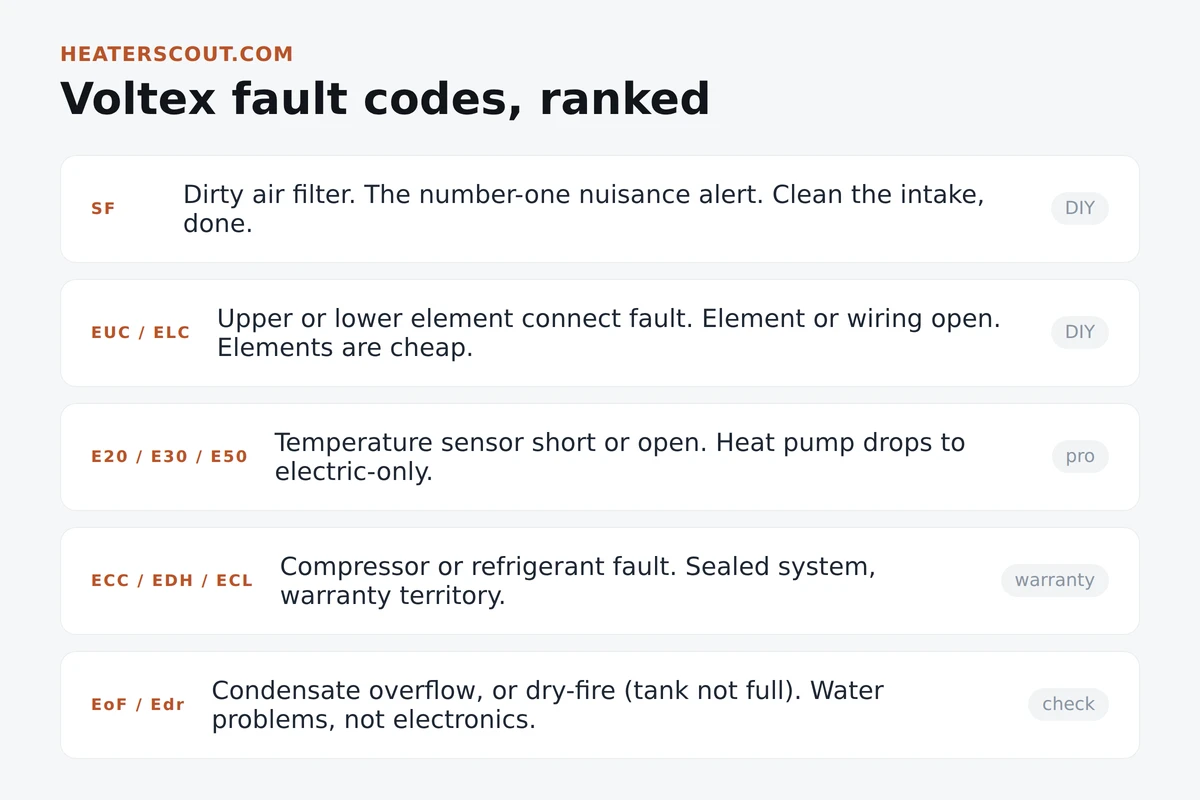
Element codes: EUC and ELC
These are the codes most homeowners actually fix themselves. A hybrid has two resistance elements, upper and lower, that back up the heat pump and carry the load in electric-only mode. When one opens up, the control loses continuity and posts EUC for the upper or ELC for the lower. Test the element with a multimeter for continuity before you buy anything, because a loose or corroded wire at the element terminal mimics a dead element and costs nothing to fix.
Do I need to drain the tank to replace an element?
Yes. The element threads into the side of the tank below the water line, so you shut off the cold supply, kill the breaker, drain the tank below the element, then unscrew the old element and swap in the new one with a fresh gasket. Refill fully and purge the air before you restore power, because energizing a dry element burns it out instantly, which is the same dry-fire condition the Edr code warns about.
Sensor and compressor codes: when to stop
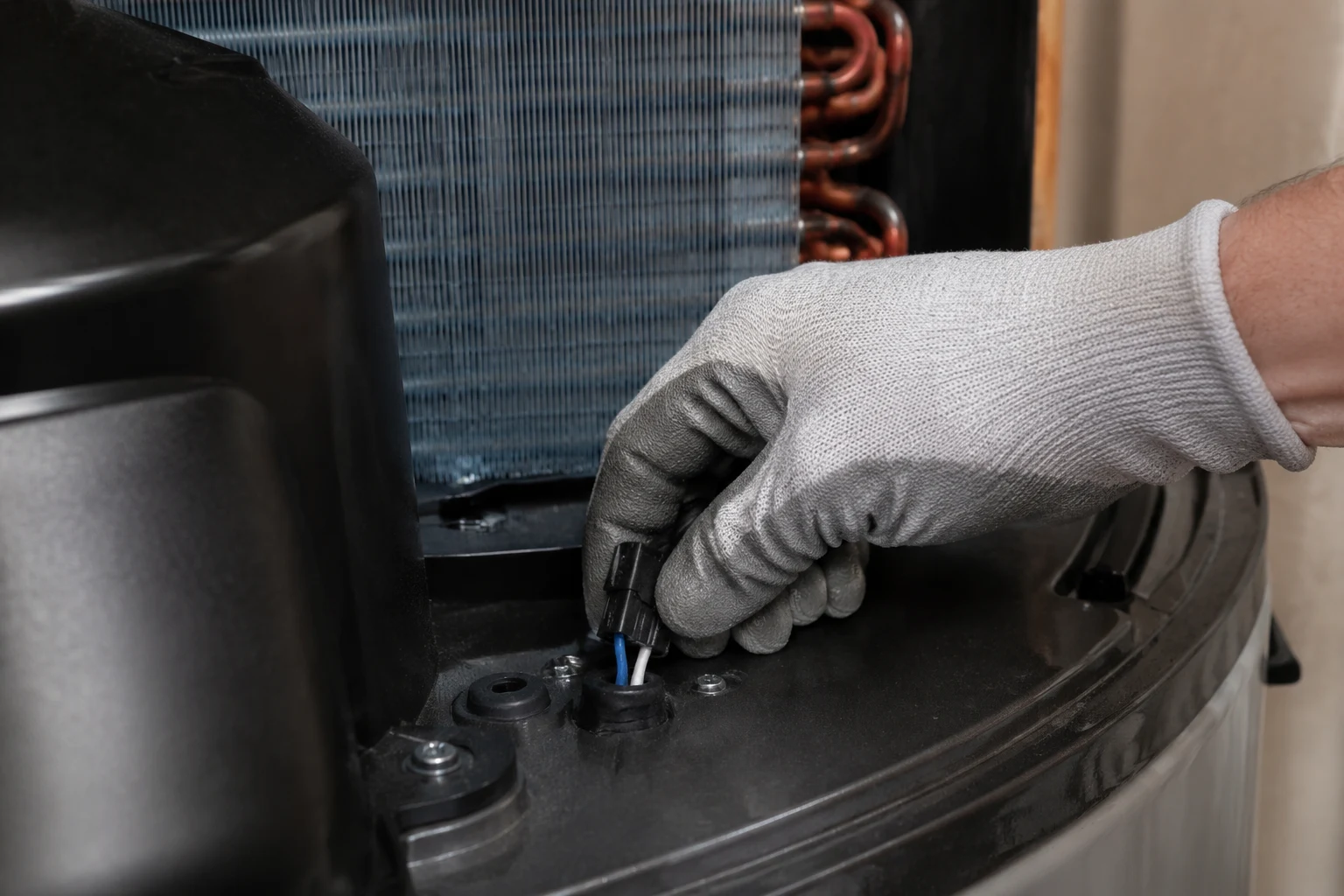
The E-series sensor codes and the sealed-system codes share one thing: on both, the heater usually keeps running on the electric elements, so there is no emergency. That buys you time to diagnose calmly rather than at 6 a.m. with no hot water. A single sensor E-code can sometimes be a connector that worked loose with vibration, so a careful check of the sensor plug is worth a minute before you condemn the thermistor. But the compressor codes, ECC, EDH, ECL, are not connector problems. They are the sealed system telling you it cannot run safely, and the right response is a certified tech and a warranty claim, in that order.
Dry-fire, freeze protection, and the low-ambient codes
Three codes get mistaken for failures when they are really the heater protecting itself. Edr is a dry-fire or low-water alert: the tank is not full enough to safely energize an element, common right after an install or a drain-and-refill. The fix is to open all the hot taps and let them run until water flows steady with no sputter, which purges the air pocket, then clear the code. FP, freeze protection, appears when the ambient air drops below roughly 40 degrees and the unit switches to electric backup so the refrigerant circuit is not asked to run in the cold. Lo is the related low-ambient lockout. None of these is broken. They are the reason a Voltex wants a space that stays above about 40 degrees and has enough air volume for the heat pump to breathe.
- Read the exact code characters off your display before resetting, so you do not lose it.
- Power-cycle once at the breaker; if the code returns immediately, the fault is real.
- SF: clean the washable air filter, every 1 to 3 months.
- EoF: level the unit, clear the condensate line, check the pump float.
- EUC / ELC: test the element and its wiring for continuity before buying a part.
- E20 / E30 / E50: check the sensor connector, then call a tech; heater runs on electric backup meanwhile.
- ECC / EDH / ECL / EPL: do not open the sealed system; check the heat-pump warranty and call for service.
- Repeating high-temp lockout or any leak alert: stop resetting and get it diagnosed.
Voltex AL: leak detection and the smart anode
The newest Voltex AL line adds two alerts the older HPTU units never had. A powered smart anode watches the tank's corrosion protection and tells you on the panel and the connected app when the rod is worn enough to replace, which matters because the anode is the single part that decides how long the steel tank survives. And an integrated leak sensor at the base fires a panel alert and a phone notification the instant it sees water. Neither is a fault in the usual sense. The anode alert is scheduled maintenance, and the leak alert is a chance to catch a slow drip before it becomes a flooded utility room. If your unit does not wear the AL badge, you will never see these, so do not go hunting for a leak code on a standard Voltex.
Whatever the code, the same logic holds: identify the bucket, clear the cheap causes, and let the heater coast on electric backup while you line up the right fix. The compressor and refrigerant faults are the only ones worth losing sleep over, and even those come with a warranty worth checking before you reach for your wallet.
Frequently asked
What do the fault codes on my A.O. Smith heat pump water heater mean?
The codes fall into four buckets. Element codes, EUC for the upper element and ELC for the lower, mean the control cannot see a heating element, usually a burned-out element or a loose wire. Sensor codes in the E-range, E20 and E21 for the upper temperature sensor, E30 and E31 for the lower, E50 and E51 for the heat pump suction sensor, mean a thermistor is reading short or open. Compressor and refrigerant codes, ECC, EDH, and ECL, are sealed-system faults on the heat pump itself. And there are housekeeping codes, SF for a dirty air filter, EoF for a condensate overflow, Edr for a dry-fire when the tank is not full, and EPL for low supply voltage. Older Vortex and Voltex panels spell these out as words instead of letters, and add FP for freeze protection and Lo for a low-ambient lockout. Read the exact characters off your own display, because the wording changed across model years even though the meanings did not.
Can I reset an A.O. Smith heat pump water heater fault code myself?
You can try, and for a one-time glitch it works. The simplest reset is to kill the heater at the breaker for two to three minutes, then restore power and watch whether the code returns. For a high-temperature electric-side trip there is also a red ECO reset button behind the upper access panel: cut power, remove the panel, fold the insulation aside, press the red button until it clicks, then reassemble and restore power. What a reset does not do is fix a real fault. If EUC, ECC, or a sensor E-code comes right back after a clean power cycle, the part is actually bad and resetting again just delays the repair. Reset once to confirm, not as the fix.
Will my A.O. Smith hybrid still make hot water if the heat pump faults?
Yes, and that is by design. When a heat-pump-side code appears, a compressor fault, a fan fault, a suction sensor, freeze protection below about 40 degrees, the control drops the unit into electric-only mode and runs the resistance elements instead. You keep hot water. You just lose the efficiency, so the electric bill climbs and recovery may feel a little slower on a big draw. That fallback is also why people ignore these codes for weeks without realizing it: the water stays hot while the compressor sits dead. If you notice your power bill jump for no reason, check the display for a heat-pump code.
How much does it cost to fix an A.O. Smith heat pump water heater fault?
It depends entirely on which bucket the code lands in. An element behind EUC or ELC is a cheap part, roughly fifteen to forty dollars, and an hour of labor, so figure a couple hundred dollars installed if you hire it out. A temperature sensor is a modest part but the labor to reach it pushes a service call toward two to four hundred. The expensive codes are the sealed-system ones. ECC, EDH, and ECL point at the compressor or refrigerant circuit, and that is where you stop and check the warranty, because these units carry a long heat-pump warranty and a covered compressor turns a four-figure repair into a labor-only job. On a unit past its warranty, a failed compressor often means it is time to price a replacement heater.
What is the SF code on my A.O. Smith heat pump water heater?
SF is the dirty air filter alert, and it is the friendliest code on the panel. The heat pump pulls room air across an evaporator coil to harvest heat, and there is a washable filter over that intake. When it clogs with lint and dust, airflow drops, efficiency falls, and the control raises SF to nag you. Pop the filter out, rinse or vacuum it, let it dry, put it back, and clear the code. Do this every one to three months, more often in a dusty basement or laundry room. Ignoring SF is what eventually turns into ECF, the short-cycling code, because a starved compressor keeps kicking on and off.
Why does my A.O. Smith heat pump water heater keep showing a condensate or EoF code?
EoF, and the older Condensate Drain Alarm, both mean water is backing up instead of draining. A heat pump makes condensate the same way an air conditioner does, several cups a day, and that water has to run out through a drain line or a small condensate pump. The usual culprits are a unit that is not level, a kinked or clogged drain hose, a plugged drain pan port, or a condensate pump that has failed or lost power. Check that the heater sits level, that the drain line runs downhill with no traps or kinks, and that any pump is powered and its float moves freely. This is a plumbing and leveling problem, not an electronics fault, so it is squarely homeowner-fixable once you find the blockage.
Is an A.O. Smith heat pump water heater fault code dangerous?
Most are not dangerous, they are just efficiency or comfort problems. A dirty-filter SF or a dead element EUC will not hurt you. The two to take seriously are the high-temperature lockout, where the water climbed past about 190 degrees and the safety cut the elements, and any leak alert on a Voltex AL model. A repeating high-temp lockout means a thermostat or sensor is failing to shut the elements off, which is a scald and pressure risk, so do not keep resetting it, get it diagnosed. A leak-detect alert on the AL line is pointing at actual water where it should not be, and the app will tell you before the floor does. Everything else you can diagnose at your own pace while the heater runs on electric backup.
What does the anode or leak code mean on a Voltex AL?
The Voltex AL line adds two things the older HPTU units do not have: a powered smart anode and an integrated leak sensor. The smart anode monitors the tank's corrosion protection and puts an alert on the panel and the connected app when the rod is worn enough to need replacement, so you are not guessing about the one part that decides how long the tank lasts. The leak sensor watches the base of the unit and fires an alert, plus a phone notification, the moment it detects water. Neither is a failure of the heater by itself. The anode alert is routine maintenance you schedule, and the leak alert is a warning to go look before a slow drip becomes a flooded floor. If you have an older Voltex or Vortex without the AL badge, you will not see these codes at all.