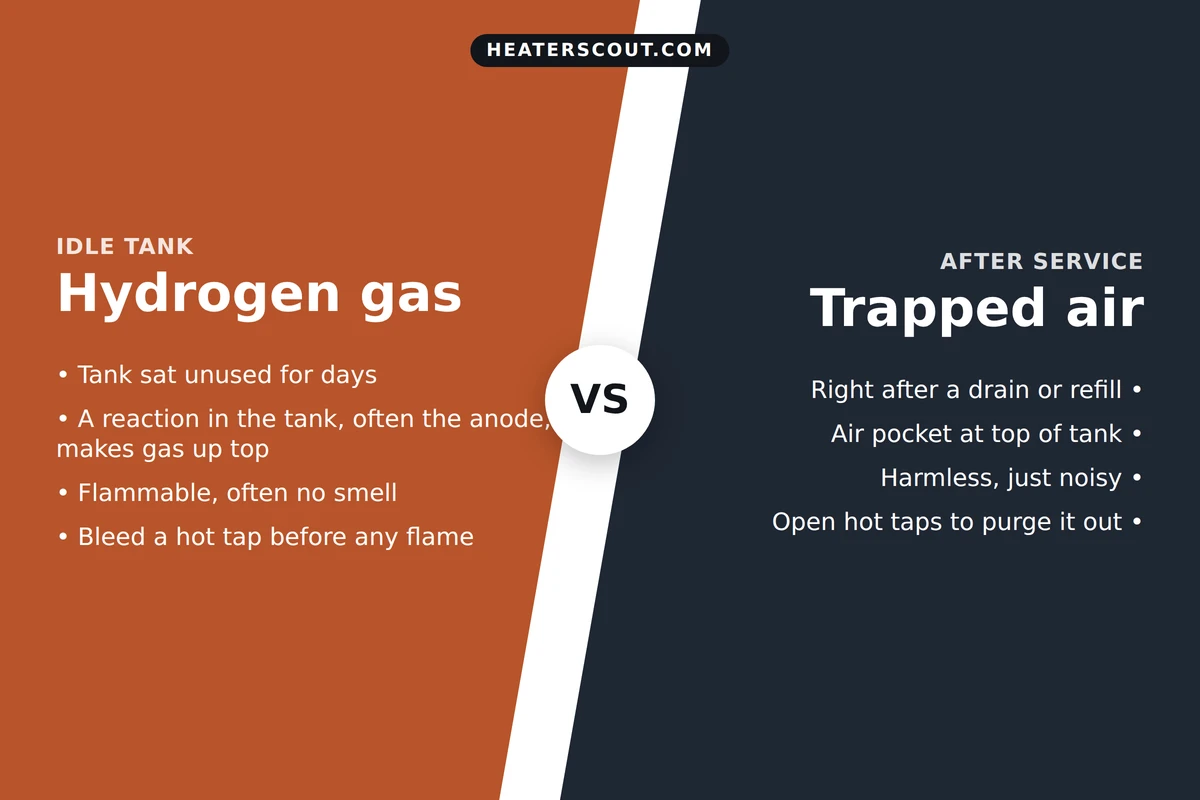
You open the hot tap and it coughs. A spit of air, a spray, a stutter, then the water finally runs steady. It almost always shows up in one of two spots: on a heater that just sat unused for a stretch, like a return from vacation or a second home, or right after someone drained and refilled the tank. Those are two different things happening inside the water heater, and only one of them carries any real risk. On an idle tank the air is often hydrogen gas from a reaction inside the tank, commonly involving the anode rod, that builds slowly while the water sits still, and hydrogen is flammable. If the tank has been idle two or more weeks, open a hot tap farthest from the heater and let it run a few minutes before any appliance, flame, or spark, so the gas vents out ahead of you. After a drain or refill it is plain trapped air that is only noisy. This page sorts out which one you have, tells you when to bleed it before you strike a flame, and walks the fix so the sputtering stops.
Hydrogen gas versus trapped air
These two causes look identical at the tap: a sputter, a spit, a cough of air. But they come from different places, they carry different risk, and the smell test tells them apart. The table lays them side by side so you can match your situation and know whether to just purge it or to vent it carefully first.
| Hydrogen gas (idle tank) | Trapped air (after service) | |
|---|---|---|
| Cause | A reaction inside the tank, commonly involving the anode rod, while it sits unused for days; gas collects at the top | Air pocket left at the top of the tank after a drain, refill, or new install |
| When it shows up | After a vacation, a second home, or any stretch of no hot-water use | Immediately after the tank was drained and refilled or a heater was installed |
| Smell | Usually odorless. A sulfur or rotten-egg smell is a different anode-and-bacteria issue | No smell, just the air itself |
| Risk | Flammable in a closed, unused tank. Vent before any flame or spark | Harmless. Only noisy until it clears |
| Fix | Open a hot tap farthest from the heater, run a few minutes before using any appliance | Run every hot fixture until the flow is steady, one pass through the house |
The important line in that table is smell. Hydrogen from an idle tank does not stink, so air with no odor on a heater that sat unused is the hydrogen case and the one where you vent before lighting anything. A rotten-egg smell is not this problem at all. That is hydrogen sulfide from the anode reacting with bacteria or sulfates in the water, and it calls for flushing, sanitizing, or a different anode material rather than just bleeding the lines.
How likely each cause is
Across the sputtering-hot-tap cases people actually run into, the two harmless causes are the ones you hit most. Hydrogen after an idle tank and trapped air after service are both common; a well or supply drawing air is the rarer one, and it is the only case that hits the cold side too. These are independent likelihoods for how often each turns up, not slices of one pie that add to a hundred.
What it looks like in real life
Back from three weeks away, the hot tap spits air
You come home from a long vacation, open the hot tap, and it coughs air before the water runs. That is hydrogen from a reaction inside the tank, commonly involving the anode, while it sat still. It is usually odorless. Because hydrogen is flammable, open the hot tap farthest from the heater and let it run a few minutes before you light a stove, a pilot, or any appliance. Vent it out the tap and the risk goes with it.
Sputtering right after draining the tank
You just drained and refilled the heater and now every hot tap sputters. That is a trapped air pocket left at the top of the tank as the water came back in. It is harmless, only noisy. Run each hot fixture until the flow goes steady and it clears in one pass.
Both taps sputter on a well
If air spits from the cold side too, the tank is not the source. On a well, air is being drawn in on the pump suction side or the pressure tank has lost its charge. Check the pressure tank and the suction fittings, not the water heater.
First, figure out which kind of air you have
The fix depends entirely on the cause, and you can sort it in about thirty seconds by asking when the sputtering started and which taps it hits. Walk this path before you touch anything.
Sputter on hot only, after the heater sat unused
If the hot taps spit air after the heater was idle for a week or two, like a vacation or a second home, you are almost certainly looking at hydrogen gas that built up in the tank while it sat still. It is usually odorless. Bleed it: open a hot tap and let the gas run out before any flame or appliance.
Sputter right after a drain, refill, or install
If the air showed up immediately after someone drained the tank, refilled it, or installed a new heater, it is a trapped air pocket at the top of the tank, not gas. It is harmless, just noisy. Purge it by running every hot fixture in the house until the flow goes steady and quiet.
Sputter on both hot AND cold taps
If air spits from the cold side too, the tank is not the source. On a well or pump system, air is being drawn in on the suction side, or the pressure tank has lost its charge. That is a supply problem to trace at the pump and pressure tank, and bleeding the hot lines will not fix it.
How to bleed the lines
The fix for both harmless cases is the same simple purge. Open the hot tap that sits highest and farthest from the water heater, all the way to hot, and let it run. You will hear it sputter and spit as the air pocket clears, then the flow smooths out to steady water. Run it until it is quiet and even, usually a minute or two, then move to the next hot fixture and do the same. Working through every hot tap in the house clears the trapped air from the whole hot side in one pass. After a fresh drain or refill, that single sweep usually settles it for good.
On a well system there is one more thing to check when the air keeps coming back. The pressure tank holds an air charge that keeps the pump from short-cycling, and if that charge is off or the bladder has failed, air works its way into the plumbing and shows up at the taps. Check the pressure-tank air with a gauge against the label spec, and look for a fitting on the suction side of the pump that could be drawing air. If the sputtering returns on both hot and cold after every bleed, the tank and pump are where the fix lives, not the water heater.
When bleeding stops working on the hot side alone, inspect the connections at the top of the tank. A cracked or loose heat-trap nipple, a failing dip tube, or a fitting that weeps can let air in when the system depressurizes overnight, so the air is back by morning no matter how thoroughly you purged it. Persistent air is also an early hint of a small leak, because a spot that lets water seep out will let air seep back in, so it is worth a close look at the anode port and the hot and cold nipples rather than more bleeding.
Symptom to cause to fix
Match your symptom in the left column and read across. Remember the one safety point: hydrogen is flammable, so on a tank idle two or more weeks, run a hot tap away from any flame or ignition source before you light anything.
| Hot only, after the heater sat idle | Hydrogen gas. Bleed the hot taps; vent before any flame on a tank idle 2+ weeks |
| Sputter right after a drain or refill | Trapped air pocket. Purge every hot fixture until the flow runs steady |
| Both hot and cold taps sputter | Well or supply drawing air. Check the pressure tank and suction fittings |
| Air keeps coming back after a full bleed | Small leak or failing heat-trap nipple. Inspect the top-of-tank connections |
| Air with a rotten-egg smell | Hydrogen sulfide, not trapped air. Flush and sanitize or change the anode |
Frequently asked
Why does air come out of my hot water faucet but not the cold?
Because the air is being made or trapped inside the water heater, and the cold side never runs through the tank. Cold water goes straight from the main to your cold taps, so it stays smooth. Hot water sits in the tank first, and the tank is exactly where two things collect: hydrogen gas that builds up when the heater sits unused for days, and an air pocket left at the top after someone drains, refills, or installs the unit. Either one rides out the hot lines the next time you open a hot tap, so you get sputtering, spitting, and that cough of air followed by water. If you ever get air sputtering on the cold side too, the problem is upstream of the heater, usually a well or pump drawing air on its suction side, and the tank is not the cause.
Is the air in my hot water lines dangerous?
In small amounts, no. A little air or gas that clears in a minute of running the tap is harmless and common, especially after the water sat unused. The one real hazard is hydrogen. When a water heater sits idle for a couple of weeks or more, a reaction inside the tank, commonly involving the anode rod, slowly produces hydrogen gas, which collects at the top of the tank. Hydrogen is flammable. In a closed, unused tank it can build to a level where an open flame or a spark near a running tap is a genuine risk. That is why the standard advice after a vacation or on a second home is to open a hot tap farthest from the heater and let it run a few minutes before you light a stove, a pilot, or anything else. Vent it out the tap first and the risk goes with it.
How do I get air out of my hot water lines?
Open the hot taps and let the tank push the air out. Start with the hot tap that sits highest and farthest from the heater, open it wide to hot only, and let it run. You will hear sputtering and spitting as the air pocket clears, then the flow smooths out to steady water. Run it until it is quiet and even, usually a minute or two, then move to the next hot fixture and repeat. Working through every hot tap in the house clears the trapped air from the whole hot side. If the air came from a fresh drain or refill, one good purge like this usually fixes it for good. If it keeps coming back after you have run every tap, the air is being drawn in somewhere, and you move on to checking fittings, the heat-trap nipples, or a well system.
Why does my hot water sputter after a vacation or being away?
Because the tank sat still long enough to build hydrogen. While no one draws hot water, a reaction inside the tank, commonly involving the anode rod as it protects the steel, produces hydrogen gas that gathers at the top of the tank. Come home, open a hot tap, and that gas coughs out ahead of the water, so the tap sputters and spits for a few seconds. It is normal on a heater that has been idle for a week or more. The safe habit is to open a hot tap, ideally the one farthest from the heater, and let it run a few minutes before you use any appliance with a flame or spark. Keep it simple: run the tap, let the gas escape, then carry on. If the sputter never clears no matter how long you run the taps, then you are looking at a trapped air pocket or an air leak rather than a slug of hydrogen.
Why does air keep coming back in my hot water no matter how much I bleed it?
Air that returns after a full bleed means something is still feeding it in, and it is no longer a one-time pocket. On a well or pump system, the most common culprit is the pressure tank losing its air charge or a fitting on the suction side drawing air, and that shows up on both hot and cold, not just hot. If it is only the hot side that keeps re-airing, look at the water heater itself: a failing dip tube, a cracked or loose heat-trap nipple at the top of the tank, or a fitting that is weeping and letting air in when the system depressurizes. Persistent air is also worth taking seriously as an early sign of a small leak, because a spot that lets water seep out can let air back in. When bleeding stops working, stop bleeding and start inspecting the connections at the top of the tank and, on a well, the pressure tank.
What is the difference between hydrogen gas and a sulfur smell in my hot water?
They are two different problems, and the smell is the tell. Hydrogen gas from an idle tank is usually odorless, so if your hot water sputters air after the heater sat unused but nothing stinks, that points at hydrogen, and bleeding a hot tap handles it. A rotten-egg or sulfur smell is a separate issue. That odor comes from a reaction between the anode rod and bacteria or sulfates in the water, producing hydrogen sulfide gas, and it means the water chemistry and the anode are involved, not simply trapped air. If you have the smell, the fixes run toward flushing and sanitizing the tank or switching to a different anode material, not just bleeding the lines. So: air with no smell is usually hydrogen or trapped air to vent, and air with a sulfur stink is an anode-and-bacteria problem to treat.
Do I need to bleed my hot water lines after draining the water heater?
Yes, and it is the normal last step of a drain-and-refill. When you drain a tank and refill it, air fills the empty space and gets trapped at the top as the water comes back in. Until you push that air out, your hot taps will sputter and spit. The routine is to refill the tank with a hot tap already open so air can escape as water rises, then, once the tank is full and the water heater is back on, walk the house and run each hot fixture until the flow is steady and quiet. That purges the trapped air from the tank and the lines in one pass. Skip it and you will chase sputtering taps for a day until the air finally works its way out on its own, so it is worth the five minutes to bleed it properly right after the refill.