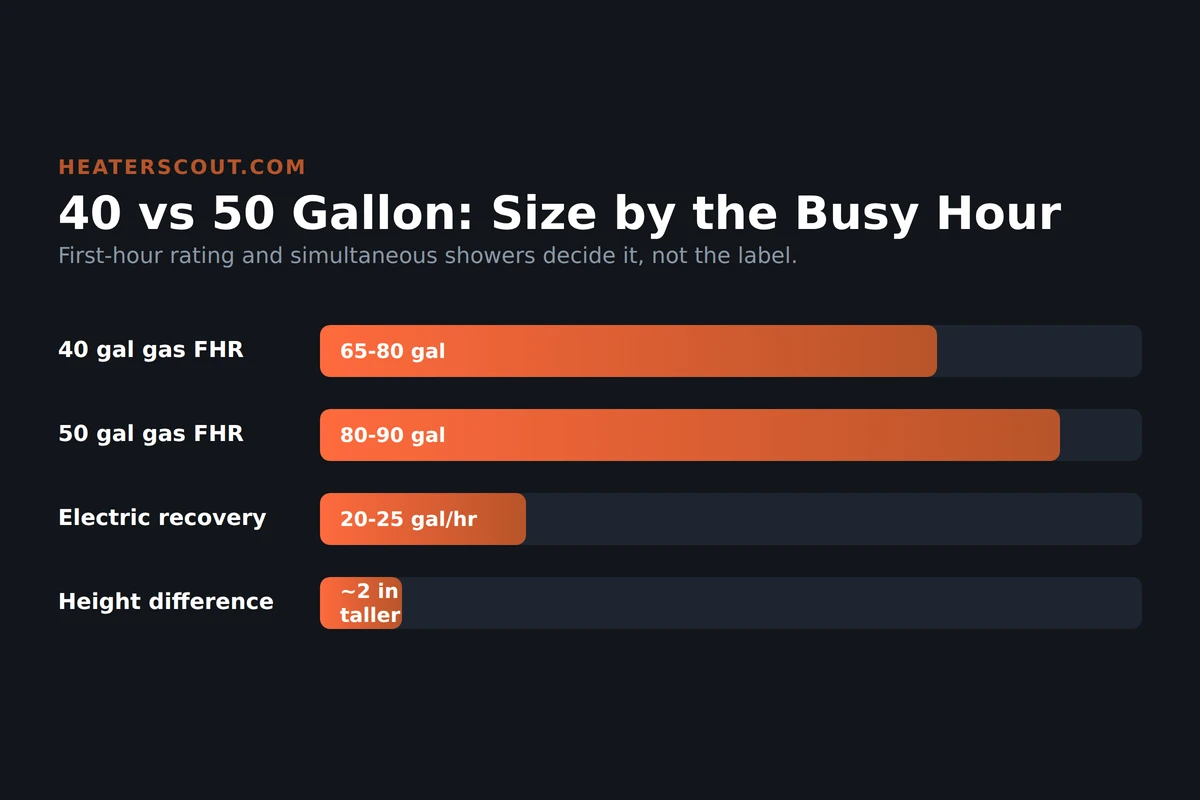
A 50-gallon gas water heater can push out 80 to 90 gallons of hot water in its busiest first hour, while a 40-gallon gas unit tops out closer to 65 to 80. That gap, not the ten extra gallons of storage, is the whole decision. Two homes can each hold 40 gallons and have completely different outcomes at 7 a.m., because what runs a tank dry is not its size on the label but how much hot water leaves the faucets in one concentrated hour and how fast the burner or elements can pour more back in. Get the peak-hour math right and either tank is fine. Get it wrong and no amount of storage saves you.
Does the 50-gallon tank use a lot more energy?
Only a little. The extra water it keeps warm costs a few extra dollars a year in standby heat loss, which is real but small next to the daily cost of running out of hot water. If you genuinely need the capacity, that handful of dollars is not the deciding factor. If you do not need it, the savings from the 40 are equally modest, so let peak demand and closet height decide, not the standby line.
First-hour rating (FHR)
The number that should drive your choice. FHR is how many gallons of hot water a heater can deliver in a single busy hour, starting from a full tank, combining the water already stored with what the burner or elements can reheat during that hour. It is printed on the yellow energy label. A 40-gallon gas unit often rates 65 to 80 gallons FHR because the burner keeps refilling behind you; a 50-gallon gas unit rates 80 to 90. Compare your peak-hour demand to FHR, not to the tank size, and the 40-versus-50 question usually answers itself.
Why first-hour rating beats tank size
Two 40-gallon tanks are not equal. A 40-gallon gas heater and a 40-gallon electric heater hold the same water, but the gas unit reheats roughly twice as fast, so during a run of showers it keeps topping the tank up while the electric one drains toward cold. That reheat speed, folded together with the stored water, is what the first-hour rating captures. A tank is not a bucket you empty once. It is a bucket with a hose refilling it, and FHR measures how much you can pour out of that bucket in the hour it matters, hose and all. This is why a 40-gallon gas unit with a 70-gallon FHR can out-serve a 50-gallon electric with a 60-gallon FHR, even though the electric holds more water on paper.
Electric recovery runs around 20 to 25 gallons an hour, which sounds fine until three people shower in 45 minutes. Once the stored hot water is gone, the elements can only add that 20-odd gallons per hour back, and demand outruns supply. Gas, recovering about twice as fast, keeps pace with a heavier draw. Heat-pump, or hybrid, models are the efficient outlier: a 50-gallon heat-pump tank is common and cheap to run, but it pulls heat from the surrounding air, so it wants a warm, open space with enough air volume and slows down in a cold, cramped closet where it may fall back on slower backup elements.
Which size to buy
Size to your busiest hour, then round up if it is close. One or two people with spaced-out use are well served by a 40, and the 50 is capacity you pay for and never touch. Three or four people with a morning rush want the 50, and if you are on electric, lean harder toward the 50 or a heat-pump because electric recovers slowly. Five or more, or a home that keeps outgrowing tanks, is where you price out 80 gallons or tankless. When two showers plus a dishwasher land in the same hour, that peak is the spec, not the number on the label.
Run the peak-hour math
The sizing calculation is simpler than the marketing makes it look. Figure out the most hot water your household pulls in its single busiest hour, because that hour is the test the heater either passes or fails. A shower runs about two gallons a minute, and a typical shower lasts around ten minutes, so call it twenty gallons of comfortably mixed water at roughly 105 degrees per shower. Now stack what actually happens at peak: a second shower back to back, a dishwasher on the same cycle, a load of warm laundry. Two morning showers plus a dishwasher clears 45 to 50 gallons inside one hour without anyone feeling like they are wasting water.
Take that peak number and compare it to first-hour ratings, not to tank sizes. If your worst hour is around 40 gallons, a 40-gallon gas unit at 65 to 80 FHR clears it with room to spare, and even a 40 electric may cope if the draws are spaced. If your worst hour pushes 50 gallons and lands all at once, you want a 50-gallon unit, and on electric you want to size up or add a thermostatic mixing valve, which blends cold into the stored hot water at the tank so a given number of stored gallons stretches across more minutes of usable shower. The rule of thumb by headcount, one to two people 30 to 40 gallons, three to four people 40 to 50, five or more 50 to 80 or tankless, is really just this peak-hour math rounded off.
Cost, footprint, and the case for rounding up
Reasons to stay at 40
- One or two people whose showers rarely overlap. A 40-gallon gas FHR of 65 to 80 covers this easily.
- A tight closet or short alcove where even two extra inches of height will not clear the flue or the connections up top.
- You want the lowest upfront price and the few-dollars-a-year edge in standby heat loss, and you genuinely do not have a hard morning peak.
Reasons to step up to 50
- Three or four people with a real morning rush: back-to-back showers plus a dishwasher or laundry.
- You are on electric, which recovers only 20 to 25 gallons an hour, so the bigger stored volume is doing the work the slow elements cannot.
- You expect the household to grow, or you already end mornings with someone getting a cold rinse. The 50 costs only about fifty to a hundred fifty dollars more.
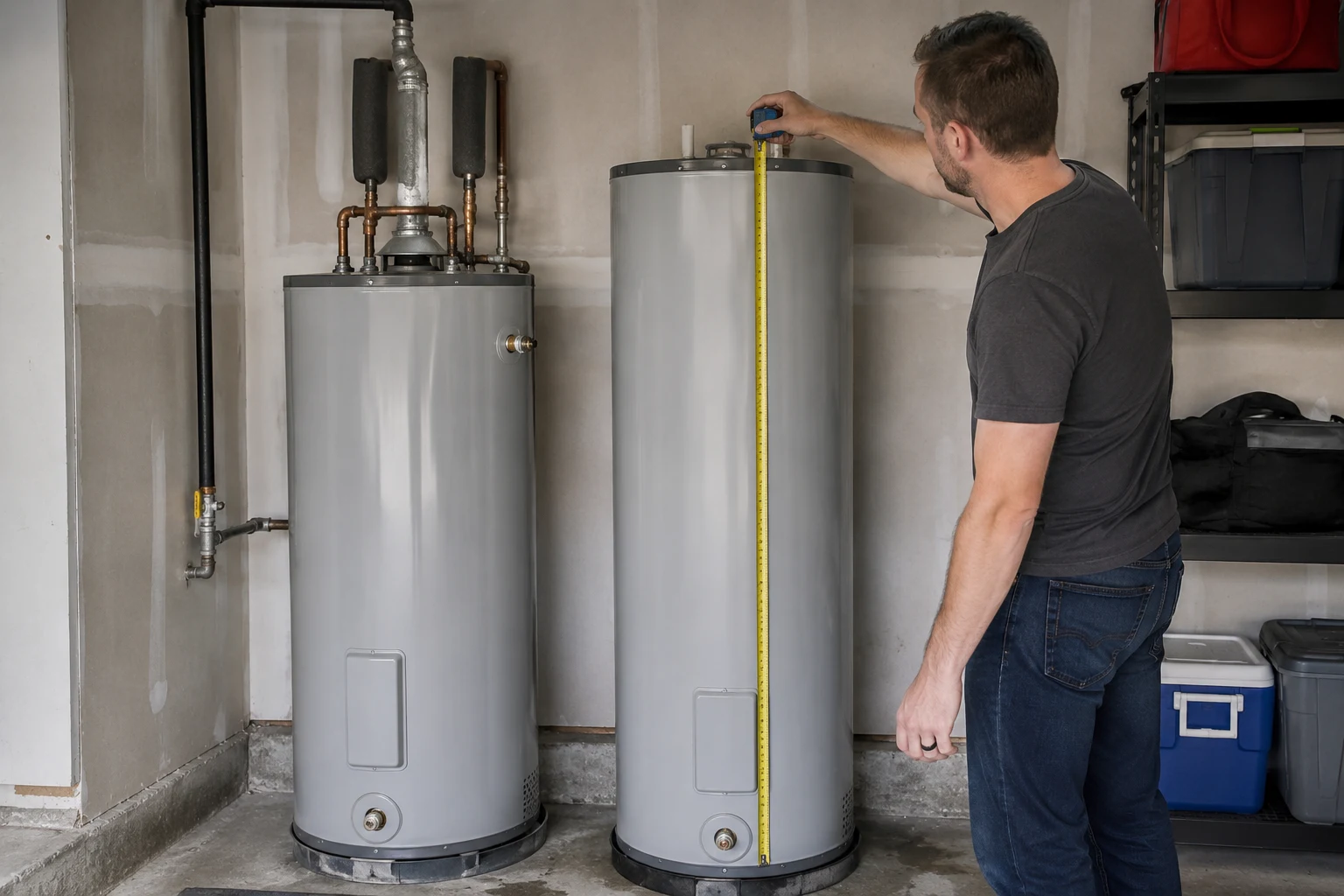
The cost gap is smaller than people fear and the footprint gap smaller still. Fifty to a hundred fifty dollars more up front, a few dollars a year in extra standby loss, and usually only about two inches of added height in the same product class. Because both tanks share the same nominal 18-to-22-inch diameter, the floor space does not change; the ten gallons goes up, not out. So the only physical gotcha is ceiling clearance, which is exactly why you measure the space above the old heater before buying. Given how modest the penalties are, the asymmetry of the mistake settles it: an oversized tank wastes a few dollars a year, while an undersized one fails you every morning and cannot be fixed without buying a second heater. When the peak-hour number lands near the line between 40 and 50, round up.
Frequently asked
Is a 50 gallon water heater worth the extra money over a 40?
It depends on how many people draw hot water at the same time, not on square footage or price alone. A 50-gallon tank costs roughly fifty to a hundred fifty dollars more up front and loses a few extra dollars a year to standby heat, so if you are one or two people who never overlap showers, the 40 is the smarter buy and the 50 is money spent on capacity you never touch. Where the 50 earns its keep is a household of three or four with a morning rush: two back-to-back showers plus a dishwasher or laundry load is the moment a 40 runs lukewarm, and the 50-gallon unit, with its higher first-hour rating, carries that peak without a cold surprise. Size to your worst hour, not your average day.
How many people can a 40 gallon water heater serve?
A 40-gallon tank comfortably covers one or two people, and it stretches to three if their hot-water use does not overlap much. The number that actually matters is the first-hour rating, which is how many gallons of hot water the heater can deliver in a busy first hour starting with a full tank. A 40-gallon gas unit typically rates around 65 to 80 gallons for that first hour, which is enough for a couple of spaced-out showers and normal kitchen use. The trouble shows up when three or four people all shower in the same 45 minutes: that stacks demand faster than the burner can reheat, and a 40 electric, which recovers slower, hits the wall sooner than a 40 gas.
What is the difference in physical size between a 40 and 50 gallon water heater?
Less than people expect. Both sit in the same nominal diameter class, usually somewhere between 18 and 22 inches wide, so the footprint on the floor barely changes. The extra ten gallons almost always goes into height, and within the same product family a 50-gallon unit often stands only about two inches taller than the 40. That two inches is exactly what bites people in a tight closet or a short alcove under a stair, so before you assume the bigger tank drops in, measure your ceiling clearance and the space above the existing heater for the flue or the water and gas connections. A tank that fits the floor but not the ceiling is not an upgrade, it is a return trip.
Does a 50 gallon electric water heater work as well as a 50 gallon gas?
Not for peak demand. The tanks hold the same water, but a gas burner reheats far faster than electric elements. Gas recovers roughly twice as fast as electric of the same size, so while both start with 50 gallons ready, the gas unit refills that tank behind you as you use it, and the electric one drains toward cold if the draws keep coming. Electric recovery runs around 20 to 25 gallons an hour, which means a 50-gallon electric can behave like a smaller gas tank once you push past the stored water. If your household has a hard morning peak and you are on electric, either size up, add a mixing valve to stretch the stored hot water, or look at a heat-pump model, which is efficient but needs a warm, open space with enough air volume around it.
What happens if I buy a water heater that is too small?
You run out of hot water mid-task, usually mid-shower, and usually at the worst moment. An undersized tank empties its stored hot water faster than the burner or elements can reheat, so the last person in the morning gets a cold rinse and the dishwasher that runs during shower time steals capacity from everyone. It is not a safety problem, it is a daily annoyance that never goes away, and the fix after the fact is buying another heater. That asymmetry is why sizing errs slightly large: an oversized tank costs a bit more up front and wastes a few dollars a year in standby heat, but an undersized one fails you every single morning and cannot be fixed without replacement.
Should I just get a tankless water heater instead?
For a household of five or more, or one that keeps outgrowing tanks, a tankless unit is worth pricing out because it makes hot water on demand and never runs dry the way a tank does. But it is not a free upgrade. A gas tankless needs a larger gas line and different venting, an electric tankless needs serious electrical capacity, and the install cost can be double a straight tank swap. For most one-to-four-person homes deciding between a 40 and a 50, the tank is the simpler, cheaper answer, and the real question is just which tank matches your peak. Reach for tankless when the peak demand outgrows what a single 50 or even an 80-gallon tank can hold, or when you genuinely have no floor space for a tank at all.
How do I figure out my peak hot water demand?
Add up the hot water your household pulls in its single busiest hour, because that hour is what the heater has to survive. Count a shower at roughly two gallons a minute for about ten minutes, which is close to twenty gallons of mixed water at a comfortable 105 degrees. Then add the fixtures that run at the same time: a second shower back to back, a dishwasher, a washing machine on warm. Two morning showers plus a dishwasher can easily clear 45 to 50 gallons inside an hour. Compare that number to a unit's first-hour rating rather than its tank size, pick a heater whose FHR meets or beats your peak, and you have sized it correctly regardless of whether the label says 40 or 50.